

FLUFLL
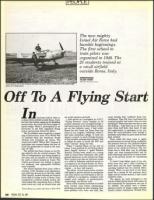
The now mighty
Israel Air Force had
humble beginnings.
The first school to
train pilots was
organized in 1948. The
25 students trained at
a small airfield
outside Rome, Italy.
VICTOR PERRY
Special to The Jewish News
Chuck Gordon, one of the American volunteer instructors, about to enter one o t e schoo s ig t
planes for a flying lesson.
,
Off To A Flying Start
the latter half of 1948, in
a sleepy little airfield outside Rome, Italy,
far from the battles raging in the fledgling
Jewish state, the Israel Air Force began to
sprout wings. There, I participated as an
instructor in the first organized flying
course and ground school for pilots.
The 25 students were taught by a mixed
bag of instructors, most of us World War
II veterans from the American, South
African and Canadian air forces. The
course was called "Minus Two" because it
took place two courses before the first of-
ficial one graduated in Israel in the sum-
mer of 1950.
The airfield had been chosen as the fly-
ing school's site for several reasons. The
War of Independence was being fought at
the time, and no suitable or safe location
for such a school existed in Israel. The
Italian government was willing to ignore
our presence, and appropriate facilities
were available.
The school operated from June 1948 to
January 1949. Students and administra-
tive staff were housed in an old villa, called
Villa Lauchli, located beyond the historic
Ponte Milvio bridge north of Rome. Once
occupied by a famous Italian author, the
villa looked like something from a Holly-
wood movie set, with an ornate front and
Victor Perry is a writer who lives in New York.
60
FRIDAY, OCT. 30, 1987
set amid spacious grounds.
I had served as a navigator in a B-17,
"Flying Fortress," heavy bomber on 50
combat missions over occupied Europe. I
had been based not far from Rome at Fog-
gia on the Adriatic coast. I had volun-
teered for the Israel Air Force from my
home in Los Angeles, California, where I
had been attending college. It took me
almost a month to reach Europe because
of the complex underground system I had
to follow in order to avoid the FBI and
other "snoops" along the way.
When I reached Rome on my way to
Israel, I was grabbed for the flying school
there, largely because I spoke Hebrew
fluently, having been raised as a young
child in Israel (then Palestine). The chief
ground instructor at the school was Noga
Beth Lachmi who, like me, had been raised
as a child in Palestine and had served as
a navigator in the United States Air Force.
But not all the volunteer instructors were
Jewish — in fact, half weren't.
The pilots' course lasted seven months,
half spent in ground school on navigation
and other lessons and half spent in the air.
In addition to navigation, students were
taught such subjects as aerodynamics,
meteorology and Morse code.
Most of the students had been in Israeli
army combat units before volunteering
and being accepted for pilot training. Our
main problem with them was that, like
many Israelis, they "suffered" from over-
confidence. They felt they could learn the
material quicker and easier than we were
teaching it. There was only one way to cure
this feeling — take them up in the air and
show them hol,(7 little they knew. (I take
this opportunity to apologize to my stu-
dents for such pettiness, even though it
probably stood them in good stead in their
pilot careers).
Thus, when the time came to apply
ground lessons to actual flying conditions,
the pressure was on. Our practice flights
covered a radius of some 300 kilometers,
about as far north as Florence. The stu-
dents had to find their way by pilotage
(sight and map interpretations) and by
dead reckoning calculations without look-
ing at the ground except for calculating
drift.
It wasn't long before most of my stu-
dents were lost, and I didn't hesitate to
bawl them out for their mistakes. This
teaching method had the desired effect,
though. When we got back to the class-
room for a review of the previous day's
flight and for further lessons, I had a most
attentive class.
The planes we used belonged to the
private Italian flying school with whom we
had contracted for equipment and use of
its airfield. The planes were a hetero-
geneous bunch of single engine aircraft,
mostly Italian Ambrosinis, British Proc-