

of these is in Jerusalem where the squad
has become one of the few in the world that
not only responds to threats, but patrols
around the clock, searching the possible
bombs in garbage cans, empty buses, and
suspiciously parked cars.
Every day begins in the Old City. An old
Ottoman era police station known as
Kishle serves as the Squad's headquarters.
In their regular uniforms, form-fitting dark
blue T-shirts, grey-green army pants and
rubber-soled boots, the men look like phys
ed teachers — except for the tell-tale baret-
tas or .45 automatics stuffed into holsters
at the small of their backs.
In the squadroom, floor-to-ceiling shelves
are stocked with the artifacts of terror: cof-
fee containers, egg crates, clog shoes, cola
cans, tubes of toothpaste — all of them hol-
lowed out and rigged with explosives,
timers and fuses. Enough plastique can be
crammed into a tube of toothpaste to
destroy the man who steps on it. Enough
TNT can be loaded into a rigged flower pot
or a fire extinguisher to devastate
everything within 100 yards.
A bottom shelf is devoted to booby
traps. One of the more sinister is a tiny
PLO flag atop a small wooden box filled
with explosives. The box is planted in the
ground with the flag protuding. When the
flag is picked up by an outraged Israeli, the
box explodes, generally blowing off the
Israeli's hand.
The sappers are essentially a bunch of
boys. Nearly all are under 24, some are as
young as 21. When they get together, they
joke and laugh and try not to let life or
their jobs become oppressive. When chang-
ing shifts, or while waiting for new orders,
they read magazines, snooze in their bunks
or drink instant coffee. But relaxing in-
terludes between assignments and shift
changes are deceiving. Just when the day
looks dull, the radio announces the report
of a suspicious object. The men rise from
their bunks, drop their magazines, leave
coffee cups half empty and bounce into the
white vans. Out they go.
This time it is an old Subaru parked
obstructively across from the American
Consulate. Sappers Pyoter and Itzhk ap-
proach the beat-up wreck, not a good sign.
Jalopies are frequently sacrificed for car
bombs. Pyoter declares, "I can tell if it's
a bomb when I first see it, even before I
come close. This one is not."
Both agree. But they never second guess
"the book," the manual on proper bomb
disposal. They call in the license plate. A
computer at police headquarters checks
the number. Within 28 seconds, the answer
squawks back on Pyoter's radio —!'Not
stolen?' Most car bombs are in stolen
vehicles, so this car might be innocent —
unless the owner hasn't reported it yet.
Fifteen seconds later, they enter the
locked vehicle. The glove compartment and
back seat are examined. There are no signs
of tampering with the interior. Pyoter and
Itzhak run their hands over the trunk lid,
sizing it up from different angles. Itzhak
"attacks" and safely enters the trunk. The
contents are harmless.
Walking to the front of the car, Itzhak -
begins on the hood. Just as he is about to
pop it, he hesitates. His eyes squint. Pyoter
looks at Itzhak. Is it boobytrapped?
Itzhak attacks. First, the hood is careful-
ly "prepped" in a procedure unique to the
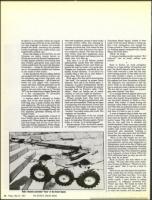
Hobo: Remote-controlled "hero" of the Bomb Squad.
48
Friday, May 22, 1987
THE DETROIT JEWISH NEWS
Jerusalem Bomb Squad. Itzhak is then
ready to lift the hood. Slowly, it comes up,
first- a few centimeters, just enough for
Pyoter to look in. Then it comes all the way
up. Nothing appears tampered with. Itzhak
slams the hood down.
"Zilch," he barks.
A woman standing nearby mutters "Kol
hakovod," but as usual, neither man
notices.
•
Back at Kishle, an Arab youngster
brings in a large platter of hummus and
pita, the Bomb Squad's daily lunch fare.
Chico tells everyone a joke and the men
start horsing around. In the midst of it all,
the radio crackles a report. A bomb has
just exploded beneath the driver's seat on
the express bus from Jerusalem to Haifa.
The explosion was calculated to kill the
driver while on the highway, causing the
bus to crash into other vehicles on the road.
The bus did not crash, but seven passen-
gers were injured. One died.
It's a strange breed of anguish these men
feel when they hear such news. For a mo-
ment, they ponder the possibilities: Where
was the bomb planted, in Haifa or Jeru-
salem? Why wasn't it found during the
searches made before and after each bus
run? Was this an isolated incident, or part
of a new campaign? All this in an instant,
and then it's time to get to work.
A crew of sappers hops in their van and
drives to the bus barn. Lined up in several
neat rows are dozens of red-and-white in-
tercity buses. This will be a tedious job.
One by one, each bus is checked and
double-checked: Under every seat, through
every engine, in every cargo hold. Electrical
outlets and service ports on board are
unscrewed and examined. Nothing is
found, but the men sense that the Haifa-
Jerusalem bus explosion is a message.
"Most of the real bombs are not ran-
dom," explains Pyoter. "They are timed to
commemorate various days important to
Palestinians, such as the day of Sabra and
Shatilla [two Beirut camps where Christian
militiamen launched a massacre], on Israeli
Independence Day. Plus, whatever is going
on in Lebanon, we hear it here. When the
PLO infiltrates back, as they are now do-
ing, they let us know."
Back at Kishle, the men refuse to be
somber. "We hear this news every week,"
says 28-year-old Shimon. "There's no time
to get upset." But it can be a time to
reflect.
How do the men feel about the bombers,
what would they do if they acutally met
one? Each had their own idea. "In a dark
alley?" half-jokes one of the men. "He
would vanish. I don't believe in taking
prisoners." A colleague corrected him,
"Don't say that. We would do what we
must, we would arrest him." A third
dismisses the whole subject, "Our job is
to catch the bombs, not the people who