

authors of the text explain,
"Conservatism and innova-
tion are counterbalanced to
present perennial Passover
themes relevant for the
1980s."
In 1983, an influential
modern Orthodox theologian,
Rabbi Shlomo Riskin, pub-
lished his "Passover Hag-
gadah: With Traditional and
Contemporary Commentary"
It is based on lectures Rabbi
Riskin delivered at the Lin-
coln Square Synagogue in
Manhattan, which he found-
ed. The text represents an
oral tradition of teaching, and
does not include secular
sources or artwork, though
the Orthodox tradition per-
mits decorating and beautify-
Reconstructionist movement.
Dr. Kaplan's haggadah, which
is still in use, relates the
Reconstructionist philosophy
of universality and social/
cultural "peoplehood" to the
celebration of Passover.
For three recent genera-
tions of Passover celebrants
in the United States, one of
the most familiar — and still
widely used — editions of the
haggadah has been a booklet
distributed free by the
makers of Maxwell House
Coffee.
Since the first edition, in
1936, more than 20 million of
these paperback haggadahs
have been given out in
grocery stores and super-
markets across America. Ear-
An illustration within a decorated frame depicts a well-to-do figure holding round
matzah.
ing the Haggadah.
Many rabbis note that a
haggadah need not use non-
Jewish sources and readings
to promote an authentic ap-
preciation of the holiday.
Memorials for Holocaust vic-
tims, prayers for Soviet Jews
and the State of Israel should
be included in a new tradi-
tional haggadah to increase
Jewish identification and
brotherhood they suggest.
The Reconstructionist
movement, which lies be-
tween the Conservative and
Reform branches of Judaism,
has not produced a new hag-
gadah recently. In 1941, it
published "The New Hag-
gadah" by Dr. Mordecai
Kaplan, a leader of the
ly editions have become
nostalgic family possessions.
The old pages, often stained
with wine and sprinkled with
stale matzo crumbs trapped
around the booklet's staples,
recall the seders of long ago,
and of a less affluent era.
Currently, a wide range of
haggadahs is sold in book-
stores specializing in Judaica.
These include the popular,
traditional "Haggadah" by
Rabbi Nathan Goldberg;
"The gelling: A Loving Hag-
gadah for Passover," Dov ben
Khayyim, editor, published in
1983, which advertises itself
as "non-sexist"; and "The
Shalom Seder: Three Hag-
gadahs," compiled by . New
Continued on next page
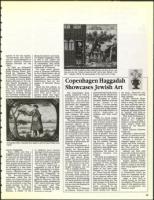
Illustration of "And he stood by them under the tree, and they did eat. And
they said unto him: 'Where is Sarah thy wife?' And he said. 'Behold, in the
tent.' " (Genesis 18:8-9), the announcement of the future birth of Isaac.
Copenhagen Haggadah
Showcases Jewish Art
The Copenhagen Hag-
gadah, created in 1739, is
considered an outstanding
example of the art of il-
lustrated manuscripts.
Philip Isac Levy wrote and
illustrated the Haggadah.
He was originally from
Hamburg-Altona, in north-
west Germany, one of the
centers of Jewish life in the
18th century. He immi-
grated to Copenhagen and
created the Haggadah there.
This year, Rizzoli Interna-
tional Publications issued a
facsimile edition of the
Copenhagen Haggadah. An
explanation accompanying
the Haggadah notes that
the Hamburg-Altona school
of art evolved in the context
of a region known for social
interaction among Jews of
different origins and the
assembly of artists from dif-
ferent backgrounds.
The art of manuscript il-
lustration reached its peak
during the Renaissance.
Aftei the invention of print-
ing in the latter half of the
15th century, this special-
ized craft almost disap-
peared. The revival of hand-
written, illustrated works in
the 18th century is an artis-
tic phenomenon that is
largely liturgical, and one
that is notably Jewish.
Levy's illustrations of the
Passover story reveal an
unusually exotic treatment,
the result, according to the
explanation, of the meeting
of Jewish tradition and folk
art with European art and
culture that was fostered in
Hamburg-Altona.
The festival of Passover
(in Hebrew, "Pesach") corn-
memorates the Exodus from
Egypt and the release from
bondage of the Jewish peo-
ple. According to Jewish
tradition, Passover is known
as the "season of our
freedom." It is this concept
of freedom, along with the
customs and rituals express-
ing it, that make Passover of
central importance to
Judaism and Jews every-
where.
While its actual origins
can be derived from ancient
Near Eastern pastoral and
agricultural customs, Pass-
over as it is celebrated today
is traditionally understood
as having its roots in the
first twelve chapters of the
book of Exodus. This dra-
matic biblical account of op-
pression and liberation,
which is actually retold dur-
ing the modern Passover
celebration, gives the
festival its remarkable
popularity and significance.
Passover ultimately com-
memorates the victory of
religious freedom over
tyranny.
The story as it appears in
the book of Exodus begins
with the plight of the Jews
in Egypt. In what scholars
approximate as the 13th
century B.C.E., Moses, the
leader of the Jews, asks
Pharaoh to "let my people
go." When Pharoah refuses,
God is said to bring a series
of ten plagues against the
Egyptians, each one worse
than the preceding one. The
tenth plaque is the death of
all first-born Egyptian
males. According to the
Passover legend, an angel of
death "passes over" (hence
the name, "Passover") the
homes of the Jews, sparing
their children.
Finally, Pharaoh" allows
the Jews to depart. In their
haste to leave, the Jews do
not have sufficient time to
let their bread dough rise
before baking it, taking the
resultant unleavened bread
or "matzah" with them as
they flee Egypt to freedom.
This story of Passover is
retold in the haggadah
(Hebrew for "telling"),
which is a combined history
book, prayer book and
manual for the Passover
celebration.
Some common Passover
words are:
afikomen, a piece of mat-
zah that is reserved for the
dessert of the seder meal;
haroset, a mixture of
chopped apples, nuts, cin-
namon and wine commem-
orating the mortar which
the Jews used for brick-
laying construction;
hametz, any food with
leaven (the word may also be
used to signify any food
traditionally not allowed to
be eaten during Passover);
karpas, (greens, usually
parsley) a symbol of spring
which is eaten at the sedar
after being dipped into salt
water;
maror, bitter herbs (usual-
ly horseradish) which are
eaten as a reminder of the
bitterness of slavery; and
seder, a feast held in
Jewish homes on the first
two nights of Passover (also
refers to the special service
which accompanies the
Passover meal).
47