

Sunday's
Chocolate
Jubilee
will fund
respite care
for victims of
Alzheimer's
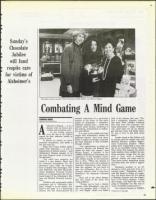
Chocolate Jubilee samplers Pola Friedman, Rikki Shafer, and Bluma Siegal.
Combating A Mind Game
A
RAMONA GRIGG
Special to The Jewish News
lzheimer's Disease — it is a
disease with no known pre-
vention and no known cure.
It can strike anyone
over the age of 40 without
regard for diet, exercise, health or
state of mind.
It knows no ethnic or socio-
economic boundaries, and death is
the only way out.
Some two to four million adults
suffer from dementia — a loss or
impairment of mental powers — and
Alzheimer's Disease appears to be
the most frequent cause of irreversi-
ble dementia.
Yet, until very recently, we
called it a rare disease. There was
no national foundation for Al-
zheimer's until 1980. Its victims
have included Otto Preminger, Nor-
man Rockwell, and Rita Hayworth,
whose daughter, Princess Yasmin
Kahn, is a representative for the na-
tional board of the Alzheimer's Dis-
ease and Related Disorders Associa-
tion.
Children and uninformed adults
sometimes call it "Oldtimer's Dis-
ease," though it is not strictly con-
fined to the aged. It is a dementing
illness, but one characterized by
marked reductions of a particular
enzyme in the brain. In the early
stages its symptoms — confusion,
dizziness, memory loss — could also
indicate small strokes, hardening of
the arteries, malnutrition or medica-
tion side effects.
It is only in the middle and later
stages that Alzheimer's makes its
presence known. And even then,
while it might be strongly suspected,
the final diagnosis is only available
through autopsy.
Our organization is called Al-
zheimer's Disease and Related Dis-
orders for that very reason," said
Bluma Siegal, a member of the
ADRDA Endowment Committee, key
organizers of this Sunday's Choco-
late Jubilee benefit at the Somerset
Inn in Troy. "When the patient is
over 65, doctors won't call a patient's
dementia Alzheimer's until they've
seen the autopsy. It's too hard to
spot the difference. But if it's a
younger patient with a long-term
dementia, the diagnosis becomes
easier."
They call it the silent disease.
The slow death of the mind. The
"long goodbye."
"Unless you've had a family
member with Alzheimer's, you can-
not even imagine what a horror it
is," said Siegal, whose own father
died of the disease last year. "Pic-
ture a handsome, dynamic, articu-
late man. Then consider watching
this man turn into someone con-
fused, disoriented — angry. Someone
who could start out on an errand,
get half-way there and forget where
he was or how to get back home
again."
Funds raised at the Jubilee will
be mainly spent for respite care, said
Marlene Borman, another Endow-
ment Committee member. "What
people don't understand is that this
can be an incredibly violent illness.
They think that because the person
looks healthy, there couldn't be any-
thing seriously wrong. But the sad
part is that, with a dementia
patient, reality can come and go.
They know there's something wrong
and often their fear turns to aggres-
sion."
Borman's mother is an Al-
zheimer's victim and now lives in a
nursing home. "Sometimes when I
visit her there's a flicker of recogni-
tion, but that's about all. It's almost
a blessing, because now she doesn't
have to be afraid anymore. I think
she's happy, and that's the way I'm
going to remember her. She was al-
ways a beautiful, happy person."
The Detroit Chapter of ADRDA,
Continued on next page
81