
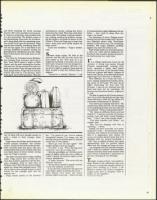

and forth chanting the ritual morning
prayers. His voice mumbles monotonous-
ly, rises to a crescendo, then recedes back
to a low muttering. The leather straps of
his phylacteries criss-cross his forearms,
and a strap binds the box containing a por-
tion of the Torah upon his forehead. Feige
watches him intently, wondering when she
will see him again. He is absorbed in his
praying. Suddenly he pauses, strokes his
greying beard, and glances up at her; Feige
feels embarrassed and looks down at her
packing.
The train for Antwerp leaves Kishinev
this evening; from Antwerp, she'll sail to
New York. She'll spend a night on Ellis
Island, and the next morning her brother
will meet her. He has written that there are
black men in New York; she has never seen
black people before. Feige will live with her
brother and work in. a hat factory; she'll
make good, her brother promises. Then the
/
3
two of them will save enough money to
send a ticket to their younger sister
Rachel.
Feige enters the kitchen and watches her
mother prepare breakfast. Her mother
tucks a strand of hair back under her ker-
chief, smooths down her apron. She lays
smoked white fish on the wooden table and
cuts thick slices of brown bread, saving
some for Feige's journey.
The older woman looks at Feige, smiling
sadly. Feige knows how worried she is
since last month's pogroms; will the Rus-
sians slaughter Jews in their part of
Kishinev next? She will not see her mother
again for a long time, perhaps never. Will
> she be able to save enough money to send
tickets for the younger girls and her
parents too?
Feige stands quietly in the doorway
watching her mother, etching her move-
ments into her mind. There has rarely been
time to talk. Her mother is always market-
ing, cooking, tending the children, manag-
ing her father's inn while he learns at the
Yeshiva. What can Feige say in these last
hours, when they have hardly spoken all
these years?
"Come eat breakfast," Feige's mother
calls.
heron stops crying. We look at the
pictures and she tells me how much this
man meant to her. Now that he is no
longer her boyfriend, I can listen, try to see
their lusty romance from her perspective.
Now that she is no longer with him, I do
not have to fight to separate them and can
allow myself to hear her without fear or
defense.
"Tomorrow is special, Sharon," I tell
her. "I'm proud of you. You're making
thoughtful choices.. I'm happy you are
leaving with good will between us, instead
of the way it was before."
"Don't go over all that again!" Her
cheeks dimple when she laughs.
"It's late," I say. "We're leaving early
tomorrow. Let's go to sleep now."
I kiss'her goodnight, as I did the twelve
years of nights when she was a child; as
I didn't during the anxious nights of her
stormy adolescence.
"G'night, Mommy." She never calls me
Mommy anymore.
I do not trust myself to speak; instead,
I tuck the blankets around her.
In my own bed, scenes from the past two
years flash: nights watching the clock —
when Sharon isn't home and hasn't
phoned; nights worrying — about our lack
of communication; nights fighting with her
father — how could he sleep when she
wasn't yet home?
The slamming of doors. Reggae music
blaring from her barricaded room. Myster-
ious midnight phone calls. Boyfriends
alluded to and never met. The screaming
sessions. Her angry defiance, pushing
against any limit we tried to set.
Wide awake beside my snoring husband,
I relive my white gloved departure for
Stanford; then memory pushes beyond to
the real leaving two years later.
▪ 9
• m a college sophomore, home for the
summer. A young man passes through
Phoenix unexpectedly, wearing dirty
Levis, sporting a bushy dark beard.
Strewn on the seat of his battered black
Ford are a guitar and banjo, volumes of
Sartre and Camus: an on-the-road Kerouac
pilgrimage from Harvard to Berkeley.
How different he is from the boys I
know, singing Appalachian ballads, pluck-
ing tunes on his banjo. We stay up all
night, discussing No Exit and The
Stranger, I open up my nineteen-year-old
heart and pour out my yearnings. He
becomes my adventure-mentor, urging me
to risk.
We plan to camp on the Navajo reserva-
tion, but in 1958 nice girls do not take trips
alone with boys. After all, my father is a
prominent businessman in Phoenik.
You cannot go camping with him!" My
mother lays down the law. We are sitting
in the sparkling kitchen that the maid has
just cleaned. What would people think?"
"My values are different from yours and
Daddy's!" I gesture towards the formica
counter tops and shiny waxed linoleum
floor. "I don't care what people think!"
"You must consider your father," my
mother cries.
"But I'm not sleeping with him or
anything," I shout.
Indeed, we don't even kiss. It is some-
thing else I want — the adventure, the ex-
citement, the wildness of traveling; ironic
that it is appearance that counts. Of
course, my mother doesn't know that I am
sleeping with my current boyfriend, a
"nice" boy, a medical student, who chats
appropriately with my parents before
dates and who brings me home on time.
I go camping with this bearded stranger.
And I suffer my parents' recriminations,
silences and dirty looks until summer ends
and I return to Stanford, a small price to
pay for a leaving of my choosing.
9
T
onight, tossing in bed, I am unable to
sleep. Scenes of my adolescent days and
of Sharon's tumble like tangled clothes of
many lives swirling in a dryer. I am
Sharon's mother and Claire's daughter;
images come, first as daughter, then as
mother to my daughter.
Continued on Page 53
45