

Will Argentina's Jews
Recover From
The Junta?
The reign of terror for Argentinian
Jews ended in 1983 with the over-
throw of the military regime. But
the threat of assimilation is now
greater than ever. And debate still
rages whether Jews did everything
possible to resist the horrors.
The Nightmare Continues
AVIVA CANTOR
Special to The Jewish News
rgentina's night of ter-
ror and carnage is over
at last — but the night-
mare goes on. The dawn of
democracy has brought no
end to the agony of the rela-
tives of the "desaparecidos,"
the 9,300 (documented) to
30,000 (estimated) individ-
uals, mainly youths, devoured
by the junta during its 1976-
83 reign of terror.
These "disappeared per-
sons" were pulled from their
beds at gunpoint in the dead
of night, snatched off the
streets into unmarked cars,
hauled off from their offices.
Never heard from again, they
have no graves, not even un-
marked ones..
The Jewish community,
traumatized by this reign of
terror, now seeks, like the ma-
jority of Argentinians, to put
the past behind it, fearing
that disinterring the human
rights atrocities might endan-
ger the fragile democratic re-
48
Friday, August 22, 1986
gime of Ffresident Raul Alfon-
sin. The community, however,
is still rent by bitter conflict
over what it did and did not
do for the victims of the ter-
ror, in particular, the Jewish
desaparecidos.
While these charges and
counter-charges have come in-
to the open in Argentina since
the reinstitution of democ-
racy in that country, informa-
tion regarding the heroic res-
cue of Jews during the reign
of terror via an "underground
railroad" organized by Israe-
lis stationed in Argentina has
not been made public.
An estimated 10 percent of
the desaparacidos were Jews
— a proportion higher than
the Jews' one-and-a-quarter
percent in the population.
They included what the jun-
ta called "ideological crimi-
nals," people in - psychology,
the social sciences, journal-
ism, teaching — and over 100
children of desaparecidos. En-
tire chapters and all the local
emissaries of Hashomer Hat-
zair, the Socialist Zionist
youth movement, disap-
THE DETROIT JEWISH NEWS
peared. Most of the counsel-
ors and almost the entire
youth movement in Cordoba
disappeared.
Since the reign of terror
began in 1976, a group of
women has been marching
every Thursday in front of the
Presidential Palace in Buenos
Aires to demand an account-
ing on the fate of their disap-
peared children. They are
known as the "Madres," the
Mothers of the Plaza de Maya
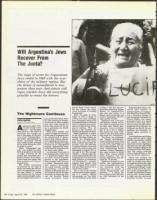
Renee Epelbaum, a widow
in her 60's, is one of their
leaders. Her three children are
among the desaparecidos;
none have ever been heard
from or about since their ab-
duction. Luis, who had been
a medical student concerned
about his country's poor, was
kidnapped in August 1977 at
the age of 25. The younger
children — Claudio (then 23),
a poet and musician who was
studying law to be able to de-
fend prisoners of conscience,
and Lila (then 25) — were kid-
napped three months later
from Uruguay. Their mother
had sent them there to try to
ensure their .safety.
She is one of six mothers
and one grandmother appear-
ing in a recently released
documentary on "Las Mad-
res: the Mothers of the Plaza
de Mayo." The film was pro-
duced and directed by Susana
Munoz, an Argentine-born
Jew who was active in a
Zionist youth movement, and
lived in Israel from 1972-79,
and Lourdes Portillo.
Epelbaum said, in an inter-
view during a recent visit to
New York in connection with
the film, that Jewish desa-
parecidos "were not kidnap-
ped as Jews, but it helped.
The police were more suspi-
cious of Jews. For them, every
Jew must be a Communist."
The junta, she continued,
was "deeply anti-Semitic."
Jews in prison received three
or four times the measure of
torture as non-Jews. This has
been substantiated by Am-
nesty International, former
prisoner Jacobo Timerman,
and, most recently, by Nobel
Peace Prize winner Adolfo
Perez Esquivel, who was
himself imprisoned and tor-
tured for 14 months.
Epelbaum charged that the
DAIA, the representative
body of Argentine Jewry, did
not intervene with the
authorities on behalf of
Jewish desaparecidos and
prisoners — a charge the
DAIA emphatically denied in
its 1984 document on the
subject.
Rabbi Marshall Meyer, who
served until recently as
spiritual leader of Congrega-
tion Beth-El of Buenos Aires,
was a founding member of
the Permanent Assembly for
Human Rights, and visited
prisoners in jail. In a recent
interview in New York, where
he now serves as rabbi of Con-
gregation B'nai Jeshuran, he
criticized the DAIA for not
speaking out forcefully on
human rights atrocities in
general.
Both Epelbaum and Meyer
charge that the DAIA urged
Jewish communities outside
the country to keep silent
about the horrors. Epelbaum
said she was told that World
Jewish Congress affiliates did
so because. of the WJC policy
that they cannot intervene
when a local affiliate, in this
case the DAIA, opposes it.
Meyer also revealed the
scope of the unofficial rescue
work the Israelis were doing
in Argentina during the reign
of terror: running a latter-day
"underground railroad" to get
Jews at risk out of the coun-
try. Israel's Ambassador un-
til 1980, the late Ram Nirgad,
and his staff "worked tireless-
ly night and day, and saved
hundreds of Jews," he said.