

PURELY COMMENTARY
Pioneers of Federation
Continued from Page 2
A3235 and A3235 of the Congressional
Record of April 27, 1950 contained the
traced history, as follows:
From the traditional minyan
in 1850, Detroit Jewry has grown
to a community of nearly 100,000
people. It now rates a place
among the seven largest Jewish
centers on this continent, to-
gether with New York, Chicago,
Philadelphia, Boston, Los
Angeles, and Cleveland.
Although there is a record of .
Jews who had lived in Detroit as
early as the year 1763, the history
of Jewry as an organized com-
munity in Detroit did not begin
until 1850.
Since Jewish tradition desig-
nates that a "minyan" — a group
of 10 men who are at least 13
years of age — is required for the
holding of congregational serv-
ices, the "minyan" has became
the symbol of community organ-
ization.
It was not until the beginning
of 1850 that the number of Jews
in Detroit grew to the traditional
"minyan." Their predecessors,
included Jewish traders who
probably were among the first
arrivals at the trading posts
along the Great Lakes. At the
time of Chief Pontiac's conspi-
racy in 1763, two Jews, Levy and
Chapman were captured by the
Indians. Old records show that
Chapman settled in Detroit and
lived here until 1796.
Another Jewish pioneer, Sol-
omon Ben Isaac Halevi, who
lived in Detroit in 1783, is men-
tioned as a witness in a matrimo-
nial case before the Beth Din —
the Jewish Court — of London.
Names of other Jews in the early
Detroit records, prior to the for-
mation of the Detroit Jewish
community, include: Isaac Moses,
whose name appears in the 1796
and subsequent records of the
first Masonic Detroit lodge: A. J.
Solomon, who was en route to
Mackinac, among the 10
passengers whose names were
listed in the Gazette of June 17,
1820, as satisfied with the "ar-
rangements and accommodation"
of the steamer Walk on the Water;
Louis Benjamin, a merchant who
may have been Jewish, who was,
according to Michigan Territory
records awarded a lot in Detroit
to indemnify him for losses in the
fire of 1805; and, according to the
records of the common council,
an Alex Cohen was on the
payroll for grading a street in
1835.
In the first directory to be
published in Detroit, in 1837,
there was not the name among
the 1,100 that was certainly
Jewish. In the second directory,
published in 1845, there were
only two Jewish names — Sol-
omon Bendid and Moses
Rindskoff. In the directory of
1850, in spite of the marked in-
crease in Detroit's population
which then numbered 21,000,
there were only three Jewish
firms and five individuals listed:
S. and H. Bendid & Co., dry
goods; Silverman & Hersch, cigar
manufacturers; S. Freedman &
Brothers, dry goods; Alex Grun-
wald, Leopold Rappenkeimer or
Rappenheimer, fancy goods; F. E.
Cohen, portrait painter; Solomon
Cohen, pedlar.
Detroit Jewry's history began
in 1850 with the coming to De-
troit of Isaac and Sophie Cozens
who were followed by other
Jews, mostly from Bavaria.
Available documents show that
among these first settlers were
the following pioneers who as-
sisted in the establishment of the
Detroit Jewish community: Am-
berg, Bresler, Franke, Friedlan-
der, Heineman, Hirschman,
Kanter, Lang, Newman, Proll,
Schloss, Sloman, and Springer.
Eager for religious services,
Mr. and Mrs. Cozens converted
their home on Congress Street
into a synagogue and Sabbath
services were held there reg-
ularly:until September 22, 1850,
when the founding group or-
ganized itself into the Beth El
Society which served as the be-
ginning for Michigan's first
Jewish congregation — the 100-
year-old Temple Beth El of De-
troit.
Joseph Newman was tem-
porary chairman of the newly-
formed Beth El Society. Later,
Jacob Silberman — to whom
•
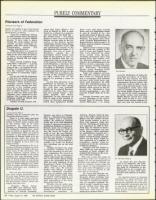
Fred Butzel
went the distinction of being the
founding president of Temple
Beth El, was chosen the first
head of Detroit's first community
organization. Marcus Cohen, who
came here early in 1850, was the
first acting spiritual leader of the
congregation until, later that
year, he brought from New York
his friend Rabbi Samuel Marcus
who served the small synagogue
as rabbi, cantor, and schochet.
Rabbi Marcus served here until
1854 when he fell as one of the
victims in the cholera epidemic of
that year and was buried in the
•
Dropsie U.
Continued from Page 2
quarterly will be continued under the
Annenberg Institute name.
There is a local angle associated
with Dropsie. The Jewish Welfare Fed-
eration of Detroit made nominal gifts
to the school. One of its early
presidents, Dr. Abraham Aaron
Neuman, an outstanding authority on
the Sephardic communities, would
come to Detroit to appeal for the me-
nial contributions. Then he found it
necessary to ask Rabbi Abraham M.
Hershman of Shaarey Zedek to do the
chore for him. Later, this writer fol-
lowed Dr. Hershman as the pleader for
funds for Dropsie. It was a role I was
happy to fulfill.
Among the successors to Dr. A. A.
Neuman as Dropsie president was Prof.
Abraham Katsh, who added to the aca-
demic fame of the university. Tal-
mudist, historian, linguist, author of
note, Dr. Katsh brought to the school
attention that kept attracting Jewish
and Christian candidates for higher de-
grees in Jewish studies. It was during
his administration that the Handleman
Chair in Public Relations was estab-
lished by Joseph and Sally Handleman,
former Detroiters now residing in
Miami Beach, Fla.
Who was this man Dropsie whose
very name caused puzzlement? Since
the very name Dropsie has become an
important chapter in Jewish scholasti-
cism, his story should be known by all.
The Encyclopedia Judaica carries this
lengthy item about him:
Dropsie, Moses Aaron
(1821-1905), U.S. attorney, busi-
nessman, philanthropist, and
patron of Jewish learning.
22
Friday, August 15, 1986
Dropsie was born in Philadel-
phia to a Dutch-Jewish immig-
rant father and a Christian
mother. He embraced Judaism
at the age of 14, and ultimately
became a vigorous proponent of
traditional Judaism in America.
Dropsie made his livelihood in
the jewelry business until he
was 28, when he began the
study of law. He was admitted
to the bar in 1851. Although his
practice was largely in business
law, Dropsie became a scholar
in legal history and published a
number of works on Roman
law, including one on the trial
of Jesus.
Dropsie invested very early
in streetcar ventures and be-
came the president of two trac-
tion companies. He served as
chairman of the commission
which supervised the construc-
tion of the South Street bridge
across the Schuylkill River in
1870. An early organizer of the
Republican Party of Pennsyl-:
vania, Dropsie ran for public
office only once. He became
leader and officer of many
Jewish communal activities,
and was an admirer and disci-
ple of Isaac Leeser. Their sense
of mutual understanding was
disturbed only by their diver-
gent sympathies in the early
days of the Civil War.
Dropsie was an active sup-
porter of Leeser's short-lived
Maimonides College from its in-
ception in 1867, the first Jewish
theological seminary in
THE DETROIT JEWISH NEWS
America. Dropsie believed that
one of the major reasons for its
failure was the refusal of New
York Jewish leaders to give it
their full support; when the
Jewish Theological Seminary
was organized in 1886 in New
York City, he refused to lend a
hand. This resentment was one
of the factors which motivated
his establishing a bequest for a
totally new institution for
higher Jewish learning. Another
factor was his anger, which he
also expressed in a number of
pamphlets, against what he
considered to be the extremism
of Reform Judaism.
Dropsie's will was written in
1895, while he was serving as
president of Gratz College. He
assigned his fortune to the crea-
tion of Dropsie College.
What hope is there that under the
Annenberg name the traditions of
Dropsie will yet be perpetuated? Dr.
Bernard Lewis offered a planned pro-
gram for scholarly actions under the
new regime. It was introduced in a
news story from Philadelphia in the
New York Times by William K. Ste-
vens. Here is its analysis:
Dr. Lewis said that the An-
nenberg institute, building on
Dropsie's library holdings and
its tradition of textual research,
will seek to expand and moder-
nize its research methods. He
said it would "extend the range
of our studies from Asia and
Africa to Europe and the
Americas; from ancient and
medieval to modern times."
Dr. Abraham Katsh
In short, the new director
said in an interview, the insti-
tute's scope will stretch from
the birth of civilization in the
Middle East to, for example, the
interaction of Jews with other
societies and cultures in modern
times.
An important chapter in American
scholasticism is being confronted with
alterations. Hopefully, the major obli-
gations first assumed will not be aban-
doned. Hopefully, scholarship with such
an enriching background will be re-
spected. In any event, the name Moses
Aaron Dropsie will remain indelible in
Jewish history.