

PURELY COMMENTARY
PHILIP SLOMOVITZ
Michigan Jews As Farmers: Their Roles Depicted In Exhibition
In a saddening period in American life
when the farmer's duties are becoming ex-
tremely difficult and agricultural pursuits
in many areas are facing bankruptcy, it is
enchanting to take into account the role
Jews played in the pursuit of farming. •
Tens of thousands of American Jews
were engaged, since the early years of the
19th Century, in agricultural endeavors.
The figure at one time exceeded 100,000
and the contributions in many areas for the
benefit of the entire nation were immense.
The story of the American Jewish
farmer is related alluringly in an exhibi-
tion arranged by the American Jewish
Archives in Cincinnati. It is another valu-
able performance benefiting American
Jewish historical values by the AJArc-
hives of which Dr. Jacob R. Marcus, the
nonagerian historian, is the executive di-
rector and Dr. Abraham Peck is the ad-
ministrative director.
As a guide to the exhibition, the Arc-
hives published a special catalogue
entitled The American Jewish Farmer,
containing valuable background material.
As Dr. Peck explains, "The exhibit in-
tends to develop a photographic overview
of the entire history of the American
Jewish farming experience, as well as to
concentrate on the decline of this experi-
ence through the example of New Jersey
Jewish farmers."
The referred-to New Jersey experi-
ment is described in an article in the
AJArchives catalogue by Uri D. Herscher,
professor of American Jewish history at
Hebrew Union College-Jewish Institute of
Religion, Los Angeles. It is a fascinating
essay about numerous Jewish experimen-
tal tasks in farming, in several American
areas; with emphasis to a degree on the
experiences of Jewish farmers in Alliance
and Woodbine, N.J. Because of the il-
luminating descriptive and historical
merits of the New Jersey element in
Jewish agrocultural pursuits and the sup-
port given them, Prof. Herscher's article
gains special significance.
This is the exciting story he relates:
Alliance's early history, paral-
leling that of other ventures which
failed to survive, served to em-
phasize that a Jewish colony
founded purely on agriculture
could not endure; that if coloniza-
tion was to achieve any measure of
success, it had to be combined with
industrial or mechanical pursuits.
Still, the best example of an
agro-industrial community is not
Alliance but Woodbine, the Cape
May County sister-colony which
was begun in 1891. Woodbine, too,
failed as an agricultural settle-
The Ellias home in Bad Axe was formerly
the Palestine Colony synagogue.
2' Friday, June 27, 1986
ment. The aim of establishing a
colony consisting exclusively of
Jewish farmers soon had to be
abandoned, and as Woodbine de-
veloped, the number of those
engaged in agriculture continued
to decline. Nonetheless, farming
placed a vital, however subordi-
nate, role in the life of Woodbine.
The Baron de Hirsch Fund,
which stood behind Woodbine,
was not .concerned exclusively
with agricultural activities, nor did
it aim solely to make farmers out of
the Jews. It's major task was to
help the immigrant adjust quickly
to his new home; the fund sought to
achieve its goals by whatever
means seemed best. From its in-
ception, the Woodbine colony was
predicated on the assumption that
some form of industrial activity
would be necessary to supplement
farm income, though ultimately, it
was hoped, all the residents of the
colony would become farmers.
In August 1891 the Woodbine
Land Improvement Company pur-
chased 5,300 acres of land for the
sum of $37,500. The entire venture
was marked by a great effort to
leave nothing to chance. The ex-
perienced New York representa-
tive, Herman Rosenthal, was as-
signed the task of selecting the col-
onists. The de Hirsch Fund-
sponsored Woodbine Land and
Improvement Company paid the
colonists a weekly wage to clear
ten acres of their thirty-acre tracts,
build their houses and plant four
and a half acres of fruit trees and
berries. The company supplied all
lumber, tools, trees and seeds be-
side the necessary animals. It was
not an easy life, but, particularly
once families were reunited, it held
genuine promise. The trustees of
the de Hirsch Fund turned toward
the development of industries and
toward the establishment at
Woodbine in 1894 of an agricul-
tural school named for Baron de
Hirsch and intended to raise intel-
ligent, practical farmers" in a
two-year course of study.
The picture of Woodbine after
1893 would change considerably.
The next seven years witnessed the
establishment of a number of
industrial ventures. The policy of
the Woodbine Land and Improve-
ment Company was to grant man-
ufacturers subsidies of all kinds
(free rent, free light, etc.) in order
to encourage them to set up their
factories there.
The first such enterprise was a
short-lived broom and basket fac-
tory. It was followed by a machine
shop which later developed ino the
Woodbine Machine and Tool Com-
pany, one of the most successful of
all Woodbine enterprises. Behind
all the Woodbine ventures was the
hope that the town population
would create a market for farm
products, that agriculture and in-
dustry would complement each
other. This hope was far removed
from the original conception of
making agriculture the paramount
objective.
By the end of the first decade,
Woodbine presented a hopeful
picture of growth. What had been
at the outset a barren wasteland
with hardly a sign of habitation
presented a strikingly different
appearance in 1901. Industrial ac-
tivities included the Woodbine
THE DETROIT JEWISH NEWS
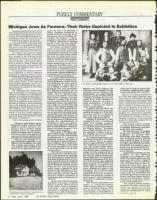
The Kahn and Malinoff families in the early 1900s in Bad Axe.
Machine and Tool Company, the
Universal Lock Company, a large
clothing concern (Daniels and
Blumenthal), two small clothing
factories, and the Woodbine Brick
Company. Woodbine by now pos-
sessed many of the attributes of
political autonomy: an improve-
ment association, a board of
health, a volunteer fire depart-
ment, a school system.
In March 1903 Woodbine was
formally incorporated as an inde-
pendent borough, the "Fiist Self-
Governed Jewish Community
Since the Fall of Jerusalem," a
New York enthusiast called it.
Writing of Woodbine in 1904,
Abraham R. Levy, a rabbinical
visitor from Chicago, compared
the pioneer work of the South Jer-
sey colonists to the achievement of
the Pilgrim fathers: "Woodbine
proves that although the Jew is
not naturally a farmer, with pro-
per training, aid and encourage-
ment, he can become one."
As a grand experiment in ag-
ricultural colonization, Woodbine
was a failure, but as an experi-
ment in agro-industrial coloniza-
tion, it must be pronounced a suc-
cess. The largest single differ-
entiating factor between Wood-
bine and the other colonization at-
tempts was the support given by
the Baron de Hirsch Fund. Wood-
bine was the child of the fund, the
direct application of its principle.
Despite the reluctance of the trus-
tees of the fund to pour unlimited
sums of money into Woodbine lest
their largesse corrupt the col-
onists' spirit of self-reliance, they
never withheld aid when it was
necessary. The de Hirsch Fund
leadership had come to under-
stand that for Jews to succeed as
farmers was primarily a matter of
environment and adaptation.
Jews had no instinctive aversion
to fa*rming.
The Jewish agricultural col-
onists in turn-of-the-century
North America testify to a utopian
quest, a messianic urgency. They
had all known the experience of
social justice or degradation; a
sense of insecurity bred by social
crises, the craving for a great deal
of purpose captured their imagi-
nation and guided their energies.
There is an intriguing additional fac-
tor in the New Jersey experience, espe-
cially when the Jewish farmer developed
poultry farming into a major agricultural
branch, mechanizing the industry. This
portion of the drama of Jews in agricul-
ture is related in another essay in the
AJArchives catalogue of the exhibit by
Dr. Gertrude Dubrovsky, who grew up in
the Jewish farming community of Far-
mingdale, N.J., and has just completed a
book-length manuscript entitled The
Land Was Theirs: A History of the Far-
mingdale Community. In her revealing
article, Dr. Dubrovsky presents the un-
usually interesting facts:
The farmers never became
rich, but as long as they were able
to maintain themselves and their
farms, they were satisfied.
By trial and error, by reading
books and consulting with their
neighbors, by pooling their
knowledge and their energies,
they developed poultry farming
into a major branch of U.S. ag-
riculture, mechanizing the indus-
try, taking the chickens out of the
backyard, and making eggs a
money crop for farmers. New Jer-
sey became known as the egg bas-
ket of America.
Small family farming, once the
backbone of the American
economy, is now extinct as a way
of life. The Jewish farmers for the
most part, like others, support
their families today in different
ways. Yet none seem to have re-
gretted the years they spent on
their farms. As seen through their
memories, the farm enriched them
in every other way except finan-
cially. And, the community life
provided that which no amount of
money could buy. It gave its mem-
bers an extended family, a vibrant
intellectual community, and a
sense of connection to it.
The Jewish family farmers
persisted, like their counterparts
across the country, as an eco-
nomic and cultural force in the
American communities in which
Continued on Page 36