

2
Friday, November 8, 1985
THE DETROIT JEWISH NEWS
PURELY COMMENTARY
PHILIP SLOMOVITZ
`No One At Home For Racists Of All Faiths'
There apparently are no restrictions
judiciously. That's Israel's democracy. It
is workable and merits respect and ad-
miration, although it often grants free-
doms for some who would destroy free-
doms.
A Libertarian Voice
Sounded In Detroit
Encyclopedia Ju daica
Detroit Jewish Welfare Federation
President Joel Tauber on Oct. 24 had a
message to messengers of ill will:
"No one is home to Meir Kahane
and his racist ideology."
It was a warning to the carriers of
bigoted views if they tried to confront
Federation leaders and their associates
and tried to enter their headquarters.
Let the media and the concerned citizens
make a slogan of Tauber's words, and
racism will thereby be effectively out-
lawed.
The pity is that people with bias
should have created the need for the ac-
tion performed here as a repudiation of
threats to the ethical Jewish codes under
the guidance of a man who bears the
title Rabbi. What was dolie needed to be
said against the regrettables in a
Kahanism that is causing so much mis-
ery in Israel and is spilling over to the
Diaspora. The added pity is that a prom-
inent columnist should have found it
necessary to link that movement with an
American agony, calling the develop-
ment Farrakhanism.
The action in behalf of the Detroit
Jewish Welfare Federation is not limited
to this locality. It merits treatment as a
national slogan, and hopefully can be
applied, in Joel Tauber's words, to Israel.
On the American front the prejudices
were negated a long time ago, when
George Washington coined the American
slogan: "To bigotry, no sanction." In Is-
rael, sorrowfully, the bias gets approval
under the claim of sanctity. Therefore,
the duty of the scholars in Jewry, the
religious leaders, the defenders of Jew-
ry's moral and ethical codes, never to
permit the spread of discrimination di-
rected against those who differ and who-
ever is not Jewish in Israel. There has to
be an understanding that no one will be
permitted to say that a resident in Israel
who is not of Jewish birth is to be driven
out of the land. That's the Kahanism for
which there can never be sanction.
Truly distressing about the ex-
tremely rightist attitudes among many
Israelis is the supporting view that the
Divine Promise of the Holy Land to the
People Israel calls for rejection, even ex-
pulsion from the land, of non-Jews, in
the major instance meaning the Arabs.
To most Jews everywhere and believably
to most Israelis this is a Kahanist
abomination. This very important matter
was given serious consideration by Dr.
Charles S. Liebman, professor of politcal
science at Bar-Ilan University in Israel
and senior advisor in political science at
Everyman's University, the open univer-
sity in Israel.
In a lecture entitled The Religious
Component in Israeli Ultra -
Nationalism," which was the Eighth
Annual Rabbi Louis Feinberg Memorial
Lecture in the Judaic studies program at
the University of Cincinnati, Dr. Lieb-
man drew upon major Orthodox opinions
for his analyses and conclusions. In his
lecture, which is made available in a
brochure published by the University of
Cincinnati, Prof. Liebman quotes Rabbi
Abraham Isaac Kook (1865-1935) and
his son, the Ray Yehuda Kook (1891-
1982). He utilized the following from the
younger Rabbi Kook:
One of the memorable lec-
tures of Rav Zvi Yehuda was de-
livered on the eve of Israel Inde-
pendence Day in 1967 and pub-
lished under the heading The
Sanctity of the Holy People in the
Holy Land (Kook, 1978). Raav Zvi
Yehuda noted that when the
United Nations agreed to the es-
tablishment of the State, he did
not share the great joy that swept
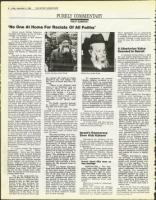
Rabbi Abraham Isaac Kook
the country. He could not resign
himself to the "evil tiding" that
the Land of Israel had been di-
vided.
"Where is our Hebron? And
where is our Shechem? And our
Jericho where is it? Will we
forget it?! And all of the other
side of the Jordan — it is ours,
every clump of dirt ... which be-
longs to the land of God — is it
our right to concede even one
millimeter of it?" (Kook, 1978,
141).
He finally consoled himself,
he continues, with the thought
that this was God's wish.
There is an extremism that keeps
utilizing this attitude toward Arabs in
Israel and may be the root of the
Kahane prejudices. Could the Rabbi
Kook quotation really serve to encourage
bias against Arabs, even denying them
domicile rights in Israel? Isn't there a
morality that dispells inhumanism? In-
deed, Dr. Liebman summarized his very
important philosophic-theological essay
by calling the Kooks to witness again, in
an affirmation of the ethical Jewish
codes and the morality of Jewish devo-
tions. He stated:
Misunderstanding and selec-
tive absorption may also be true
of the ultra-nationalists among
the religious Zionists. The Jewish
tradition understood through the
formulations of Rabbi Abraham
Kook and his son Zvi Yehuda
seem to provide proof texts for
ultra-nationalist. formulations.
Notions of an inherent sanctity of
Jews is a basis for racist doc-
trines. The attributrion of sanc-
tity to a land and the suggestion
of a mystical tie between a par-
ticular group of people and a
particular land provides a foun-
dation for the grossest form of
chauvinism.
Yet it was Rabbi Abraham
Kook who believed that "the fear
of God must never overwhelm
the natural morality of man" and
love of all men and all nations
"from the depths of one's heart
and soul" prepares the spirit of
the messiah to descend upon Is-
rael. It was his son who wrote a
letter of protest to a school prin-
cipal when he saw students bul-
lying Arabs. I prefer to believe
that neither the father nor the
son foresaw the interpretation
many of their admirers would
give to their message.
Rabbi Zevi Judah Kook
To summarize my central
thesis: religion certainly is an
important factor in accounting
for Israeli ultra-nationalism but
it, alone, is insufficient to explain
the phenomenon. A moderate
nationalist interpretation of
Judaism is possible, as the exist-
ence of such dovish religious
groups as Oz V'shalom or Netivot
Shalom demonstrates. Secondly,
religious conceptions and values,
even when they appear to sup-
port ultra-nationalist orientations
can be moderated by considera-
tions of pragmatism or by values
of compassion and natural moral-
ity.
There are in Israel tens of thousands
of escapees from Moslem counties who
bear grudges and would do to the Arabs
what Arabs did to them. Dr. Liebman
takes it into consideration but dispels it
as dominating Israel.
It is the moral code that survives.
Faith in Israel retains faith in the pre-
dominance of this principle.
Israel's Democracy
Even Aids Kahane
Throughout the Diaspora and be-
lievably overwhelmingly in Israel, the
view prevails that it would be a blessing
if Kahanism were ignored, as a measure
of silencing it.
But the Israeli courts, always on the
libertarian side, never interfere with the
rights of legislators. Therefore, Kahane
was treated with extreme respect by Is-
rael's high court. Last Friday's USA
Today summarized a court decision in
this brief:
Israel: Court OKs laws on
sex, marriage
JERUSALEM — The Sup-
reme Court ruled Thursday that
Parliament member Rabbi Meir
Kahane has the right to intro-
duce laws that would strip non-
Jews of Israeli citizenship and
outlaw marriage and sexual in-
tercourse between Jews and
Arabs.
That's how it works in a democracy!
That's Israel!
There are always the dangers
within, there is a constant fear of a Fifth
Column, yet there are several Com-
munist Arabs in the Israel Knesset and
restrictions are limited legislatively.
A columnist having chosen to label
the new bigotry-dispensers jointly as
Farrakhanism must be treated with re-
spect as a prominent churchman who re-
fuses to magnify prejudice.
The Rev. Charles G. Adams, pastor
of Hartford Memorial Baptist Church
and president of the Detroit Chapter of
the National Association for the Ad-
vancement of Colored People, wrote an
essay for the Detroit Free Press (Oct 29)
under the title "Why Do the Media
Shine a Spotlight on Farrakhan?"
Deploring the vocal criticism contin-
ually calling attention to Louis Far-
rakhan, the Rev. Adams commences his
essay by stating: "It is ironic that people
who abhor Louis Farrakahan and his
vicious attacks on the Jewish people and
who wish him to fade from the national
scene continue to call attention to him
by vocal criticism.
Dr. Adams exposes the Farrakhan
prejudices with challenges to Far-
rakhan's economic views. He lends em-
phasis to the lessons taught in historical
perspectives when black leaders spoke
for justice without prejudicing anyone
else's rights. Thereupon, he condemned
anti-Semitic prejudices and asserted:
The River of American his-
tory runs red with the blood of
fearless black preachers and
prophets who never hesitated to
condemn the evil of injustice
wherever it was found. W.E.B. Du
Bois, Paul Robeson and the Rev.
Martin Luther King Jr. are just
three of hundreds who said what
they had to say and suffered —
even died — for saying it.
King was just as incensed
over anti-Semitism as he was
over apartheid in South Africa,
and just as exercised over an
immoral war in Vietnam as over
racism in the United States.
Robeson was just as dedicated to
the economic liberation of Welsh
coal miners as he was committed
to the advancement of his own
race. The civil rights movement
has demonstrated its ability and
desire to extend its roof to shelter
and sustain all victims of bigotry
and hate.
Despite Farrakhan's nefari-
ous attempts to separate black
people and Jewish people, black
people and Jewish people con-
tinue to work together. We si-
lently vote for each other, work
for each other and bleed for each
other's sufferings. No irresponsi-
ble rhetoric can succeed in
separating those of us who have
struggled together for justice at
home and peace with justice in
the world. When the media hype
now magnifying Farrakhan is
taken away, he will be seen for
what he is: A minor man with a
narrow view.
These are the views of a libertarian
who recognizes the values of honorable
citizenship. They are viewpoints for
which praginatic Jewish and black fellow
Continued on Page 54