

2
Friday, JuIy,26, 1985
THE DETROIT JEWISH NEWS
PURELY COMMENTARY
PHILIP SLOMOVITZ
Rational Faith: Thomas Jefferson And The Separation Principle
Separation of Church and State, al-
ways among highest principles of
Americanism, has also always continued a
serious debate separating some Ameri-
cans. It is an especially challenging matter
at this time, with President Ronald Rea-
gan strongly supporting religious obser-
vances in public schools and in many re-
spects denigrating the inerasable ideal
which has become a basis foi differing with
the President.
The President, when he regains all his
strength, which is the hope of all in this
country and of millions everywhere,
should be apprised of a most interesting
analysis of the Jeffersonian interpreta-
tions of that ideal which so many of us see
as the Separation obligation. In an article
entitled "A Forgotten Fight for Religious
Freedom," (Wall Street Journal, July 16),
Joy Hakim, a Virginia Beach, Va. free-
lance writer, provided a very valuable les-
son. The background outlined by Ms.
Hakim states:
Thomas Jefferson was in
France when on Jan. 16, 1786,
James Madison finally was able to
get the Virginia . General Assembly
to adopt "A Statute for Religious
Freedom." Jefferson had written
the statute seven years earlier.
Getting it passed was, he said, "the
severest contest in which I have
ever been engaged."
That bill, little remembered
today, was the first in Western his-
tory to outlaw religious persecu-
tion. No longer could the state
compel residents to support a reli-
gious establishment, nor could it
deny public office because of per-
sonal beliefs.
The idea of separation of
church and state, which the statute
articulated, was too much for
many Virginia residents. Patrick
Henry argued against it. (So did
George Washington and James
Monroe.) Henry, who had so
eloquently denounced taxation
without representation, cham-
pioned a bill to establish general
assessment for Christian worship;
it would replace the tax that had
supported the Anglican Church.
Henry's bill passed its first two
readings in 1784. Passage on its
third and final reading seemed a
certainty.
From France, Jefferson wrote
to Madison, "What we have to do, I
think, is devotedly pray for his
death." Madison was more prag-
matic. He supported Henry's elec-
tion to the vetoless post of gover-
nor. And he wrote "A Remonstr-
ance Against Religious
Assessments," specifically decry-
ing the taxation of Virginians to
support teachers of religion, but
going far beyond that in a brilliant
attack on all religious tyranny.
Then, with the help of the well-
respected George Mason, he lob-
bied his peers and got Jefferson's
bill passed. Five years later, in
drafting the First Amendment, he
made the ideas of the Virginia sta-
tute the law of the land.
What were those ideas? How
did Jefferson actually feel about
religion? Back in 1776, Jefferson
had addressed the Virginia House
and asked the rhetorical question;
"Has the state a right to adopt an
opinion in matters of religion?" He
answered with a strong negative.
Men are answerable for their reli-
gion. solely to God. History shows
that religious establishments are
ays oppressive, he told the
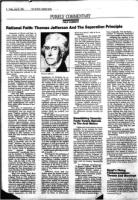
Thomas Jefferson
legislators. In Virginia, he re-
minded them, laws on the books
made it a criminal offense to deny
the validity of the Trinity, heresy
was punishable by death, and
free-thinkers might have their
children taken from them. That
these laws were rarely enforced
was not the point, he said. Besides,
they all knew of cases of persecu-
tion, particularly of Baptist
preachers.
Later, writing in "Notes on
Virginia," he continued: "The
legitimate powers of government
extend to such acts only as are in-
jurious to others. But it does me no
injury for my neighbor to say there
are twenty gods or no god. It
neither picks my pocket, nor
breaks my leg."
In the statute' he poured forth
all his feelings about the corrup-
tion and meanness associated with
the history of thealliance of church
and state. It is as much eloquent
manifesto as landmark legislation.
"To compel a man to furnish con-
tributions of money for a propaga-
tion of opinions which he disbe-
lieves, is sinful and tyrannical," he
said. And, "to suffer the civil
magistrate to intrude his powers
into the field of opinion ... is a
dangerous fallacy, which at once
destroys all religious liberty"; also
"it is time enough for the rightful
purposes of civil government, for
its officers to interfere when prin-
ciples break out into overt acts
against peace and good order; and
.. truth is great and will prevail if
left to herself ..."
Then he got to the substance of
the act, "That no man shall be
compelled to frequent or support
any religious worship, place, or
ministry whatsoever, nor shall be
enforced, restrained, molested, or
burthened in his body or goods,
nor shall otherwise suffer on ac-
count of his religious opinions or
believes...."
Jefferson never had any
doubts about the statute's impor-
tance. His directions for his
epitaph, found after his death in
his own handwriting, read: "On the
faces of the obelisk the following
inscription, and not a word more,
'Here was buried Thomas Jeffer-
son, author of the Declaration of
American Independence, of the
statute for religious freedom, and
'father of the University of Vir-
ginia,' by these, as testimonials
that I have lived, I wish to be re-
membered."
For Jefferson the statute did
more than just guarantee the free-
dom to choose a church. Its con-
cern was with intellectual liberty,
the freedom of the mind. Dumas
Malone, author of a six-volume
biography of Jefferson, says: "It
was a proclamation of both the in-
tellectual and the religious inde-
pendence of the individual ... It
remains an ineffaceable landmark
of human liberty; and men in any
land would do well to turn to it at
any time that persecution for opin-
ion may raise its ugly head."
Writing to Madison from
France, Jefferson said, "It is hon-
orable for us, to have produced the
first legislature with the courage to
declare, that the reason of man
may be trusted with the formation
of his own opinions."
Harvard historian Bernard
Bailyn has called the statute "the
most important document in
American history, bar none."
Did Jefferson's hostility to a
marriage of church and state in-
clude a distaste for religion? No,
say the experts. Merrill D. Peter-
son, a biographer and a professor
at Jefferson's university, says:
"His hatred of establishments and
priesthoods did not involve him in
hatred of religion. He wished for
himself, for his countrymen, not
freedom from religion but freedom
to pursue religion wherever in-
telligence and conscience led."
The points advanced are so clear that
they do not need further evaluation. The
views quoted merely elicit the hope: May
the Jeffersonian principle continue un-
abated!
Demolishing Canards:
Facts Versus Hatreds
In The Arab Malice
Utilizing the United Nations General
Assembly as the medium for hate-
spreading, Arab propagandists are resort-
ing to most unusual and most shocking
venom. They have not even hesitated to
resort to the shockingly atrocious blood
libel in their attacks on Jews and Israel.
The U.N. General Assembly is not the
only vehicle for these hatreds. The Chris-
tian Science Monitor especially, as well as
other nationally circulated newspapers,
have been used as means to advertise the
hatreds. It was in response to one such full
page ad in the CS Monitor that Phil Baum
and Raphael Danziger, writing in behalf of
the American Jewish Congress, de-
molished some of the claims in the anti-
Israel-Jewish canards. On March 26 the
CS Monitor published this Baum-Danziger
letter under the heading "Questionable
Ad?":
In a full-page advertisement
("Lebanon's Appeal," March 15),
the National Association of Arab
Americans (NAAA) makes a
hypocritical and dishonest at-
tempt to turn American public
opinion against IsraeL
Even while departing from
southern Lebanon, many Israeli
soldiers continue to be killed and
maimed by suicide car bombings,
remote-control bombs, and armed
ambushes originating in local
Shiite villages. As would any other
army, the Israelis have gone after
the initiators of these senseless at-
tacks in order to protect their/
lives; tragically, but inevitably, a
number of innocent bystanders
have been caught in the cross fire.
Omitting any mention of the
reasons for the Israeli actions, the
NAAA feigns moral outrage at the
resultant Lebanese casualties. Its
selective compassion, however,
permitted no such sentiments to be
expressed when the PLO attacked
countless civilians when the Sy-
rian Army slaughtered 20,000 of its
own citizens in Hama, or when the
Iraqis employed outlawed chemi-
cal weapons.
Even more hypocritical is the
NAAA's denunciation of Israel's
battlefield censorship in southern
Lebanon — considerably less
stringent than was that applied by
the United States in Grenada or
Great Britain in the Falklands —
while finding nothing wrong with
the total censorship routinely im-
posed by all Arab states.
Finally, the NAAA seeks to
create revulsion against Israel
through partial, inaccurate, and
misleading quotes from the New
York Times and the Washington
Post. Thus, it misrepresents the
Post as reporting on its own
authority that Israeli soldiers
"struck a 4-month-old baby with a
rifle butt and fired at a boy"; in
fact, the Post quoted a local doctor
in a Shiite village as making these
totally unsubstantiated allega-
tions. The ad then quotes the Times
as saying that a woman was "shot
at the checkpoint on the Israeli
front line Thursday," neglecting to
mention that she was the unfortu-
nate, unintended victim of the
heavy fighting that took place in
the area that day. And it conjures
up the image of brutal murder by
quoting the Times as saying that a
Shiite religious leader taken pris-
oner by the Israelis "was found a
week later in an abandoned well,"
whereas the next sentence in the
Times makes clear that the man
was found alive.
The authors of such distor-
tions seek not to bring peace but to
sow further hatred and misun-
derstanding.
It's a pity that there are so many de-
mands for a hearing and reading of facts
and truth about conditions affecting Israel.
There are so many opportunities for just
and friendly relationships. Yet the prop-
agandists, so many unfortunately in this
country, keep spreading libels that lead to
hatreds rather than mutual respect. It is
regrettable that instead of devotion to
amity there is so much need to concentrate
on demands for truth.
That the Monitor should have placed a
question mark after the title to the pub-
lished letter is also cause for regret. Wasn't
the factuality of the letter's contents evi-
dent?
Egypt's Rising
Fundamentalism:
Threats And Warnings
Fundamentalism has emerged as a
warning of a rising tide that could lead to
Khomeinism in Egypt and therefore as, an
increasing menace to the peace of the Mid-
dle East and therefore to the entire world.
It has become a major problem for Egyp-
tian President Hosni Mubarak. The issue
is reviewed, on the basis of current de-
Continued on Page 26