
/
40.7 %.
/•7 NN , - 'kt te. 4, \ ,,,,,;";'''''
/...\
4ti folV s° , ".' el r 'Af .,.
\-">
rt.9
'
-,:.:t4.
• ,< P,..<4, 4, ...,-.•,,,;:s", ,..." 4%•
/ 41 \ •k...
,
.4' ,.:`!",, I - -,
// ti, ...:e• d,, i. e'.,4: 4 e, A 4' -..°,-
e.,,,, , :c . -(*.e ss,-, . .., 5-• ./P.:0-
/ .'•. A.,,, s r , +.0-", •, .;.. 0 , .,... 4.4"4,4, AP.;.•
" •rrIP
, .4 c , ,„.4 tci. ,,,,-, „. 4° • ,-. * e, ....
,,,r4 ,,,,,,/,..,
i
• 4."- . ' 40
-701 .,;,"1
..0 1`
.,, e
,.",
,.:,
,;.t., .4*
,',
1;'
44 1
4-46: 0 4
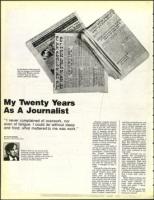
In the shadow of the powerful
New York papers, the Yiddish
dailies that Wiesel wrote for
"couldn't help but feel a
certain inferiority complex."
My nventy Years
As A Journalist
"I never complained of overwork, nor
even of fatigue. I could do without sleep
and food; what mattered to me was work."
Resume a regular column?
The idea tempts me. Journal-
ism has played a significant
role in my life. For twenty
years I lived with the obses-
sion of keeping myself in-
formed and with the fear of
missing my deadlines. Every-
thing interested me and ex-
cited me. I wanted to find
myself always at the center of
events: to know everything,
to guess everything.
A romantic, I was ready to
set out on a journey no mat-
ter where, when, or what cir-
cumstances. Unfortunately,
the Israeli newspaper
Yedioth Ahronoth for which
I was a correspondent first in
Paris, then in Europe, did not
have the resources to satisfy
my taste for adventure. So
what: I managed as best I
could.
During this time (the post-
war years), reporters moved
around without great diffi-
culty. They unearthed a
ticket here, an invitation
there. My particular problem
was not only that the Israeli
press did not enjoy at that
period the prestige it does
today, but also that I was
stateless, therefore a stranger,
a stranger everywhere: with-
out a passport, with only a
letter of transit, I spent hours
BY ELIE WIESEL
Special to The Jewish News
Editor's Note: In the second of his
exclusive monthly columns for The
Jewish News, Elie Wiesel - author,
teacher, witness - reflects on his career as
a reporter for the Israeli press and
American Yiddish dailies.
" 1"'""t4,414. 1 .e. / .
44'
Z114V
4,+
"
11:
$ 4 ttt t..4i• 4 ft 4 .
-4, 4 A. :
ri R.ft
4 .4
A 44
4
11.
.4
4
v
16,16%
"%k
and days procuring exit and
entry visas: what an Ameri-
can or British colleague ob-
tained in five minutes cost
me a week. A stateless man
was suspect everywhere: each
functionary took care not to
facilitate my task, but rather
to make it more difficult.
Nonetheless, I traveled a
good deal. Diplomatic meet-
ings, film festivals, various
inquests: I never complained
of overwork, nor even fatigue.
I could do without sleep and
food; what mattered to me
was work.
What attracted me es-
pecially was investigative
reporting; I preferred it to
daily news coverage which
was necessarily brief and
often superficial. Instead of
going every day to the Quai
d'Orsay, to the embassies, or,
later, to the United Nations,
I preferred to devote a series
of articles to a single subject
that I could, then, treat in
depth.
Spain, Morocco, Brazil, and
so many other countries, so
many other subjects, so
many other encounters: I
wrote and wrote. I never
stopped writing.
In Paris and later in New
York, I ran up against ob-
Continued on Page 92
,,••
si•
'10 t,
A * * .4 4 4
•••••.. ••••
•
Scanned image of the page. Keyboard directions: use + to zoom in, - to zoom out, arrow keys to pan inside the viewer.
April 05, 1985 - Image 112
- Resource type:
- Text
- Publication:
- The Detroit Jewish News, 1985-04-05
Disclaimer: Computer generated plain text may have errors. Read more about this.