

THE DETROIT JEWISH NEWS
wish to introduce my son-in-law,
a volunteer, who devots his leisure time
to helping others less fortunate — the
terminally-ill, wrote Jean Zaremberg.
Michael Rosett, 47, is involved
with the Hospice of Southeastern
Michigan located in Southfield at
22401 Foster Winter Drive.
His involvement is primarily with
the patient. He develops a certain bond
that creates harmony as a friend who
really cares. Michael visits on a daily
basis, and the patient looks forward to
a friendly chat.
Many times Michael has been with
the patient at the time of death (in re-
spect to the patient's request) . . . His
wife, Joyce, is also a hospice volunteer.
They have two daughters, Lynn and
Laurie, and live in Livonia.
Michael finds his volunteer work
very rewarding. He lost his mother,
Margaret Rosett, five years ago from
pancreatic cancer. Since then, he has
had satisfaction working for the Hos-
pice .. .
To someone- unfamiliar with the
Hospice, expectations would be of a
negative environment for the dying.
But in less than five minutes, the
warmth of the Hospice and its staff
puts visitors at ease.
The Hospice is a casual, comforta-
ble place. Plants and flowers are
everywhere and there is no set pattern
of interior design.
Patients read, play games, • or
entertain their families in the well-
equipped "Day Room." Some weekend
nights the patients have parties there.
The same comfortable manner
carries over to volunteer Michael
'Rosett. The care and love for his volun-
teer work shines in his eyes as he
guides a visitor around the Hospice.
The reward for this work is in-
tangible," Rosett said. You just can't .
:explain it or put it in words. The sad-
ness lasts maybe five minutes," after a
patient's death, "but if I made them
laugh, if I made their life better, that's
all I can do and it feels good."
One of Rosett's philosophies is
that "I didn't give them the disease,
and I can't take it away, but if I can
make life better for even one minute,
then what I'm doing is worth it."
The philosophy of the Hospice is to
help a dying person maintain control
over his life, prepare for death in his
own way, and live whatever time is
remaining with a sense of personal
worth. It aims to relieve the suffering
of the terminally-ill without the use of
machinery. Hands-on treatment and
> human support are emphasized.
According to Rosett, there comes a
time in dealing with the terminally-ill
when medications won't help, and
since hospitals are • geared to getting
the patient better and getting him out,
the Hospice is a better place for those
s who don't have much time left to live.
"My feeling is that hospital doc-
,
- tors and nurses are not geared to face
death, only to prevent it," he said.
At the Hospice, the emphasis is on
_controlling the pain and symptoms of
the patient so that he may think
> clearly and make his own decisions.
"Here, the patients are medicated
in a manner that keeps them pain-
i
free. They maintain a high level of
consciousness so their minds are free
to make decisions."
Rosett feels that another strong
point of the Hospice is its' lack of life-
support machinery. "Since there are
no machines, the nurses have more
time for quality hands-on treatment of
patients."
At his daytime job, Rosett is in
charge of insurance repair for Fairway
Construction Co. His hours are flexi-
ble. He wears a beeper and has a car
telephone, which makes him accessi-
ble at all- times.
He usually is a primary volunteer
for two patients at a time and he
makes it a point to visit them daily.
His name is on their charts, and he is
called whenever there is a change in
the condition of the patient.
Rosett comes to the Hospice at any
time, day or night, to be with the
patient. "I get in with both feet with
Friday, December 14 1984
,
11B
The Hospice will stabilize a patient's
medications and coordinate the home
care. A chart will remain at the Hos-
pice so that a doctor can give advice
over the telephone and be familiar
with the patient if re-admission to the
Hospice is "necessary.
There are no rigid visiting hours
at the facility. Young children and
family pets are welcomed to the build-
ing. One patient even brought her
parakeet, and the Humane Society
brings puppies to visit the patients.
A patient may bring a favorite
chair or picture, or anything that
makes him comfortable.
Food is prepared in the kitchen
downstairs, but fast-food boxes, bagels
and lox, donuts and other outside
treats are not uncommon.
Rosett explains that "there are no
'games here. Don't lie, but don't tell
them more than they ask either. These
people are terminal. They know it.
"Even though the family is very atten-
tive, she has fallen in love with him."
Baker says that her mother felt
comfortable at the Hospice, where her
children and grandchildren could
visit, despite the fact that three differ-
ent fellow patients came and left her
room during her first month there.
Hinda Nesmour had only positive
feelings about Michael Rosett and the
Hospice. Nesmour's husband David
had suffered with cancer for several
years and she realized he was nearing
the end of his life.
Home care was very difficult, he
had been in and out of the hospital
many times, and a nursing home did
not seem to be the right option either.
"A friend of my daughter suggested we
talk to Mike about the Hospice,"
Mrs.Nesmour said. -
Rosett explained the Hospice con-
cept to the family and went to the hos-
pital to discuss it with David. Nesmour
There are no secrets. The chart is open
to the patients, their families and the
volunteers."
According to Rosett, one of the
toughest barriers is to accept the prog-
nosis. Families often think that the
patient is unaware of his disease.
Patients also think that their families
are unaware. Once the truth is in the
open, Rosett says the situation im-
proves 300 percent.
"The Hospice is here and it's
worthwhile. It's not an alternative to
hospital care, but there comes a point
in time when the decision is made. If
we keep them in the hospital are we
prolonging a life or extending death?
My feeling is that the patient's
priorities come first."
He feels that the Hospice is not a
sad place at all. No one here gives up
hope. They just don't suffer while
they're waiting for that cure to be
found."
Rosett believes strongly that more
people should visit the terminally-ill.
His patients become upset when
friends refuse to visit them and he
stresses that the Hospice is not a bad
place. Its emphasis is on the quality of
the last days of life, not the quantity.
Rosett is appreciated by his
patients and their families. Sylvia
Baker's mother, the late Eva
Goldstrom, was his patient.
"Mother's crazy about him,"
Baker said before her mother died.
was admitted to the Hospice and spent
14 days there before he died. The de-
cision to go to the Hospice was right."
Mrs. Nesmour said. "It's personal care
and you feel as though they (the staff)
are with you."
She is extremely grateful and im-
pressed with the Hospice staff and vol-
unteers like Rosett. She emphasized,
"Every person who works there is so
dedicated. It was as though he had a
private nurse all the time. They
treated- him as a member of their own
family."
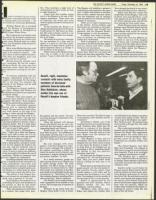
Rosett, right, maintains
contacts with many family
members of deceased
patients. Here he talks with
Glen Goldstrom, whose
mother Eva was one of
Rosett's hospice friends.
the patient and the family. I'm here
every day because it's important to the
patient," he said.
Often the patient will discuss
things with Rosett that he won't dis-
cuss with his own family, such as his
impending death and funeral.
Rosett feels that he gets back
more than he gives. "It's satisfying to
help people knowing that I can never
ask these people for any favors. I enjoy
what I'm doing and I feel good about
it.
His role changes with every
patient. "I see three things in a volun-
teer: you're a stranger but a friend to
the patient, sometimes a buffer be-
tween the patient and his family, and
sometimes a magnet bringing family
and patient together," he said.
1)
In a death situation, people are
often unsure of how to act. Rosett tries
to make things easier. He tells
families, "It's OK to touch, to talk to
the patient. Go ahead and do it." After
three years as a volunteer at the Hos-
pice, death is something he has become
accustomed to. "Sometimes I'm like
the orchestra director, standing off to a
side, conducting," Rosett explained.
The Hospice only accepts patients
with 'a prognosis of six months or less
to live. The average stay of a patient is
-'23 days.
Patients do go home from the
Hospice. Some prefer to die at home.
The 30-bed Hospice, near Nine
Mile and Greenfield, was started in
1980 and is owned by several Detroit
area hospitals. There is an oncologist
and a general practitioner on staff.
The Hospice has a speakers
bureau, which will talk to any group at
no charge. Rosett speaks to groups oc-
casionally and enjoys this aspect of his
volunteer work.
Rosett's mother was ill before the
Hospice opened. Rosett and his family
took his mother into their home, prac-
ticing Hospice techniques for the last
days of her life. He says that he and his
mother were honest and upfront about
the severity of her disease. This is the
same kind of honest rapport he tries to
keep with his patients. When his
mother died, he believes he'd done ev-
erything he could to make the last
days of her life better.