

• r
contractor, Smith and Andrews, were
hired to design and build the facility,
many of the JHA staff credit its assis-
tant director, Cindy Weingarden
Schwartz, with the ultimate building
plan and layout.
The daughter and granddaughter
of builders, Mrs. Schwartz used the
experience of her family background .
in her role as the project director for
the construction phase of the resi-
dence.
"It's in my blood. I knew how to
work with contractors." Prior to her
involvement in the Fleischman proj-
ect, she had a role in the renovation of
the Home for Aged's Borman Hall
building in Detroit.
Her specialist's degree in geron-
tology from the University of Michi-
gan also proved to be beneficial in
planning the color scheme, acoustics
and lighting. According to Mrs.
Schwartz, the bright colors were pur-
posely chosen.
As a person ages, she explained,
the lens of the eye yellows and pastel
colors are hard to discern. To avoid this
at the new Home, bright, contrasting
colors are used. There is a second pur-
pose in the color scheme: cueing. She
explained that if a resident becomes
disoriented and forgets his room
number, a color will cue him so that he
can find his floor.
Color bursts throughout the
Fleischman Residence and Blumberg
Plaza. The Nosh Nook, a little snack
shop in the plaza, is in bright reds and
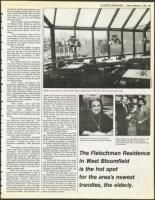
white. The communal dining room is
airy, with huge windows and accented
with bright orange chairs and blond
wood. Wolfe said the bright colors are
used to give the residence "a non-
institutional look."
"The colors were specially
selected to stimulate them (the resi-
dents) to activity and interaction." De-
signer Ruth Schnee and
environmental psychologist Lorraine
Hiatt of New York collaborated on the
decor.
Special consideration was given to
the acoustics and lighting. "We
wanted the acoustics clear and clean,"
Mrs. Schwartz explained, adding that
Muzak or "elevator music" leads to
confusion-for the aged. To achieve the
proper acoustical environment, a
variety of textures were used in the
wall and carpet treatments.
Ultimately, the colors, acoustics
and lighting were chosen because the
planners "wanted to make it as
homelike as possible," Mrs. Schwartz
said.
The design_of the building came
about after the original planning
committee visited similar facilities
throughout the country, looking for
designs that could be "replicated" in
Detroit, Mrs. Schwartz said. The orig-
inal report resulting from these trips
suggested that Borman Hall be closed,
but that it be combined with the JHA's
Prentis Manor while a new Home for
Aged is constructed.
When the planners saw the $25
million price tag attached to such a
plan, it was rejected. The prospect of
building only a Home for Aged at the
Maple-Drake Jewish Community
Campus site was discussed. It wasn't
until the Department of Housing and
Urban Development came through
with funds for the construction of the
Jewish Federation Apartments that
communal leaders and planners de-
THE DETROIT JEWISH NEWS
•
Friday,_ December 7; 1984 53
..,,Virif,M2WAS
Bright orange chairs and blond wood walls and tables greet residents in the communal dining room.
cided to join forces and build together.
The result of this joint effort is the
JHA-sponsored Fleischman Residence
and Blumberg Plaza and the Jewish
Federation Apartments-sponsored
facility, the Lillian and Samuel
Hechtman Federation Apartments.
Residents of both the Fleischman
building and the Hechtman Apart-
ments share security and mainte-
nance services.
Home for Aged President Robert
Steinberg said the Fleischman Resi-
dence came as a result of ten years of
study, calling it a new service, new
design and new concept . . . which will
impact on providing services for el-
derly in the United States."
Funding for the project came from
the Allied Jewish Campaign and
United Jewish Charities. According to
Steinberg, no one is refused admission.
It is equally accessible to all people,
no matter what their ability to pay."
A total of $5.5 million was raised
to build the Fleischman Residence and
Blumberg Plaza, according to Paul
Borman, chairman of the fund-raising
committee. The monies covered the
construction costs and provide for an
endowment.
Wolfe calls the facility the result
of a team effort. It combines the work
of the Jewish Welfare Federation (Al-
lied Jewish Campaign), United Jewish
Charities, Jewish Home for Aged and
Jewish Federation Apartments.
As Sidney Barnett taps away at
his typewriter, he may be unaware of
what went into creating his new home,
what is involved in its daily operation
and all the services and activities that
are available. But that's all right be-
cause he can be secure in knowing that
his basic needs are being provided for
by a community that really cares
about its elderly citizens.
Fleischman Residence Administrator
Sylvia Serwin checks the day's schedule.
Robert Steinberg, left, JHA president, and
Chuck Wolfe, executive vice president,
congratulate each other at the dedication of
the residence.
The Fleischman Residence
in West Bloomfield
is the hot spot
for the area's newest
trendies, the elderly.