

The Feinberg Graduate School:
Strengthening the
9
co
S
scie
c manpower
By Aaron Sittner
ONE OF the challenges accepted
long ago by the Weizmann Institute
is the training of creative scientists
at the masters or doctoral levels.
The objective is clear and vital: to
make sure Israel's standards in
sciences in the future will match —
or even exceed — those of the pre-
sent.
This is the mission of the Feinberg
Graduate School.
A survey has shown that only 30
out of 100 graduates of this school
return to the Institute for continua-
tion of their careers in science. Most
of the graduates take up occupations
in other Israeli institutions of higher
learning, or in government or pri-
vate industrial research laboratories.
Recognizing this trend, the Graduate
School recently embarked on a
programme to provide students with
some exposure to industrial research
and development as well as to scien-
tific administration. It is hoped that
this will assist them in their accom-
modation by Israel's rapidly expand-
ing base of science-oriented indus-
try.
One of the central roles of the
School is to make provisions
for graduates who plan careers with-
in the academic community. Special
post-doctoral fellowship program-
mes have been established to com-
plete their training by studying
abroad, where they will acquire
additional approaches and techni-
ques that will enrich their scientific
research when they return to Israel.
As Institute President Prof. Michael
Sela states: "All of the efforts at the
Feinberg Graduate School are
aimed at strengthening the country's
scientific manpower and enabling
Israel to compete more successfully
in an increasingly technology-
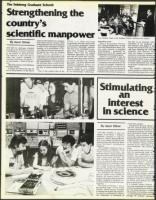
Prof Shaltiel, Dean of the Graduate School, welcomes new students.
dependent world."
Dean of the Graduate School is
Prof. Shmuel Shaltiel who, in addi-
tion to his administrative duties, pur-
sues active research in biological
communication – specifically en-
zymes involved in the transfer and
amplification of hormonal signals.
Asked if it is possible to spot the
individual attributes of a student at
the School early on, Shaltiel replied:
"Certainly it is not easy to do so, but
we make the attempt. Admission to
the School depends not only on the
student's academic record during his
undergraduate study and letters of
evaluation from former instructors,
but also on an interview with
committee of our professors. A
this interview, the student is chat'
lenged with questions that may pro
vide hints regarding his creativity
originality and analytical skills
Once the student is accepted hi
potential is continually assessed an
monitored on the basis of activitie
that include seminar courses, guided
individual study, on-going researci
in various laboratories and, finally
on the basis of independent researci
projects."
The student's independent re
search projects are closely followed
by an individual supervisor as well a
Stimulating
an
interest
in science
By Aaron Sittner
.#
`
"YOU'RE GOING to hear me
whisper at 40 metres – without a
telephone, intercom or radio be-
tween us," said Dr. Sherman Rosen-
feld, as we walked towards the sun-
drenched lawn that skirts the Weiz-
mann Institute's northeastern
periphery.
The youthful American scien, st
and education co-ordinator of the
Youth Activities Section, was
perfectly serious. "Place your ear on
this ring in front of this large dish bar
while I walk across the lawn," he
said. Arriving at a large parabolic
deVice, he placed his lips on a little
ring identical in size and shape to the
one to which my ear was glued, and
sure enough I heard his whispered
message as loud and as clear as if he
had been speaking right into my ear!
Dr. Rosenfeld was showing me
the first exhibit of the Garden of
Science, the acoustic mirrors. The
project will include other interactive
exhibits, designed to illuminate sci-
entific principles through visitor par-
ticipation.
The Garden of Science – now in
the planning stage – is one of the
Section's newest projects intended
to enhance the already rich program-
me aimed at satisfying the curiosity
and imagination of thousands of
Israeli boys and girls.
Pioneered in the early '60s by th
late Prof. Amos de-Shalit, the Yout
Activities Section is devoted to de
veloping the scientific and technolo
gical potential' of Israeli youth b:
matching science-oriented Israel
youth with youth-oriented scientist'
from the Weizmann Institute. Abou
4,000 students annually participat
in the Section's various activities
overseen by Dr. Netta Maoz, pro
jects coordinator. The activities in
dude:
• Year-round weekly science clubs
with the membership made up o
students from neighbouring corn
munities who meet weekly on th
campus to study subjects researche
at the Weizmann Institute, such a
electronics, physics, chemistry
mathematics, biology, computer sci
ences, energy and more. The club
are for students from primary schoo
through senior high school.
• Year-round outreach scienc
clubs, in which Institute scientists
travel to other parts of the country to
conduct science clubs in schools an
community centres in communitie
too distant from Rehovot for chit ,
dren to reach by bus.
• A Summer Science Institute. a
two-week programme on campus in
which outstanding Israeli students in
the 11th gfade develop a working
relationship with Institute scientists
– a relationship that often continues
through the students' subsequent
-