
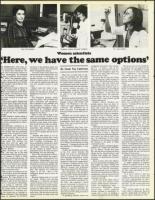

Graduate student Daniella Goldfarb.
Prof. Ora Kedem.
Dr. Nava Dekel.
Women scientists
'Here, we have the same options'
E FEBRUARY 1974 press re-
ase was headlined Woman Profes-
)r to Head New Membrane Re-
arch Unit at Weizmann Institute of
-ience. Presumably, the intention
Id been to publicize sexual equal-
,t. - In effect, the opposite impres-
3n came across. No one would have
ought of dropping the first syllable
the headline, had Professor Ora
edem been a man.
To add insult to injury, there was
)thing revolutionary in giving a
,'man a top-notch job on the Weiz-
ann campus. The Institute's recog-
tion of academic excellence has
ver been clouded by sexual con-
derations.
Twelve years earlier, Kedem had
ared the Israel Prize with the late
ofessor Aharon Katzir for their
rk on membrane biophysics. She
been a member of the Institute
ientific staff since 1954. The refer-
ce to her sex was a superfluous
ersight.
Kedem herself is unsure which is
e greater of two evils: to be label-
a woman scientist or to receive
ost of her correspondence addres-
d to a man.
Internationally acclaimed as an
pert on membranes and water de-
lination, Kedem is a well-seasoned
orld traveller who has personally
rented scores of papers at scien-
lc seminars and conferences
ound the world. She is not an
known quantity behind some
reign name. Her overseas col-
agues have seen her again and
ain on one podium after another –
d yet they persist in sending mate-
Ito Mr. Kedem.
"Male chauvinism is just unli-
F)
ited," she says, but in the next
eath declares that the general posi-
n of women in Israel is much
tter than any place she knows. "In
rael a woman is not faced with the
ice of having a family or being a
ientist. If you want to be a woman
- science, it's great to be in Israel.
ere, I won't find myself the only
oman in a lecture room."
Other women on campus can tes-
fy, like Kedem, that at the Institute
A is no impediment to career de-
lopment. Dr. Nava Dekel of the
'ormone Research Department, is
orking on one of the least known
ctors in reproductive physiology.
he is trying to discover what
echanism controls the maturation
f the oocyte which is the ovarian
g. Maturation is a necessary pro-
'.ss the oocyte has to undergo to
.-.-.Come fertilizable. The maturation
rocess is induced by hormone
'
secretion in the pituitary gland, but
according to Dekel, the mechanism
itself is completely obscure.
Very little study on the subject has
been done by other laboratories, not
on the grounds of disinterest, but
because oocytes are so difficult to
obtain. A huge number of rats have
to be used for research since there are
very few available oocytes in each
ovary.
Dekel terms her field of spe-
cialization as "one of the major
puzzles of reproductive biology – a
fundamental question of our exist-
ence."
The Weizmann Institute, which
pays her salary, has provided her
with a- laboratory and equipment.
She is assisted by two students and
one technician, "without whom I
couldn't make any progress," and is
surrounded by "intelligent people
with whom I can discuss and get
support for my ideas."
There is one minor snag in the
idyllic environment. Dekel is mar-
ried with two daughters aged 12 and
4, and she believes that her family is
entitled to some claim on her atten-
tion. So she leaves work at 4 o'clock.
But there is some unwritten rule
somewhere that scientists do not
have regulated lives – that they are
not 8-4 or 9-5 people like the rest of
the world.
"Anyone who leaves at 4 is in-
ferior. It doesn't matter that a male
may have spent the time between 8
and 4 reading a newspaper. He's
more productive because he's male
and he doesn't have to leave at 4",
says Dekel. "They don't judge you
by the number of papers you've
published, but by the time you leave
the building. It's very annoying."
This is the only element of discri-
mination which Dekel has experi-
enced. At home, her husband is very
supportive. Interestingly, he is not
an academic and has no background .
whatsoever in university studies. He
is a travel agent as much involved in
his kind of work as Nava Dekel is in
hers. The absence of a university
degree is not felt. "He's a very
intelligent person and we have no
conflicts."
Beyond making time to be with
her family, Dekel's most pressing
challenge is a deficient enzymatic
system existing in the oocyte, which
plays a crucial role in oocyte matura-
tion. It's a long-term project and the
question to which Dekel is addres-
sing herself may not be resolved for
many years. But she believes that the
time she invests in study is time well
spent.
By Greer Fay Cashman
When she is finally able to pin-
point the problem and thus fully
explain the process of oocyte
maturation, the information will bet-
ter equip future scientists in their
confrontations with other problems.
She believes that once the unknown
in oocyte studies becomes the
known, there could be important
developments in treating infertility
as well as in safe contraceptive
methods.
Research student Daniella Gold-
farb, currently working with liquid
crystals, concurs with Kedem and
Dekel. "At Weizmann," she says,
"there are equal opportunties for
everyone. The problems are at
home, not here. It all depends on
how your family accepts what you're
doing."
Goldfarb has the full support of
her engineer husband Arnon, and of
her mother."However, she and my
grandmother think that I work too
hard. They can't understand that I
enjoy my work."
The Goldfarbs have been corn-
promising ever since their marriage.
Wed when Daniella was in the mid-
dle of her B.Sc. studies, they went to
the United States where Arnon stu-
died ocean engineering. She went on
to do her master's degree at the same
university, "but it was not a universi-
ty at which I would choose to study
chemistry." Compared with the staff
and facilities at Weizmann, it was
inadequate.
In June, the Goldfarbs will return
to the U.S. where Daniella will
spend two years in post-doctoral
studies in the University of Hous-
ton's chemistry department. Arnon
found himself a job in Houston,
because it's his turn to compromise.
In Houston, Daniella will be work-
ing in physical chemistry, but with
different systems and techniques
from those employed at Weizmann.
Her fascination with chemistry
started in high school. She thought it
was "great fun" in laboratory experi-
ments to identify the solutions of
chemicals. It stopped being a game
when she enrolled at university. For
her B.Sc. she acquired a broad
general knowledge in chemistry to
prepare her for specialization. She
worked in analytical chemistry for
her master's degree and for the past
four years has been doing research in
physical chemistry.
A gruelling schedule leaves her
completely unfrazzled. After spend-
ing 7 1/2 – 8 hours a day at the
Institute, she goes home to her hus-
band and two daughters aged two
and six, and quite often has to go
back to work at night.
As far as she can tell, her family
relationships don't suffer because of
her work. "My family gets its share,
but I don't," she says. There just
isn't enough time in the day to in-
dulge in favourite hobbies such as
tennis and handicrafts, but Goldfarb
has no regrets about making a deci-
sion for science. "I may have had
some doubts about the particular
field I chose, but not in choosing
science itself. I can't picture myself
doing anything else."
Kedem, whose children are
already grown, does not have to
measure time in terms of family vs.
work. She recalls that when her
daughter was born, she took a year's
leave of absence and went to live in
Tivon. She had a thesis to complete
during her term of absence, and to
save her having to travel to the
Institute, her colleagues more or less
brought the Itistitute to her, and with
their help, the thesis was completed
on time.
After the year was up, she let it be
known that no matter who was giv-
ing a lecture after 4 p.m., she would
not be there to hear it. That rule
remained in force while her children
were small, but KedL,rn didn't miss
out. In deference to her home
obligations, her colleagues arranged
for lectures to be given at times
convenient to her.
Initially trained in chemical physics,
Kedem was "sucked into physiolo-
gy" by chance. Twenty five years
ago, she was one of a group of young
people led by Aharon Katzir, who
studied and taught the thermo-
dynamics of spontaneous processes
in nature.
None of them knew the subject,
but as each learned something new,
they taught the others. Kedem was
assigned to describing membrane
processes and general physiology.
She subsequently wrote a paper for
the first ever symposium (in 1960) on
membranes, and was amazed by the
reaction of biologists. It was a turn-
ing point in her life.
At the end of the 1960s, when it
became clear that synthetic mem-
branes would become important –
largely for desalinating water —
Institute's Professor Israel
Dostrovsky called together
Israelis working in membrane re-
search with a view to building a
central clearing house of knowledge.
The person who is not scientifical-
ly oriented may not appreciate the
significance of membranes which
are thin layers of tissue separating
cells. "Otherwise," says Kedem,
"we would be one big hag." A
synthetic membrane is a piece of
plastic which lets Some things
through and prevents the passage of
others.
Since the 1970s, Kedem has been
totally involved with synthetic mem-
branes, concentrating in more recent
years on membrane methods for
desalination.
Kedem charges that Israel has
been overusing its water potential
for years, and that the general public
is not aware of the extent to which
there are insufficient water re-
sources. "Turning off the tap won't
solve anything."
Ideally, a lot of Israel's water
problems could be solved by utilising
sea water from the Mediterranean
for agriculture, but the cost of distil-
ling sea water is as yet, prohibitive.
Israel is among the countries
whose water supplies have a high salt
content, "but which are very far
from being sea water." The salt
content is increased by all water
recycling processes. "For a long time
to . come, we will have to fight the
creeping salination of our waters,"
predicts Kedem. Distillation uses
substantial amounts of energy,
which Israel can't afford.
As an alternative, reverse osmosis
is successfully supplying Eilat with
pure water from a very salty, non-sea
source. In simplified terms, reverse
osmosis consists of taking a synthetic
membrane, putting salt water in it
and squeezing hard. The squeezing
process retains the salt and permits
the flow of clean water.
Another method which Kedem is
helping to improve is electro-
dialysis, where instead of squeezing
out the water, one pulls out the salt.
A further indication of Kedem's
interest in applied research is her
continued involvement in a nearby
company, founded by people from
her lab, which specializes in mem-
brane products.
"It is sad to observe," she con-
cludes, "that many women still
accept the myth that they don't have
the same opportunities as men."
Looking back on her own experience
she says: "In this country girls have
the same options open to them as do
boys."
Prof Kedem holds the M. Myer
Cvker Chair of Membrane Research
and Dr. Dekel holds the Charles H.
Reason Career Development Chair.