

104
Friday, September 21, 1984 THE DETROIT JEWISH NEWS
You mean I can be a composer?"
exclaimed the young pianist. And with
that, young Chajes sat down and wrote
his first composition. It is a composi-
tion his young piano students still love
to play.
He sits down at one of his two
grand pianos, this one a Steinway, and
demonstrates that simple mazurka. It
is both lovely and lively. "I didn't know
how to write music so my friend wrote
it down," he recalls. "Two days later I
wrote another composition, a lullabye,
and you know who wrote it down for
me? My father. And he wrote an intro-
duction to it." His father, Joseph, a
respected physician and chief of the
Jewish hospital in Lwow, had studied
violin and was a great lover of music.
Chajes' mother, Valerie, was an
amateur pianist and her son's first
piano teacher when he was 6.
Equally as important as piano les-
sons, she gave her son great confi-
dence. When I said to her, look I'm
the smallest in my class,' " remembers
Chajes, "she said: 'Beethoven and
Goethe and Napoleon were small too.
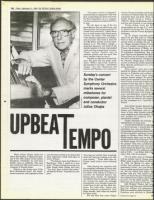
Sunday's concert
by the Center
Symphony Orchestra
marks several
milestones for
E composer, pianist
and conductor
Julius Chajes
lived in Vienna his father and brother
remained in Poland while his mother
commuted back and forth. When thE
family finally moved to Vienna in
1926, Dr. Chajes established a privatE
practice and invested in real estate.
Young Julius wrote his first
string quartet at the age of 11 and at
15 played his Fantasy For Piano and
Orchestra with the Vienna Symphony
Orchestra.
At 16, Chajes attended public
school for the first time in Vienna
Prior to that, his father had engaged
private tutors to educate his son. La.
ter, Chajes attended Vienna Univer
sity and studied conducting at thE
Vienna Conservatory of Music. As I
21-year-old composer, he could boast
20 published compositions. But onE'
year after he was awarded the Honor
Prize of the City of Vienna, in 1933 al
the First International Competition
for Pianists, Chajes gave a farewell
concert at which the world reknownec
Rose Quartet performed two of his
string quartets.
That concert must have beer
painful for Chajes, who left to join his
parents in Palestine and realized at
the time his career plans might
undergo drastic change. His parents
hadn't really wanted to leave their be
loved Vienna. It was only at their son's
insistence that they did so. They had
been so content with the quality of lifE
they had discovered in Vienna, boa
materially and culturally, that the:,
had closed their eyes to the rising and
overt anti-Semitism around them.
Julius, however, did not. He could not
shake from his memory the pogroms
he had witnessed as a 7-year-old ir
Poland.
And Julius' brother Richard had
returned from Vienna University
shaken and frightened, with an ac-
count of how some Jewish students
were roughed up by Nazi soldiers. He
had escaped by jumping from e
second-story window.
Chajes discusses his feelings o1
apprehension in those days:
"I believed that Hitler would corn.
to Vienna because I noticed that thE
population was very anti-Semitic . .
increasingly so and they looked at Hit-
ler like a messiah. I used to go to soccer
games on Sunday where there were
40,000 people there and we had thE
Jewish (soccer) Club and I heard: Wait
till Hitler comes. You will play under
the ground.' This was a professional
soccer club and they were very good,
and of course, the better they were, the
more anti-Semitic the audiences wen.
and so I felt . . . my father didn't feel
what I felt. I felt it in school.
"So we three were in Palestint
and my brother was in Vienna when
Hitler came to power there on March:
12, 1938. On March 15, after my
brother had collected rent from our
apartment house, our non-Jewish
lawyer called up and said to him: 'Tell
me, did you collect rent today?' M3
brother said yes. The lawyer said
`Don't you know the new Nuerenberg
law is that if a Jew collects rent from ?
non-Jew, it's the death penalty. You
better get out as soon as you can.' "
And Richard Chajes, tall with
blond hair and blue eyes, left for Italy
that day without any possessions
Within a month he joined his family in
Palestine and enrolled at Hebre',=1 ,
,
When Julius Chajes raises his
baton this Sunday to signal the open-
ing of the 45th season of the Center
Symphony Orchestra, he will have
double cause to celebrate. This year
also marks his 50th anniversary as a
composer of Jewish music.
Sitting in the living room of his
West Bloomfield home, the white-
haired musician with expressive blue
eyes becomes excited as he shares this
early experience which took place in
Lwow, Poland.
"Too bad my name isn't Mozart or
Beethoven. Then I could be a com-
poser," Chajes remembers saying to an
older friend when Chajes was nine.
"You don't have to have that name,"
advised the friend. "Anybody can corn-
pose."
Your legs are smaller than somebody
else's but that has nothing to do with
your brains.' " From that time on,
Chajes' small stature never bothered
him.
After playing two concertos with
the symphony orchestra of Lwow (also
known as Lemberg and today as Lvov),
his father took Julius to Vienna to
audition for Richard Robert, the
famous piano teacher. So impressed
was Robert that he insisted on taking
the 10-year-old under his tutelage
immediately, even though it meant he
would have to give up two other stu-
dents. Not long after, Julius also
began studying composition with
Hugo Kauder, with whom he studied
for many years.
For the first four years Chajes
:
Continued on Page 14