

14 Friday, July 6, 1984
THE DETROIT JEWISH NEWS
CLOSE-UP
A LYONS' SHARE OF
FAITH
From Front Page
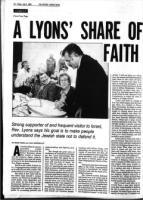
Strong supporter of and frequent visitor to Israel,
Rev. Lyons says his goal is to make people
understand the Jewish state not to defend it.
BY HEIDI PRESS and GARY ROSENBLATT
A
t Jewish affairs he wears a
yarmulke, recites
Hamotzi on bread and the
Birkat Hamazon (grace
after meals) at dinner's
end. He conducts a Seder, visits Is-
rael frequently and, from his pulpit,
is known for his Rosh Hashanah and
Yom Kippur sermons.
But he is not a rabbi. Instead, he
is a Congregationalist minister and,
as he will tell you with a smile, "the
closest thing to a Jew a goy can get."
His name is Jim Lyons and he
has taken upon himself a unique
mission, one which has brought him
much praise, some skepticism and
even worse. As the director of the
Ecumenical Institute for Jewish-
Christian Studies here, he strives to
bring Jews and non-Jews closer to-
gether by promoting goodwill and
.
.
understanding and fighting prej-
udice.
But though his goals seem as
wholesome as motherhood and apple
pie, Rev. Lyons acknowledges that
there are those who oppose his ef-
forts. "I get hostile reaction from both
Jews and non-Jews at times," he
says, "but it's mostly out of ignor-
ance. It's upsetting for some Jews to
think in terms of interfaith dialogue
with Christians, and it's painful for
Christians to confront their own sub-
conscious anti-Semitic feelings. But I
think that if you don't confront these
problems and deal with them, they'll
only get worse, and on the whole the
response has been very supportive."
Lyons deals with the problems
through his basically one-man insti-
tute, giving numerous lectures to
both Jewish and Christian groups,
v,-
meeting with fellow clergy, and
sponsoring and participating in a
variety of inter-faith activities, all
with an enthusiasm and energy that
seems boundless, and in addition to
his duties as interim pastor of the
First Congregational Church of Pon-
tiac.
During an interview in his small
office in the North Congregational
Church in Southfield, he talked
about his work and the status of in-
terfaith relations.
Rev. Lyons is a warm, dedicated
and sincere man of 47 whose work is
motivated in part by his belief that
the Church bears a responsibility for
anti-Semitism and the tragedies that
have resulted for the Jewish people.
He is disturbed that "the same Chris-
tianity that proclaims the God of love
has slaughtered people" in the name
of God. "I will not allow, as a Chris-
tian, the hatred and bitterness that's
been done in the name of Chris-
- tianity to represent my views. I re-
fuse to allow the Crusades or the
Christians of Nazi Germany to be the
ones to define Christianity. I think
Christianity is better than that. I
know it is. And that's part of why I'm
in this kind of work, because I want
Christianity to stand. for what it
really is, a bridge of love."
Lyons' own work is a bridge of
love, one which began some 25 years
ago when, as a student at Wayne
State University, he began to sense
the difference between what he was
taught in Church about Jews and
what was actually true about the
Jews he knew from campus and, ear-
lier, from Detroit's Mumford High
School, which had a large Jewish
student population at the time. "The
Church teaches a certain contempt
for Judaism, but it's very subtle and
not overt. In the hymns, in the refer-
ences to the death of Jesus. But it's
not a living Judaism they're talking
about, it's a dead Judaism, one that
probably never existed."
Lyons said he came away.with a
general feeling "that Jews are hard-
hearted, tricky and don't understand
their own Scriptures because they re-
jected Jesus. Then when you meet
them in school and play ball with
them and interact with them, they
become human beings like everyone
else — good, bad and indifferent."
Lyons was president of the
Council of Religious Organizations
while a student at WSU and he came
into contact with many Jewish ac-
tivists. He was also deeply influenced
by a teacher who was a Holocaust
survivor. After graduating from
WSU, Lyons studied for the clergy at
the Southern Baptist Seminary in
Louisville, Ky., where he found that
what he was being taught about the
Jewish people was inaccurate.
But it wasn't until after he re-
covered from a near fatal diabetic
coma that Lyons decided to dedicate
his life in some way to service of
mankind. He didn't know quite how
exactly, he says, but "I wanted to do