

72 Friday, September 30, 1983
THE DETROIT JEWISH NEWS
Menahem Begin's Resignation Ends an Historic Era
By VICTOR BIENSTOCK
As fate would have it, it
was a youthful civil servant,
Dan Meridor, the prime
minister's spokesman
whose face has become
familiar to Israelis from
countless television news-
casts, who delivered the
message to President
Chaim Herzog that marked
the end of an era in Zionist
and Israeli history.
The day of the charisma-
tic great in the Zionist
movement comes to an end
as Menahem Begin leaves
the prime minister's office
and fades into history.
Begin was the last in a rare
series of passionate, dedi-
cated men with the power to
strike fire in the hearts of
the Jewish people and to
kindle the Zionist fervor
without which Israel would
never have been born and
without which Israel could
not have survived all these
critical years.
Herzl, a magnetic per-
sonality with his dreams
and unquenchable hopes;
Weizmann, the - scientist-
statesman who prevailed on
the British government to
promise a Jewish National
Home in Palestine;
Jabotinsky, the poet,
dreamer and activist who
held steadfast to the concept
of a Jewish state in all of
Palestine and who refused
to compromise that ideal;
Ben-Gurion, the orator who
could galvanize the masses,
the politician who could win
over the wealthy skeptics
and the realist who seized
the moment to proclaim
Jewish statehood; Golda
Meir, whose overriding in-
terest and concern was the
well-being of the Jewish
people everywhere; and Be-
gin, disciple of Jabotinsky,
utterly dedicated to fulfill-
ment of the biblical promise
of a reborn Jewish state oc-
cupying all of the Holy
Land.
These were the leaders
in the era of greatness
which ended with Begin's
resignation.
Weizmann, with all his
human frailties, was one of
the handful of men I met in
50 years of journalism who
wore the aura of greatness.
Jabotinsky I loved as a
warm and friendly human
being although I could
never reconcile myself to his
politics and to some of his
associates.
Golda Meir was a nation's
mother, a womah who could
be warm and friendly and
loving and yet be ruthless
and as hard as steel. I ad-
mired her greatly in those
World War II days when she
had to battle the Mandate
Government for everything
the Yishuv needed — even
tires for the Egged busses.
I could never establish a
personal. relationship with
Ben-Gurion. I met him for
the first- time in 1943 when,
as a war correspondent in
U.S. Army uniform, I vis-
ited him in his apartment in
Tel Aviv. He immediately
upbraided me for being in a
U.S. Army unform instead
of being a soldier in the
Hagana.
Over the years in which I
covered his activities, I
found him dictatorial, into-
lerant of criticism and al-
most savage in his treat-
ment of his political oppo-
nents.
Compared to the cos-
mopolitan Weizmann,
who walked in the cor-
ridors of the great with
assurance and aplomb,
Ben-Gurion always
struck me as provincial,
operating comfortably
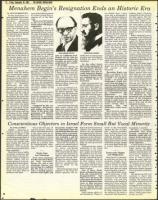
MENAHEM BEGIN
• THEODOR HERZL
only on a different level.
Despite all the time he
had spent in America, for
example, he never really
understood the country
or the people.
At our first meeting, he
harangued me about "the
pogrom in Boston" (of which
I knew nothing) and ad-
monished me to remember
that "the day will come
when you American Jews
will get on your knees and
thank God there is a Jewish
National Home where you
can take eefuge."
As soon as I left him, I ca-
bled my office to ask about
the Boston pogroms. The
answer was: the usual gang
fights in Scollay Square.
Reuters had apparently put
a racial connotation on the
street gangs' frequent fights
for control of the turf.
scribes him as having been
arrogant and self-centered,
disliked by most of his
classmates.
L never had more than the
most cursory contact with
Begin and cannot speak of
him from firsthand know-
ledge. But there is a man in
Florida, a former Israeli en-
gineer who went to school
with him in Poland, who de-
On the other hand,
there is the experience of
my old friend, Richard
Scott Mowrer, a war cor-
respondent who was se-
verely injured in Begin"s
bombing of. British milit-
ary headquarters in the
King David Hotel in
Jerusalem.
Begin, he recounted in an
article published some 30
years later when Begin be-
came prime minister, sent
emissaries to the hospital to
make certain that he was
comfortable and had every-
thing he wanted. When
Dick was released from the
hospital, Begin, then in hid-
ing with a reward on his
head, risked exposure to
have Dick escorted to his
hideaway so that he could
make his apologies person-
ally. Dick was impressed by
his Old World courtliness.
I always regarded Begin
as something of an anomaly
in the heated atmosphere of
the Middle East. I have holding today's Germany
never seen a photograph of responsible for the crimes of
him at a Knesset session or the Nazi regime. The Ger-
public meeting at which he man press has even specu-
was not fully attired, jacket lated that Begin's an-
and all, when the accepted nouncement of his resigna-
attire was an open-neck tion came when it did, on
shirt. Even the impeccable the eve of Chancellor Hel-
diplomat, Abba Eban, cast mut Kohl's scheduled visit
off his jacket and necktie to Israel, so that Begin
when he took to the hust- would not have to welcome
ings for the first time to Kohl.
Kohl's scheduled arrival,
campaign for a Knesset
seat. Begin adhered to a according to the Zeitung of
European code of courtli- Stuttgart, "was not the real
reason for Begin's leaving
ness. now almost obsolete.
office but it probably had an
Begin took office after emotional influence on the
nearly .30 years of Labor timing. Begin who for a long
Party rule during which . time has been an implaca-
young hopes, idealism, ble enemy of things German
energy and drive were for all the well-known
gradually overcome by reasons which have their
stagnation and bureauc- roots in his personal fate, is
racy. His accession to power incapable of drawing a line
marked the first shift in the under the darkest chapter of
upper levels of government German history."
since statehood. His milit-
History will judge Begin
ant course galvanized a and
appraise his contribu-
people out of its lethargy tions, the greatest of which
and created a new
was probably the estab-
dynamism.
lishment of peace with
Menahem Begin was Egypt, against what may
truly a product of the have been his most tragic
Holocaust and he never error, the failure to control
escaped — or wanted to Gen. Ariel Sharon and limit
escape — its bonds. His the invasion of Lebanon last
biographer, Frank Ger-• year to its original an-
vasi, wrote that Begin re- nounced goal, the line 40
fused to speak Polish be- kilometers north of the in-
cause he remembered the ternational boundary.
Polish ghetto and refused
Begin leaves office by
to speak German because all accounts a very sick
he remembered the and dispirited man,
Holocaust. The overwhelmed by the
Holocaust was his most enormous cost in Israeli
powerful motivation in lives of the Lebanese
trying to make Israel an campaign and unable to
invulnerable fortress to see a way out of the
make certain that a Lebanese morass.
tragedy like the
His one consolation is
Holocaust could never that his efforts to settle the
recur.
West Bank have proceeded
Many Germans, recalling so far that they can never be
Begin's savage attacks on undone and that a good part
former Chancellor Helmut of the West Bank, if not all
Schmidt, believe that Begin of it, will remain forever a
was never able to cease part of Israel.
Conscientious Objectors in Israel Form Small But Vocal Minority
By CARL ALPERT
One of the first was 19-
HAIFA — Small but ar- year-old Amnon Zichroni
ticulate groups in Israel who in 1954 refused to serve
continue to object to the in the army since he ob-
campaign in Lebanon and to jected to the "very existence
continued presence there of of the institution of armies
Israeli soldiers. Protest vig- in Israel and the world as a
ils have for months been whole." He was sentenced to
held outside the home of prison by a military court
Menahem Begin or at the for insubordination, deser-
Knesset, and occasional tion and refusal to carry
public demonstrations have arms.
been organized.
* * *
Since Jews have a highly
Davis
Case
developed conscience and
was
Notorious
moral sense, and are fre-
quently found as leaders in
Even more notorious
liberal, leftist, and ex- was the case of Uri Davis,
tremist groups, it is not sur- not long thereafter.
prising that we have the ex- Davis, too, was a con-
tremists here as well. In- scientious objector, and
deed, they are not new, and served time in a military
the previous Labor govern- jail. He went on to be-
ments had their share of come a leading spokes-
problems with them.
man for Arab rights, and
0
frequently tangled with
the authorities when his
activities led him into vio-
lations of law or security.
By 1970, his pacifist prog-
ram included a call for
sabotage of Israel's rail-
ways and military plants.
Davis left the country to
take up an academic post in
London, where he served as
an active anti-Israeli
agitator. In the spring of
1979, interviewed on radio,
he stated that Israel had no
right to exist and that its
government was not "like"
Nazism, but actual Nazism.
He foresaw, with evident
pleasure, a prospective de-
feat of Israel on the
battlefield.
Most of the present crop of
objectors to the Peace for
Galilee operation who re-
fuse to do military service in
Lebanon are undoubtedly
sincere, but the situation
was aggravated by the alac-
rity with which the political
opposition to the Likud gov-
ernment seized upon the re-
fusals and exploited them to
whip up anti-governemt
feelings.
Communications media,
unfriendly to the Likud
government in any event,
gave ample and encourag-
ing publicity to every man-
ifestation of the anti-war
feelings. Something like 90
Israeli civilians, called up
for their military reserve
duty, have refused to serve
in Lebanon and have been
sentenced to various short
terms in prison.
One of them, Shuki
Kook, writing to the press
from jail, expressed his
disappointment that
there were not more. He
called upon all who felt as
he did to implement their
views in their personal
lives so that he would not
get the feeling that his
own sacrifice was a waste
of time.
Small groups which cal-
led themselves "There's a
Limit" or the "Committee
Against the War in Leba-
non," drawing members
from the Peace Now move-
ment, found frequent new
publicity gimmicks to ex-
press their hostility to the
Likud government, but few
indeed felt 'strongly enough
to do what Shuki Kook did,
or Amnon Zichroni in his
day.
* * *
Democratic Rights
and Obligations
Since Israel is a democra-
tic state they are free to de-
monstrate, though any at-
tempt to keep them within
normal bounds of public
order is at once met with
howls that they are being
denied freedom of speech.
It was Mark Gefen, an ac-
cepted spokesman of left-
wing Zionism, when com-
menting on the Uri Davis
situation, who said that
those who cry for freedom of
speech don't know what the
word freedom means. There
is not such thing as absolute
freedom; there must always
be some restrictions when
the welfare of the whole is
concerned. The alternative,
he implied, is anarchy.
Of late, a contrary
movement has been
formed, consisting of
patriotic youth who vol-
unteer, in the nation's in-
terest, to serve in Leba-
non if necessary in place
of the objectors.
A recent issue of Yachad,
journal of the kibutz move-
ment, quotes one Mike
Jaffe, a 31-year-old kibutz
member who had been cal-
led up for his military re-
serve duty. "Refusal to
serve as ordered under-
mines the army which as-
sures our survival," he said.
"If I refuse to serve in Leba-
non, I abrogate my right to
fight for my views in a
democratic fashion because
I have excluded myself from
society."
The opponents of the war
continue to object that
though they may be a small
minority, the majority has
no right to impose its will on
them — which leads to a
strange definition of democ-
racy! There is no doubt that
the vast majority of the pub-
lic in Israel disavows the ob-
jectors, looking upon them,
at best, as naive.