

N Friday, March 25, 1983
THE DEW TEIMSH NEWS
Matza: Bread of Affliction and the Bread of Freedom
By IRVING GREENBERG
Director, National
Jewish Resource Center
The traditional Seder
opens with the host pointing
to the matzot and reciting
the ancient formula: "This
is the bread of affliction
(slavery) which our ances-
tors ate in the land of Egypt
. . ." This tradition is based
on the Biblical verse
(Deuteronomy 16:3) ".
Seven days you shall eat it
with matza, the bread of
affliction . . . in order that
you remember the day you
left Egypt all the days of
your life."
In this view, the hard
matzot, made only of water
and flour, with no shorten-
ing or yeast or enriching
products, are eaten to re-
mind Jews of the hard crust
and meager food given to
the Hebrew slaves in Egypt
by their exploiting masters.
Like the bitter herb which is
eaten at the Seder, the
matza represents the de-
gradation and suffering of
the Israelites.
There is another tradition
about matza. This second
view is cited in the Haggada
when the three central
ritual symbols of Passover
— the Paschal sacrifice, the
matzot and the bitter herb
affliction or the bread of
freedom?
The answer is that matza
is both. It is not surprising
for ex-slaves to invert the
very symbols of slavery.
Thus, they express their re-
jection of the master's val-
ues and their new inner
self-affirmation. In the late
1960s, black nationalists
deliberately used the term
"nigger" as an in-group
term in defiant reversal of
racists' use of the term as an
epithet of degradation. Afro
hairdos were reclaimed as a
statement of identification
DR. IRVING GREENBERG
— are displayed. To quote with African forebears in-
the account in Exodus stead of with the master
(12:39) "and they baked un- with light skin and straight
leavened cakes of the dough hair.
which they took out of Similarly, later Jewish
Egypt. The dough was not tradition interpreted the
leavened for they were has- Hebrews' Paschal lamb sac-
tily driven out of Egypt and rifice in Egypt as deliberate
would not delay and yet slaughter of an animal wor-
they had no food prepared shipped by Egyptians to ex-
for themselves." press the casting off of the
In this view, eating masters' values. Adopting
matza re-enacts the Is- the slave bread as the food of
raelites' eating the bread freedom is consistent with
of the Exodus, the bread the intentional repudiation
which Jews baked to go of the old slavery norms.
into freedom. This is a
There is yet a deeper
surprising, almost con- meaning in the double-
tradictory account of the edged symbolism of matza.
matza symbol. What is The basic change from slay-
matza — the bread of ery to freedom is not that
slaves endure hard condi-
tions while free people enjoy
ease. The bread remained
equally hard in both states,
but the psychology of the Is-
raelites shifted totally.
When the hard crust
eaten by the Jews was
given to them by tyranni-
cal masters who disposed
of them as they willed
and the Jews accepted it
passively, then under
those conditions the
matza they ate was the
bread of slavery. Eating
matza was a sign of
gradation.
When the Jews willingly
went from green fertile de-
ltas into the desert because
they were determined to be
free, when the Jews ate
hard bread rather than stay
one more day in servitude,
then the hard crust itself
became the bread of free-
dom.
Out of fear and irrespon-
sibility, the slave accommo-
dates to ill treatment. Out of
dignity and determination
to be responsible for his own
life, the free man will
shoulder any burden or
endure any suffering to pro-
vide for his family and to
stay free. Enduring such
hardship is the essence of
freedom.
A number of scholars
have recently argued that
Zionism has failed because
it has not cured the problem
of anti-Semitism; rather,
the state of Israel itself is
the object of hatred and ob-
loquy at the United Nations
and all over the world.
These scholars fail to
understand the achieve-
ment of Zionism — and the
message of the matza.
The test of freedom is
not that troubles end.
When Jews were totally
dependent on the suffer-
ance of others, they
endured anti-Semitic
hatred. Out of an ethic of
powerlessness, they took
mistreatment to be their
inescapable fate and they
accepted whatever
cruelty their oppressors
meted out. Their suffer-
ing only deepened the
Jews' subjection while it
strengthened their
enemies.
Today, Israel and Jews
who back it have taken re-
sponsibility for Jewish de-
stiny. Then the slings and
arrows of outrageous
enemies are the hard condi-
tions we willingly buck as
we build our strength and
the capability to be masters
of our own fate. The French
and British arms boycotts
led Israel to build a strong
defense industry. The
gratuitous worldwide
hatred has only
strengthened the bond be-
tween Diaspora Jews and
Israel.
Running scared and dis-
tancing from Israel in times
of criticism or unpopular
wars is the sign of the per-
sistence of slave mentality.
The response of greater
political effort and in-
creased philanthropy in
America, even as the brav-
ing of the risks of war and
threats of genocide in Israel,
are the most eloquent proofs
that Jews have chosen free-
dom over dependency.
True, there is no guaran-
tee of ultimate success in
this process. Many would
accept slavery/dependency
in return for security. But
the bones of the slaves
bleach in the desert sands
and their bodies fertilize the
masters' soil. Every
Passover when Jews eat
matza, Jews testify that a
free people will pay every
price, will persist through
hardship and will reach the
Promised Land.
The Passover Haggada Has a History of Its Own
the Haggada into an illus-
trated and illuminated
JERUSALEM — Next to manuscript was possible
the Bible, more copies of the because it was not bound
Haggada are produced than by any religious restric-
of any other Jewish book. tions. The beginning of
Printed or handwritten in Haggada illustrations
practically every language can be dated back to the
spoken by Jews, it has be- beginning of the 14th
come a unique volume in Century and resulted in
world literature.
the creation of a new
The basic text of the Hag- form of Jewish pictorial
gada, as we know it today, art.
was formulated by Rabban
There are two types of
Gamliel in the Second Cen- medieval illustrated Hag-
tury CE. The first complete gada manuscripts — the
text is found in the 10th Sephardi or Spanish version
Century Siddur (prayer-. and its Ashkenazi or
book) of Saadia Gaon. As its Franco-German counter-
recitation became an in- part. Those coming from
tegral part of the Seder in Italy display some of the
the home, it was felt that it characteristics of both
should be separated from schools.
the Siddur, and became a
The earliest surviving il-
book on its own.
luminated Ashkenazi Hag-
To be used properly, it gada is the Birds' Head
was essential that the Hag- Haggada in the Israel
gada be not only read but Museum. Produced around
understood. Translations of 1300, it substitutes birds'
the Hebrew text into the heads for the human face,
various languages of the thus circumventing the
Diaspora began to appear prohibition of the Second
very early, so that Jews in Commandment. All the fig-
every country could follow ures wear the famous
however was conducting the medieval "Jews' hat," so
Seder ritual. But it was sev- even those who could not
eral hundred years before read could not mistake their
illustrations were added, identity.
not only as an art form, but
The second great revolu-
also to engage the interest tion in the production of the
of the old and the young Haggada came with the in-
around the table.
vention of printing in the
The transformation of middle of the 15th Century.
By DAVID GEFFEN
World Zionist Press Service
What is believed to be the
first printed Haggada was
produced in the Spanish city
of Guadalajara in 1482.
This is a rather modest
Haggada containing no
illustrations or decorative
initial letters.
More than 3,000 differ-
ent versions of the Hag-
gada have been pro-
duced in various parts of
the world over the cen-
turies. One of the most in-
teresting is the 17th-18th
Century Chinese manu-
script of the Jewish
community of Kai-
Feng-Fu. The text in-
cludes instructions in
Parsee written in He-
brew characters, which
indicates that the Jews of
China derived their reli-
gious teachings from
Persia. Written with a
reed pen on rice paper,
the letters have a some-
what Chinese look.
A Haggada was produced
for the Indian Bene Israel
community in Bombay in
1846. It is in the local lan-
guage, M-ahriti, with the
Hebrew text alongside. A
second edition printed in
Poona 28 years later has
illustrations showing
women in typical Indian
dress baking matza in
specific shapes for the three
matzot used in the Seder.
IstAtbitt;..
transmitting their own
ideas. Best known in this
category are the Hag-
gadot produced by the
kibutzim. There, an effort
was made to formulate a
Haggada which would
express the striving and
yearnings of the Halut-
zim. Hundreds of these
Haggadot have ap-
peared, and through
them one can better
understand the history
and outlook of the var-
* * itik imocOmit
1 01 1
ious
kibutz movements.
/
milf
' 1 4ilt‘ alb
In the United States in
4
I
recent years, the struggle
A6ceR WIKtviiifbak %vewslowItik
1
A fl
for equal rights by all op-
pressed groups reflected it-
kAreskiliAmlimikkert* 721 6100! "N484/,
self in a Freedom Haggada
N 4NA
produced by Arthur Was-
104 00#44040
kow. Originally it appeared
tot
- •
in Ramparts magazine and
was later produced as a
separate text, founded on
concepts of peace, freedom
and equality.
A very meaningful Hag-
gada reflecting the struggle
of Soviet Jewry was pro-
duced in the 1970s by Mark
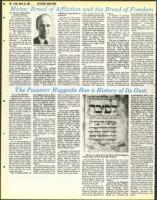
Shown is a page from the Birds' Head Haggada, Podwal, with the Russian
commisars in place of the of-
which dates back to the 13th Century.
ficials of Pharaoh's Egypt.
During World War II, the initiative of a local Moreover, Jewish feminists
even the Nazis showed re- school principal. A German have produced a Haggada of
spect for one of the greatest officer was sent to Sarajevo their own in the U.S.
medieval gems of Jewish to pick up the Haggada from
The Haggada then, is a
art, the Darmstadt Hag- the school, in which it was book which permits each
gada produced in the 15th housed. The principal had a individual Jew to add his
Century in southern . Ger- quick copy made and hid the own interpretation to it. It is
many. They kept it hidden original in a nearby cave, never really complete be-
in the Offenbach Leather where it lay until the end of cause its theme, oppression
Museum so that it did not the war. It was then placed and tyranny, still exists.
share the fate of thousands in the Bosnian National When persecution forever
of other Hebrew books and Museum.
ceases, when every trace of
manuscripts, which were
Because the Haggada bondage disappears, when
burned or destroyed.
stresses the idea of free- right rules over might, then
Another precious trea- dom and the liberation perhaps the ideas of the
sure, the Sarajevo Haggada, from bondage, many Haggada will reach frui-
one of the best known different groups have tion. That really is what the
Sephardi Haggada manu- utilized its format and Haggada, perhaps our
scripts of the 14th Century, that of the Seder service greatest Jewish book, is all
was saved for posterity by itself as a means for about.