

64 Friday, October 20, 1918
THE DETROIT JEWISH NEWS
A Biographical Tribute to Dr. Max Nordau
(Editor's note: This ar-
ticle continues the biog-
raphy of Zionist leader
Max Nordau. It is written
by his daughter, Maxa,
and began in the Oct. 13
Jewish News.)
By MAXA NORDAU
In 1893, he spent some
time with German friends
in a summer resort on the
island of Borkum in North-
ern Germany. For the first
time, he heard anti-Semitic
remarks. He found at his
place at the table in the
hotel dining-room insulting
messages and even threats.
These did not frighten him,
but the whole atmosphere
disgusted him.
His mind began to
change.
Soon after, the hideous
wave of pogroms, blood
libels and attacks against
Jews swept Europe and fi-
nally, there was the Dreyfus
Case, where France was
split into two camps which
drove her to the brink of
civil war — those who be-
lieved in Captain Alfred
Dreyfus's innocence and
those who were persuaded
of his guilt of high treason
because he was a Jew.
Latent anti-Semitism
broke out into open day-
light. If even in France Jews
and their non-Jewish de-
fenders, like Zola, could be a
prey to such persecutions,
some remedy had to be
found.
Suddenly, Max Nor-
dau, the European, be-
came fully conscious of
his Jewishness, proud of
his kinship, ready to sup-
port the people which he
recognized as his own.
He became interested in
_ Baron de Rothschild's first
settlements scheme, in the
beginning of the Bilu
movement in Palestine, in
the Argentinian experi-
ments of Baron de Hirsch.
Yet he understood that none
of those projects, however
humanitarian and idealis-
tic, was the solution of the
problem. Something else
had to be done!
It was at that time that
Theodore Herzl felt his own
revival of Jewish feeling.
Herzl was the Paris corre-
spondent of the Neue Freie
Presse of Vienna.
He had written plays and
essays and was a highly cul-
tured and appreciated
writer, assimilated to all
that was European in spirit
and in tradition; but when
the Jews, after nearly a cen-
tury of emancipation were
again a target of the most
hideous anti-Semitism, ac-
companied by mass-
murders in Russia, his soul
arose and he knew that he
had been chosen to lead his
people to redemption.
He approached those
who were the "great
Jews." They mocked or
pitied him. In 1895, he
wrote his immortal book
"The Jewish State" and
was considered by his
best friends as almost a
madman.
Max Nordau was at the
time correspondent of the
Vossische Zeitung of Berlin
and had met Herzl on sev-
eral journalistic occasions.
He had appreciated him but
they had never discussed
the Jewish question.
Herzl, practically driven
to despair by the lack of
understanding he met
everywhere, had finally
opened his heart to a friend
of his, a journalist by the
name of Schiff, who kindly
and pitifully advised him to
visit Nordau.
He did not mean Max
Nordau the Jew, but the
psychiatrist! Herzl took the
hint.
For three days he went
to see Nordau, read him
his book, explained his
project. Not only did
Nordau listen to him, but
he became more and
more enthralled and,
when Herzl had finished,
he rose, took him in his
arms with tears in his
eyes and said: "I am your
man! If you are insane,
we are both insane."
From that day Zionism
was born.
Herzl was the inventor,
Max Nordau- with his ex-
perience and his knowledge
of world politics, his insight
into human psychology,
seconded him with all his
might. Herzl alone could
never have attained recog-
nition, had Nordau not
thrown into the balance his
world fame, the power of his
words to which men were
accustomed to listen.
Herzl was known only in
literary circles and had not
been taken seriously as a
political man; when Nordau
supported him, the world
began to consider the new
idea and to attribute to it
importance. Herzl and Nor-
dau complemented each
other and -it is their conju-
gated effort that alone could
bring the first success.
Max Nordau was per-
fectly aware of the mag-
nitude of the task and of the
sacrifices it entailed. The
fact that he was returning
to his people would seem to
the world a total break with
all his past work. It would
shake his position to its
foundations and be used by
his enemies as a weapon to
drive him out of the circle of
the world's thinkers.
It would turn him in the
eyes of all into the cham-
pion of a single cause in-
stead of universal justice.
He did not waver for an
instant. His duty seemed
clear to him and the cost not
too high. So, with Herzl's
genius, it became Nordau's
part to find the formulas
which were suited to the
realities of life.
Moreover, Max Nordau
was an exceptionally great
orator. His ideas were clear
and powerfully expressed.
He found master-words and
had irony too and could
strike hard. The language of
his most intimate thought
was German, but he could
deliver speeches in French,
English and Spanish, which
made him the authentic
voice of all Israel.
Besides, he knew the
Jewish mentality better
than Herzl, having grown
up in an Orthodox home and
in a surrounding of poor
people. He felt that the na-
tional movement, difficult
enough by its greatness and
its novelty, would be ren-
dered more so by the lack of
political education of the
Eastern European masses,
who. were most in need of
redemption, and, as 4 physi-
cian, he was aware of the
necessity of physical de-
velopment as the necessary
foundation for the freedom
of spirit.
This, together with the
indifference or even hos-
tility of the assimilated
Western Jews, made the
Zionist endeavors a
heavier burden than
perhaps he could bear,
but nothing could deter
him from seconding
Herzl, as the first and
most efficient.
In spite of the opposition
of the "Germans of the
Mosaic persuasion" and the
French Jews freed by the
Revolution who were over-
zealous to show their pa-
triotism, the first adherents
to Zionism appeared in the
West. -
Max Nordau having gone
to London for the publica-
tion of both "The Conven-
tional Lies" and "Degenera-
tion;" had met Israel
Zangwill at publisher
William Heineman's house.
Zangwill, who later became
a "territorialist," was soon,
won over to Zionism.
There was already a
sports club of the "Maccab-
bees" who, with the
"Kadima" of Vienna, had
called themselves Zionists
before the rise of political
Zionism. The term Zionism
was created by Nathan
Birnbaum, a member of
Kadima.
They were, of course,
among the first adhe-
rents and answered Nor-
dau's desire for that
transformation of the
Jews, for which he
coined the word "the
Judaism of the muscle."
Some action had to be
taken. Herzl had the idea of
calling a meeting of Jewish
notables or, if not, of
enthusiastic students who
wished for a Jewish ideal.
Nordau was convinced that
this would be a failure. He
conceived the revolutionary
idea to which he persuaded
Herzl of a worldwide Jewish
congress which would
gather together the great
masses of Judaism.
Nordau set to work im-
mediately and his voice was
heard. Zangwill was of
great assistance in convinc-
ing the Jews of Britain.
Herzl had gone to him with
a letter from Nordau, which
spurred him to do his ut-
most.
In Paris, the socialist
Bernard Lazare. was one of
the first French adherents.
He later dropped the move-
ment for a futile motive.
With Herzl's prophetic
impulse and Nordau's
solid knowledge of men,
the first Zionist Congress
was opened at Basel in
August 1897, with Swit-
zerlind's hospitable wel-
come. A new era had ari-
sen in Jewish fate.
At this Congress, the
"Basel Program," which
remains as the basis of polit-
ical Zionism, was formu-
lated. Max Nordau created
the term "Jewish National
Home" to which Herzl
added "legally guaranteed."
The Actions Committee
was established. Max Nor-
dau had no seat on it. He
never accepted any official
Zionist office, wishing to
preserve his complete inde-
pendence.
The Congress was
presided over by Herzl.
Nordau delivered the
speech which described the
exact situation of Judaism
and he concluded: "That.
Jewish distress cries for
help. To find that help will
be the great work of this
Congress."
The Second Zionist
Congress was called the
following year and a
great part of the dis-
cussions ran on the
Dreyfus Case. Herzl's
great aim, towards which
Nordau helped him, was
the "conquest of the
communities." It was also
the beginning of the crea-
fion of the National Bank.
Some leading figures
started playing a part in the
movement, like Menahem
Ussishkin, Dr.
Bodenheimer, Ben Yehuda,
the reviver of the Hebrew
language, who obtained at
once the full support of Nor-
dau.
In Paris as well as at the
Congresses, Dr. Alexander
Marmorek, his brother Os-
car, Miss Myriam Schach,
were in the first row of the
workers for the Cause. So
was Nahum Slousch, the
scholar who had discovered
forgotten Jewish com-
munities in Morocco.
At both Congresses, Nor-
dau had had the opportu-
nity of meeting and ap-
preciating a number of
people: Dr. Mandelstamm of
Moscow, Reuben Brainin,
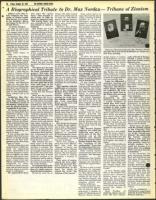
Tribune of Zionism
Pictures of Zionist leaders Dr. Max Nordau, left, Dr.
Theodor Herzl and David Wolffsohn are shown on a
New Year greeting.
Joseph Cowen of London,
David Wolffsohn, who later
was Herzl's successor at the
presidency of the Zionist
Organization, Dr. York-
Steiner, Dr. Alcalay of Bel-
grade, and others.
In the following January,
Max Nordau was called to
Vienna, where, to a crowded
hall, he delivered a speech
in which he stigmatized the
rich and cowardly Jews.
Later, he addressed a
students' meeting and
gave the famous lecture:
"Spartans and Helots,"
which deeply hnpressed
his audience. He com-
pared the timid Jews to
the Helots, that race kept
in bondage and
humiliated by the
Spartans, who gave them
a yearly banquet in
which they were repul-
sively drunk as an ugly
example to deter young
Spartans from that vice.
Nordau supposed that the
Helots might have enjoyed
their shame and thought
they played a good joke on
their oppressors. He shud-
dered at the idea and
finished: "Zionists are not
Helots. They are Spartans
. . . Goethe found no nobler
epitaph for any man than
this:
"For he was a man indeed
And that means a fighter"
"How he would be able to
praise the modern Jew, the
Zionist! For to be a Zionist is
to be doubly, nay trebly, a
fighter."
Later, in Berlin, before an
audience of German Jews
who scorned and feared
Zionism, he warned that
some day they would them-
selves have to drop their
pride and in need and pain
seek refuge in that same
land of which they shunned
the very idea. He was unfor-
tunately right: Hitler and
the Second World War
threw a ghastly light on his
thought.
In Paris, Nordau spoke
often at the People's Uni-
versity and a nucleus of
Zionists began to take
shape. He also went to
Amsterdam. Jacobus Kann
had long been a faithful
adherent and with his help,
many Dutch Jews gathered
around the banner of
Zionism.
Jean Fischer of
Antwerp, whose son was
later the first ambas-
sador of Israel to France,
formed a group of Bel-
gian Jews, whose central
figure he was.
At the Third Congress in
Basel in 1899, the great
question was the attacks of
the but too famous "Protest
Rabbis" in Germany, whose
fury was unleashed against
the national movement
which they feared would
deprive them of what they
believed were their
privileges in the country of
their birth. Nordau had to
fight them.
The Fourth Congress met
in London, which offered a
chance to get in closer con-
tact with British Jews and
some statesmen.
The Fifth Congress was
that of the creation of the
Jewish National Fund. Un-
fortunately, its initiator,
Prof. Hermann Schapira,
was no longer there to see
the realization of his vast
project. Nordau's support
certainly swung the Con-
gress to adopt it. Until the
end, Nordau was a faithful
friend of the Keren
Kayemet, of whose neces-
sity he was persuaded and
whose aims he shared.
Every year, he deliv-
ered the opening speech
at the Congress. This
time, he spoke of the mis-
ery of the "Jewish pro-
letariat." He ended with
the famous remark:
"Many -a Jew, who has
miraculously attained a
high position, must in-
wardly confess: 'As I
could not become a la-
borer, there was nothing
left for me but to become
a statesman.' "
In the meantime,• the
great controversy between
Herzl and Ahad Ha'am had
taken place. Ha'am refused
any political scope and
wanted exclusively a
spiritual gathering
rael. These two ideals
c
have complemented each
other — in fact, they did.
But when Herzl wrote and
published his novel "Alt-
Neuland," (The Old - New
Land), Ahad Ha'am's at-
tacks became personal and
insulting. Nordau defended
his friend and leader; the
discussion became hard and
violent.
(To be continued ...
Published in cooperation
with the Jewish National
Fund of America.)