

64 Friday, December 16, 1977 THE DETROIT JEWISH NEWS
'Eban,' History-Viewing Autobiography of Israeli Leader
Abba Eban, diplomat,
linguist, orator par excel-
lence;defender of his people
in all areas of the globe, is
as much historian as he is
superb in all the other des-
ignated roles as one of
world Jewry's most distin-
guished personalities.
What a gift to the literary
world that he should have
written his own story, in
"Abba Eban — An Auto-
biography (Random
House).
AE — as the title cover
.appropriately designates his
book — leaves nothing to
the imagination. He
describes his youth from his
birth in South Africa, his
life in London where his
mother who had been wid-
owed raised him and the
other children under the
adopted name of their step-
father Eban.
The scholarly achieve-
ments by the man who was
to rise to the highest ranks
in diplomacy become evi-
dent in the statesman's
elections.
At Cambridge he attained
high scholastic recognition,
in his oriental studies which
resulted in his mastering
Arabic and Hebrew in addi-
tion to the European lan-
guages. He would have
had a great academic
career but he gave that up
for politics.
His family's deep Zionist
devotions, his meetings with
Chaim Weizmann and other
noted Jewish leaders, led
him to a career in Jewish
ranks and his eventual asso-
ciation with the Zionist and
Palestinian involvements,
all leading up to the lead-
ership in behalf of Israel's
foreign affairs.
This is part of the story he
relates, and out of it grows
the immensity of his efforts
from Israel's very begin-
nings, the vote on partition,
the seating of Israel among
the nations of the world at
the United Nations, the
debates in which he mas-
tered leadership as a pro-
tector of Isreafi and Jewish
rights.
It is as an interpretive
work that the AE volume
becomes very significant
historically. - The comments
an various matters, on
American-Israel relations,
on the Arabs, on the Soviet
Union — all are echoes of
his participation in the
affairs of the world.
Because he had met with,
conferred with and had
important direct negotia-
tions with the diplomats of
all the countries in the free
world, Eban's evaluations
of many of them are of
unusual impressiveness.
-
Similarly, his comments on
the attitudes of the many
governments represented in
the United Nations ate valu-
able to the reader of AE and
for historians. His com-
ments on Israel-U.S. rela-
tions have special signifi-
cance. He states:
"There is nothing in mod-
ern international relations
quite like the American-
Israeli relationship. What
makes it incongruous at
first sight is the immense
disparity between the size
and power of the partners.
But this is outweighed by a
deep harmony of values,
memories, spiritual affi-
nities and democratic
loyalties.
"The two nations share a
common belief in the crea-
tive power of a free society.
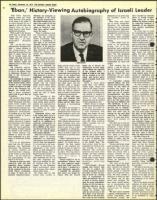
ABBA EBAN
And yet a hypochondriac
fear of an imminent col- Begin and his review of the
States not to discuss the
lapse in American-Israeli
transference of -such equip-
events that led to the
relations follows Israelis
ment without the approval
triumph of the Likud Party
across all the years. When
of the original donor. I
is like a confessional of
they see the immensity Of events that were marked by
hoped at least to win time
Arab resources in territory,
but he seemed to be irri-
errors in the Rabin-Peres
population, multiplicity of ranks and therefore also
tated, and Israel never
states; mineral and mone-
heard a friendly word from
his. He does go into details
tary wealth, Israelis often
him again."
of the political changes that
There is much about
wonder why the United
had taken place and AE
Golda Meir, Levi Eshkol,
States should bother about
therefore adds a chapter
Pinhas Sapir, Dayan and
them at all. I have heard that will be utilized by stu-
others in AE. Sapir's domin-
my own countrymen say,
dents of events in this era
ance is a revealing state-
`In America's position, we
when the internal political
ment. Dayan's role has spe-
would not care if Israel
issue in Israel is researched
cial interest in relation to
lived or died.'
for historical retainment.
administered territories.
"The paradox is that
AE is filled with anec-
Some of the Dayan
dOtes and incidents that
Americans rarely say this.
approaches may be clarified
In the United States, despite
make history stranger than
by this explanatory note:
some doubts about Israel's
fiction and the Eban story
"Moshe Dayan no longer
policies and especially her
becomes a fascinating
talked, as he sometimes had
present territorial status,
document .
in the past, of a need to
the validity of the com-
He referS, for example to
give up a lot of territory' for
mitment to Israel is almost
Idi Amin and presents a
a final settlement with
unquestioned.
background that reveals the
Egypt and Jordan. He now
"Amerkans believe that –mass murderer's early role
believed that there was an
if the United States were to
in Israel. Eban writes about
inherent Stability in the situ-
let Israel fall through lack
Amin:
ation that had developed
of American support, there
"I recall a conversation in
since 1967. There would be
would be no confidence in
1972 in Moshe Dayan's home
neither imminent war nor
American commitments to
when President Amin sud-
early peace.
other countries. And it is on
denly told us that he wanted
"His doctrine came to fre-
the credibility of the Ameri-
Israel to give him a couple
quent expression during the
can deterrent that the secu-
of squadrons of Phantoms.
summer of 1973. He
rity of the United States
He added as an afterthought
believed that the relations
itself largely depends."
that as he had no pilots, we
between the United States
Eban has not eliminated a
would have to provide these
and the Soviet Union were
single aspect of Israeli
as well.
in a sort of balance that
experience or challenging
"When I asked tentatively
favored a mutual 'hold-off'
confrontation from his anal-
what he needed them for, he
in the Middle East. The
yses of what has happened
replied, `To bomb,. Dar-es-
Arab armies would be too
or is recurring in the coun-
Salaam.' He then stated
impressed by Israel's mili-
try he represented as
that it was essential for
tary strength to risk an
ambassador to the United . Uganda to have an outlet to
offensive. The terrorists
States, as chief delegate to
the sea. Turning to Dayan,
could kill and maim some
the United Nations, later as
he asked, 'How long does it
Israelis, but their assaults
Israel's foreign minister.
take to force an outlet to the
would not eliminate the
Therefore, he treats with
sea? Six days, I
Israeli state or even change
utter frankness his role in
understand.'
its boundaries. They were,
the Labor Alignment and
"Dayan replied to me in
therefore, politically
then as an assignee for pub-
surreptitious Hebrew that
marginal.
lic relations work in this
the man appeared unbal-
"Accordingly, Dayan
anced and could I get him
country by the Menahem
thought that Israel's task
out of there. I decided on a
Begin government which
was not to explore the
more diplomatic approach.
rose to power after defeat-
`remote prospects' of peace
I reminded the president
ing his Labor Party.
but rather 'to draw the new
that Israel was bound by
He states that he had
map of Israel' by 'creating
treaty with the United
always been cordial to
facts' of resettlement in
Judea and Samaria. He saw
no point in leaving options
open for peace negotiation.
On May 14, 1973, he said in a
television interview on the
BBC that 'Israel should
remain for eternity and
until the end of time in the
West Bank.' If the Palestine
Arabs did not like this idea,
they could 'go and establish
themselves in an Arab coun-
try—Jordan, Syria or
Iraq.' "
Abba Eban and Israel
are, of course, inseparable.
Therefore, the sentiment
defining this rale becomes
one of the most impressive
declarations in a great auto-
biographical account by one
of the world's leading
statesmen. Eban concludes
his account of a rich life by
stating:
"I have fought hard for
Israel to be physically
strong, but it is the
intellectual and qualitative
element in Israel's life that
has the greatest hold on my
heart. The only greatness
that we can achieve lies in
those domains in which
matter and quantity can be
transcended by mind and
quality.
"Our country has its
defects — and we have no
lack of friendly counselors
to point out exactly what
they are. Indeed, the very
fulfillment of our aims
sometimes creates a sense
of vacuum.
"I remember asking
Edmund Hillary, the first
man to climb Everest, what
exactly he felt when he
reached the peak. He
replied that the first senti-
ment was one of ecstatic
accomplishment. But then
there came a sense of deso-
lation. What was there now
left to do? The great ambi-
tion had been fulfilled, and
with fulfillment, it left a
void behind. Were there any
Everests left to conquer?
The paradox of Israel is that
there was - more zest in
striving for the goal than
achieving it. The problem
now is to seek new Ever-
ests, new points of
elevation.
"But when all is said and
done, it has been an unusual
enterprise. I have known
both the pains and the con-
tentments, and may well
know them both again; how-
ever, there is no other
journey that would have
wished to make, and the
continuation of it is still my
strongest hope.
"Zionism and Israel made
great promises to the Jew-
ish people. They may even
have promised too much.
There has always been a
Utopian element in our
national movement. The
higher the expectation, the
greater the possibility of
disappointment.
"Yet, many of the goals
have been approached. We
have restored our nations-s
pride. We have given the
Jewish people a renewed
sense of its collective crea-
tivity. We have created a
sanctuary in which our spe-
cial legacy can be pre-
served and enlarged. We
have taken Jewish history
out of provincialism and
caused it to flow into the
mainstream of human
culture.
"We have given mankind
a special communication of
social originality and
intellectual vitality. We
have revealed an immense
power of Jewish recuper-
ation. Above all, we have
fulfilled our human vocation
by redeeming hundreds of
thousands of our kinsmen
from sterility, humiliation
and death.
"So Israel has no cause
for comprehensive apology.
It is a society inspired by a
positive vision, a nation in
which tomorrow is more
vivid than yesterday, and in
which it seems more
tant to build than to des
We have thus been immurie
to some of the nihilistic cur-
rents in contemporary cuh-
ture. Israel can only be
safely led from positions
firmly rooted in Jewish
humanism, intellectual
progress and social
idealism.
"Our landscape is not suf-
ficiently cherished, our
environmental instincts are
undeveloped and the texture
of Israeli life reveals a
weak esthetic sense. In the
search for directness and
normality there is a ten-
dency to revolt against the
lofty and humane elements
in the Jewish tradition.
"In some sections of our
society, to be tough is mis-
takenly regarded as a sub-
stitute for being strong.
Political competition goes
on in an atmosphere more
vindictive than in most free
countries, and no nation
anywhere has the least
cause to envy the strident
personal tone that gets free
rein in some of our
journalism.
"Jewish material, scien-
tific and moral power still
lies more in the Diaspora
than in Israel. And yet, it is
in Israel alone that the Jew
can face the world in his
own authentic image, and
not as a footnote in the story
of other societies. It is only
as a nation in its own soil,
its own tongue and its own
faith that the Jewish people
can hear what it has to
hear, say what it has to say
— do what it has to do.
"My main satisfaction is
that many people across the
world may have learned
from me that the Jewish
story, with its culmination
in Israel's statehood, is a
brave and noble adventure.
My road from London
through Cairo and Jerusa-
lem to New York and Wash-
ington and back to JeruQq-
lem again has been lank
eventful. Many
have been crowded into a
few decades.
"My hope is that the Jew-
ish people will be enabled
by its experience of free-
dom to rise beyond the suf-
ferings of the past and the
frustrations of history into
the assertion of its unique
spirituality."
This is the deeply moving
definition of Israel and the
credo of the man so splen-
didly self-portrayed in his
autobiography. Thus AE
must be welcomed as one of
the most fascinating books
to be published in many
years.