

, • • •
22 Frida Se tember 16 1977 THE DETROIT JEWISH NEWS
Australia Jews Uneasy Over Bias, Intermarriage
MELBOURNE—The ap-
pointment of a distin-
guished academic, lawyer
and leading member of the
Jewish community, Sir Zel-
man Cowen, to the highest
positioniin the land, that of
governor-general, was a
highlight for the Australian
Jewish community in the
year 5737. But it also sym-
bolized some of the uncer-
tainties and anxieties which
surround the changing na-
ture of Australia's popu-
lation of 72,000 Jews.
An eminent constitutional
lawyer with an inter-
national reputation, Sir Zel-
man was appointed in July
1977 after seven years as
vice chancellor of the Uni-
versity of Queensland.
When he first took over the
post in the early 1970s he
was faced with a series of
anti-Vietnam War student
demonstrations which
flared into violence against
university authorities.
There were also elements
of an anti-Semitic hate cam-
paign directed against Sir
Zelman and his family.
At the time the anti-Semi-
tism was widely condemned
by all sectors of Australian
public opinion just as Sir
Zelman's Jewishness was
seen as a source of the next
governor-general's small
"1" liberalism when his ap-
pointment was announced.
In short, Sir Zelman's ap-
pointment underlines the
continuing acceptance of
Jews in Australian society
at all levels and was wel-
comed by the Jewish lead-
ership as a confirmation of
this acceptance.
Australian Jews are pre-
dominantly a post-World
War II community; more
than 65 percent are
Holocaust survivors or their
children. They have not had
the time to sink the same
roots as other English-
speaking communities, and
to some degree show their
insecurity by seeking to
avoid public identification
as a group or as individ-
uals.
The first generation
status of Australian Jewry
and its predominantly east
and central European ori-
gin also means that it is a
very strongly Zionist- and
Israel-oriented community.
During 1977, the Zionist Fed-
eration of Australia cele-
brated its 50th anniversary
and in reports submitted to
various conferences the Zi-
onist leadership was able to
point to some significant
achievements in the fields
of education, public rela-
tions, fund-raising and
aliya.
Politically the Australian
government has followed a
Middle East policy in many
ways aligned with Presi-
dent Jimmy Carter. Since
early 1976, when the Liber-
al and National Party coali-
tion government of Mal-
colm Fraser replaced the
Whitlam Labor govern-
ment, Australian foreign
policy generally has moved
back towards a closer al-
liance with the United
Announcing:
I
JERRY TURKEN
IS NOW WITH
The New York
Diamond Cutting
Company
"The Diamond Cutters"
3000 Town Center,
Southfield, Michigan
Out Of Town Call Collect
313-355-2300
Wishing Health and Happiness for the
NEW YEAR
s
THE FRIEDMANS
Jean & Phil
Gary
Sandy, Harriet, Lisa, & Scott
Marc & Michele
States and away from the
tilt towards the Third
World which was apparent
under Whitlam. The result
has been a Middle East pol-
icy which has been less ori-
ented towards the Arab
world and the Palestine Lib-
eration Organization, al-
though ironically, as Wash-
ington moves closer to the
Palestinians, Australia is
not far behind.
During 1977 there were
two significant devel-
opments which pointed to
possible long-term changes
in Australian attitudes on
the Middle East. First
there was the admission of
3,000 Lebanese refugees—
both Moslems and Chris-
tian—which dramatized the
growth of the Australian
Arab community in recent
years to almost twice the
size of the Jewish commu-
nity. Second, the govern-
ment announced a major in-
crease in gasoline prices
from around 65 cents to 80
cents a gallon over the next
12 months. Further price in-
creases are to follow there-
after as Australia moves
from its present position of
70 percent self-sufficiency
in oil (30 percent imported
from Middle East oil pro-
ducers) to 30 percent self-
sufficiency and 70 percent
imports by 1982.
Although public opinion
as expressed in the media
is still overwhelmingly pro-
Israel, there are signs of an
erosion of support in some
sections of the American
and British press.
In response to the anti-Is-
rael propaganda, suppor-
ters of Israel have set up
the Australian Academics
for Peace in the Middle
East based on the model of
the American Professors
for Peace in the Middle
East (APPME).
During the year a new bi-
weekly, the Australia-Israel
Review was started in
order to provide a vehicle
for a balanced presentation
of the Arab-Israeli conflict
and issues of concern to
world Jewry. The Review is
a news magazine aimed at
opinion makers and was
sponsored by the Australia-
Israel Publications Corn-
mittee set up as an informa-
tion and public relations
unit by the Zionist move-
ment.
The Jewish day school
network continued to ex-
pand and late in 1976 Is-
rael's Ashkenazi Chief
Rabbi, Shlomo Goren,
opened a new wing and
synagogue complex at
Mount Scopus College. With
2,300 pupils it is the largest
private school in Australia.
Bialik College, a smaller
Melbourne day school also
opened a new school build-
ing as part of its expansion
plans. The other three day
schools in Melbourne, a
community of 36,000 Jews,
all announced plans for fu-
ture growth which indicate
that by 1980 some 60 per-
cent of primary school age
children will attend Jewish
day schools.
While the rising number
of Jewish children at day
schools encouraged Jewish
leadership, a rise in inter-
marriage figures to approx-
imately 15 percent was dis-
turbing.
Another concern was the
growing problem of mar-
riage breakdown, separa-
tion and divorce in the
under-35 age group. A Mar-
riage Guidance Council of
rabbis, social workers and
youth leaders was formed
in Melbourne to try to in-
vestigate the problem
which shares some features
in common with similar de-
velopments in the United
States.
260 Campaign Workers Attend Stag Day Event
More than 260 Detroit
Service Group members
filled the dining room of
Franklin Hills Country Club
to overflowing Sept. 7 in
one of the best-attended
Stag Day celebrations in re-
cent years.
The DSG, the year-round
organization of Allied Jew-
ish Campaign-Israel Emer-
gency Fund workers, spon-
sors the annual day of golf,
tennis and relaxation for
Campaign volunteers. The
day is capped by an awards
dinner.
The DSG Loving Cup, pre-
sented annually to the Cam-
paign division which solic-
ited the greatest percentage
increase in pledges over the
previous year, was
awarded to the Mercantile
and Professional Divisions,
which tied for first place.
Before announcing the
chairmen and co-chairmen
for the 1978 Campaign, Jew-
ish Welfare Federation
President Martin E. Citrin
paid tribute to the Cam-
paign's outgoing officers.
Citrin praised 1977 Gener-
al Chairman Daniel M. Ho-
nigman as a "young, dy-
namic and innovative indi-
vidual whose goal was to
keep Detroit in its rightful
place as the leader in funds
raised for worthy local and
overseas programs."
He reminded his listen-
ers that the Detroit Jewish
community had the fourth
largest campaign in the
U.S., although it ranks 11th
in Jewish population size.
Honigman was presented
with a mounted and engrav-
ed photograph of the Men-
ora in front of the Knesset
building in Israel, a scrap-
book telling the story of the
1977 Campaign, and the Fed-
eration Medallion.
The co-chairmen, associ-
ate and vice chairmen, pre-
Campaign officers and divi-
sion chairmen were also
presented with engraved
photographs of the Menora.
Citrin warned the au-
dience to have "no illusions
about the coming year for
Israel. I think it will be
very difficult," he said,
since the Israelis face not
only heavy military, eco-
nomic, social and immigra-
tion burdens, but also "a
growing sense of isolation
as political pressure from
4•'
all segments of the world
community ,mounts."
The continued support of
Israel by the American Jew-
ish community, as refe-
lected by next year's Cam-
paign, will have a "con-
DETROIT SER
sequential effect" on the
way the U.S. government
deals with Israel, he said.
Arthur Howard is presi-
dent of the Detroit Service
Group. Thomas I. Klein
was chairman of Stag Day.
ROUP
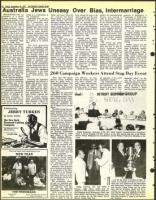
Daniel Honigman, chairman of the 1977 Allied Jewish Campaign-Israel Emergency
Fund, is shown thanking AJC-IEF workers at the 28th annual stag day of the Detroit
Service Group. Honigman was awarded the Jewish Welfare Federation Medallion at the
event.
A tie for the honor of leading all other di-
visions in Campaign increases over the pre-
vious year was achieved by the Mercantile
and Professional divisions. Holding the De-
Phillip Stollman, left, and Philip T. troit Service Group, loving cup, on which
Warren, right, whose names were an- their and the divisions' names will be in-
nounced as 1978 chairmen of the Allied Jew- scribed, are Dr. Paul Feinberg, left, chair-
ish Campaign-Israel Emergency Fund, chat man with Dr. Milton H. Goldrath of the Pro-
before dinner with Myron L. Milgrom, chair- fessional Division, and David Frank, chair-
man of prizes for the. 28th annual Detroit man with Richard A. Kahn of the Mercan-
Service Group Stag Day.
tile Division.