

7
7771.7-
1!*
•
THE DETROIT JEWISH NEWS
"10
2 May 14, 1976
. K 'is
4 s
Purely Commentary
American Bicentennial Throws Light on Significant Roles
Played by Jews in the History of This Nation . . . Poe's
Knowledge of Hebrew, Hamilton's Jewishness
By Philip
Slomovitz
American Author Edgar Allan Poe: Student of Hebrew and the Bible
American traditions have
their roots in the Bible and
in Hebraic traditions. The
Founding Fathers were de-
voutly religious and their
heritage was from Ancient
Israel.
They named their chil-
dren after Bible characters.
They looked to Jerusalem as
their spiritual haven.
The highly cultured even
learned Hebrew. Not only
Ezra Stiles of Yale Univer-
sity, who authored a gram-
mar and mastered Hebrew.
Others like him were dedi-
cated to the Hebrew tongue,
and knowledge of Bible lore
was like a compelling force
for teachers and students,
for diplomats and the
clergy.
Edgar Allan Poe may
hold a leading position
among American writers
who knew; perhaps even
mastered, Hebrew.
Impressively researched,
"Biblical Allusions in Poe,"
by Prof. William Mentzel
Forrest, then the John B.
Cary Memorial Professor of
Biblical History and Litera-
ture at the University - of
Virginia, published by the
Macmillan Co. in 1928, pre-
sented interesting factual
material as an enlighten-
ment on the subject.
Prof. Forrest makes a
study, and a very interest-
ing one, of Poe's spiritual-
ity, pantheism and mysti-
cism. He devotes chapters to
a review of Poe's references
to "death," "beyond death"
and "world end and judg-
ment," later proceeding to a
study of his prose and poetic
resemblances to the Bible
and devotes a chapter to
"The Bible in Poe."
Of unusual value for the
biblical student is the ap-
pendix, in this case a very
necessary item in the study,
containing quotations, He-
braic phrases, Scripture
proper names and an inter-
esting section on the ques-
tion of whether Poe knew
Hebrew.
The author makes a
comparison, in discussing
Poe's mysticism, between
the Jewish biblical writers
and Poe: "In the case of
both the Jewish writers
and Poe the explanation is
found in the contrast be-
tween what was and what
ought to be according to
their ideal. With Israel the
wailing arose from mea-
suring their condition by
the glorious rhapsodies
concerning national
triumphs and splendors
which the early prophets
sang to them in times of
calamity.
"They had re-established
their state after the Exile
with such hopes luring them
on. Then weary centuries
wore away and their ene-
mies continued to rule them
instead of coming to lick the
dust at their feet. Prophetic
voices no longer spoke to
them . . . Then arose the
new order of seers. In new
fashion the hope of Israel
found voice: in strange guise
the mysteries of life were
expounded. The prophecies
were not to fail. God would
yet avenge."
Prof. Forrest points to the
fact that the Bible in gen-
eral is against "vain repeti-
tions," and declares that
"this finds its precise anal-
ogy in Poe. No man ever
hated verbosity more than
he. None other ever so ap-
preciated the value of brev-
ity - stories must be short;
poems must be short."
The refrain in "The
Raven" is compared to the
refrain in the 26 stanzas in
Psalm 136, "For his mercy
endureth forever." The
double refrain, although
faintly suggested in Poe, is
APPENDIX
196
traced to Psalm 107.
We learn from Prof. For-
rest's concluding section to
his appendix that "nu-
merous passages in Poe ex-
press or imply some knowl
edge of Hebrew." The-
author publishes a list of re-
ferences to these passages.
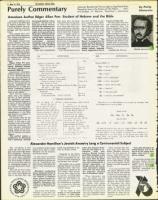
These are sample pages
from Prof. Forrests' book to
illustrate the theme he de-
veloped with an unusual in-
terest in Poe and his attrac-
tion to the Scriptural and
Hebraic.
(Copyright 1976, JTA, Inc.)
EDGAR ALLAN PO
A P PEND I X
r 208
Ezekiel XXXV. 7.
GRAI-IANI:S MAGAZINE, 1841.
Jarnes, Ancient 1 Z - ejirr2c.
c3ve up the E;host.
'under the s -In.
.AP:er;can
the second is like unto it.
Carleton,
thew Pharisaical Iitcrcry creed3.
Roo.evelt, Selene,: of
should he dan-Ined himself.
Dana, Seaman's F::end.
Ever since men went down to the sue=.
the spirit . . . the letter.
.DEMOCRzs:FIC REVIEW, 1846.
.til argira!'ia.
sins of youth.
to the end of time. (See X. 125 :30.)
'1:1 1V) -"and I will give,"
Gen. 25:3.
Eccl. 1:3.
73-11kt -"mount."
Matt. 22:39.
71 :17, vt? - "br a desolation,"
LE. 18:11.
ri???gl -"and a desolation,"
2 Ties. 2:12.
'91;7.1 7 --"and T cut off,"
ships. Psa. 107:23.
Rona. 2:29.
11 71)
--"from it,"
- 1V
-"him that goeth"
Psa. 25:7.
Rev. 10:6. -
:21111 -"and him that returned)."
3. HEBRAIC DHP,. A E
- S."
bed of dea±,
I.
257 :3 7 ;
264 :31; IV. 241 :7:
hec of e',:ony, II. '7 64:31.
of sufferini:,, , II. '6 1 :5.
brothers of Jessie, VIII. 67:4.
buttons of raeral, V. 118:33.
canoe. of
1 03 :
c.lr,:yers
gol„:1, 7 1. 1 -"3 .29.
q.e. 1.6. II. 7 59:37.
charm o:
rn , •;.
S9:5,
XIII. 'IS :21) ; 125 :12.
of wood. V. 119:13.
c1:• P,L1 of sin, -\'1t. 5 1 :32.
c1asps of 11. 13.4 :27.
cic.ek of.. ,2bohy, IV. 1 3 1 :33.
ec.:11
c,
c
1o4: 26_
3
cluster of cluster.;. XVI. 275:12,
et al.
.:_.auglit;:r Of earth, IV. 240:27.
daugbrers of heaven, II. 30:21.
days of a dog, II. 162:15.
day of days, II. 30:19.
door of br:Lss, II. 143:9.
duo: or iron, III. 239:12.
ea:.:;-:.ing of topaz, IV. 157 :16.
o: fire, V. 155 :31.
eyes of Annie, VI. 269 :14.
eyes of Ligeia, IL 251:5.
face to face, 11. 12:20; VII-
2 -'6:21; X111. 126:; 3.
XVI. 135 :37.
IV. 24 C; •
fire of tin:. VII. 1 :7.
1 ?.
s
Thus far we 1--;:ive Poe's Hebrew ju .it as given by Harrison, with
rdl its impctfec!ions ':lion its head.
Isaiah 34.10.
ClI Cri
3
4
- ;.. 1. - t*
'
F..zei/lel 35.7.
1
1
4100
rli;% "irj
/
6
riD;11
7
1 3(1n
9
1 .;1 !..7
So runs the int2,-Iiry.:::tion
nu , r.i! ,!ring of 1-threw foisted upo a
Anthon by son): (.;:1
im.:i;;ation of Harrison.
In the ahsence of any original ; , ,lituscrip',:s save ioathon's :t
now impossible to ay now many- of the glaring errols; came IC [tC
...inly the editor had little
author, editor, and priate.rf2,
to throw stones at l'oe.
Alexander Hamilton's Jewish Ancestry Long a Controversial Subject
The revelation a few
weeks ago that the pistols
that were used in the Aaron
Burr-Alexander Hamilton
duel in 1804 had secret pins
that could have controlled
the result of the confronta-
tion were known to limn-,
ton but not to Burr opens up
an interesting chapter re-
garding Hamilton's back-
ground.
Burr did not know about
the secret pins, yet he was
the victor and Hamilton
died in the duel. Burr was
,10 ‘.. O TI O N
vice president of the United
States from 1801 to 1805.
Hamilton was the economic
and finance expert.
It will also be recalled
that Alexander Hamilton
was a favorite of the late Ar-
thur H. Vandenberg who
had written a book about his
hero of early American his-
tory.
Historical recollections
about American heroes in
the Bicentennial year re-
vive interest in Hamilton
about whose Jewish an-
cestry there has been con-
siderable discussion pro-
viding an opportunity for
research by Jewish histo-
rians.
The Jewish writer Robert
Warshow, in his book "Al-
exander Hamilton, First
American Businessman,"
which was dedicated to An-
drew H. Mellon, stated:
"Deserted by his father,
tainted by a suspicion of
Jewish connections, he car-
ried the further handicap of
having been born abroad."
His mother was a certain
Rachael Fawcett of French
Huguenot stock. "Her fam-
ily had early settled in the
West Indies, where Alexan-
der was born. John Levine,
or Lavine, a middle-aged
Danish Jew, proposed to her
when she was hardly 18,
and prompted by her moth-
er's insistence on so profita-
ble a connection, Rachael
consented to marry the
wealthy planter.
"In no sense a love
match, it was foredoomed
to failure. A child, Peter
Levine, was born of this
union, but, because of dis-
taste for the father or oc-
cupation with new
amours, Rachel Levine
paid little attention to the
boy and saw him only a
few times after his birth.
The unnatural alliance
was soon terminated by a
formal separation, al-
though Levine did not di-
vorce Alexander's mother
until 1759, two years after
the generally accepted
date of Hamilton's birth.
"When Alexander was
born, his mother was still
legally the wife of John Lev-
ine, though whether Rach-
el's amour with James
Hamilton started while she
was living with Levine or
afterwards, is not known.
Nor has the matter as to
who was Alexander's father
ever been definitely deter-
mined."
Thus a certain Mr. Ste-
Soon after Hamilton de-
vens may have been his serted Rachel, and at the
father. Warshow, however, age of 32, the young Alex-
says: "It may also be, of ander, then only 11, as
course, that John Levine left an orphan.
was -Alexander's father. In
some ways, this is as logical
In one of his vitriolic radio
as any other theory. At the speeches, Father Charles
time of Alexander's birth
Coughlin, the Royal Oak
Rachel was still married to
(Mich.) priest, allude
- 3-
Levine.
paragingly to Alexa .er
It is quite possible that Hamilton, describing him
the lack of affection on the reportedly as a Jew.
part of Rachel, and perhaps
a doubt on Levine's part as
to the actual parentage, re-
S
- uited in placing the respon-
sibility on another man.
Whoever the actual father
of Alexander may have
been, the boy was given the
name of Hamilton, and
Rachel Levine lived openly
for a time with the James
Hamilton to whom the pa-
ternity was generally im-
puted."