

—7msnoramir
56 January 9, 1976
THE DETROIT JEWISH NEWS
Jewish Organizations and Leadership are Criticized
LESSONS OF 1975
CHALLENGES IN 1976
"Freedom is the recognition of necessity." — Hegel
BY MURRAY ZUCKOFF
Editor, JTA
NEW YORK (JTA) — For
Israel and the Jewish people
1975 could not have ended
too soon. It was a year of
diplomatic defeats for Israel
and steam-roller victories
for the Arab-Communist-
Third World bloc.
In 1975 nothing seemed to
go right for Israel. The deep-
going economic crisis, remi-
niscent of the 1960s, pro-
voked a series of major
strikes. The government
was under mounting pres-
sure from doves within and
outside the government to
change its attitude toward
the Palestinian issue.
rfl.,€, illegal settlement
move in Sebastia by the
Gush Emunim and the com-
promise the government
reached with the settlers
created a furor in the Labor
Party and caused Premier
Yitzhak Rabin to threaten
to resign.
The victory of a Com-
munist mayor in the Naza-
reth election brought a
series of charges that the
government had neglected
the problems of Israeli
Arabs and counter-
charges that the Commun-
ists were preparing a base
in that city for terrorist
activities.
Throughout all this, ter-
rorist bombs_ripped through
downtown Jerusalem in
July, October and November
killing a total of 21 people
and injuring 46, and terror-
ist activities in Tel Aviv and
along along the border were
responsible for the death of
some 24 Israelis and terror-
ists.
The year 1975 was also
filled with a series of ironies
and perversities for Israel
and the Jewish world. The
adoption by the General
Assembly in November of a
resolution equating Zionism
with racism was a pervers-
ity because it was the culmi-
nation of a series of similar
resolutions adopted in Mex-
ico City at the International
Women's Year Conference;
in Lima, Peru at a meeting
of ministers of non-aligned
states; in Kampala, Uganda
at a meeting of the Organi-
zation of African Unity;
which were convened to deal
with the socially progressive
issues involving the elimina-
tion of apartheid, colonial-
ism and imperialism.
It was 'ironic that the
groundswell of voices in Is-
rael calling for talks with
any Palestinian group that
renounced terrorism and
recognized Israel's sover-
eignty was attributed in
large measure to American
pressure for accommoda-
tion with the Palestine Lib-
eration Organization rather
than an ongoing demand
over the years by progres-
sive and radical Israeli and
Jewish political leaders and
intellectuals.
- It was perverse that
immediately after Israel
signed the interim accord
with Egypt in September
the Jewish state was cast
as the heavy in the Middle
East by Secretary of State
Henry A. Kissinger and by.
major sections of the
American news media.
Most ironic of all was that
the universal solidarity of
the• Jewish people in the
Diaspora and Israel was
the result not of any inter-
nal intellectual or ideologi-
cal development and Zionist
consciousness-raising, but a
reaction to the Assembly
resolution.
* * *
Former Israeli Premier
Golda Meir called attention
last - week in an NBC
"Today" program to the fact
that Congressional refusal
to support U.S. military aid
for the anti-Communist fac-
tions in Angola raised a se-
rious question about Ameri-
can security guarantees for
Israel.
The West could play out
its charade of voting against
or abstaining on issues cru-
cial to Israel in the UN be-
cause the interests of both
the West and the Arab bloc
came together on the eco-
nomic level. What counted,
give or take a procedural ap-
proach or an incidental and
secondary difference on
short-range goals, was that
the West and the bloc
needed each other on the
level of trade and capital
investments.
France, for example,
voted against the anti-Zion-
ist resolution in the UN
Third Committee on Oct. 17,
but two weeks later author-
ized the PLO to open a bu-
reau in Paris. Similarly,
France voted against the an- -
ti-Zionist resolution in the
General Assembly on Nov.
10, but a month later.con-
eluded an economic 'and
arms deal with Egypt much
to the satisfaction of both
countries.
In addition, Egypt's
plan to invest $8 billion in
an armaments industry
will also aid the British in-
dustry since Egypt plans
to buy helicopters and na-
val equipment from Brit-
ain.
Another example was
Mexico's seemingly para-
doxical vote for the anti-
Zionist resolution. Israeli
and Jewish leaders attrib-
uted this to Mexican Presi-
dent Luis Echeverria's am-
bition to become the next
UN Secretary General.
In fact, however, Mexico's
vote was due less to Echev-
erria's ambition than to that
country's bid to be atknowl-
edged as the representative
of the Third World in Latin'
America. That was the es-
sential reason for the stren-
uous campaign embarked
on by Mexico to hold the In-
ternational Women's Year
Conference in Mexico City.
* * *
The year 1975 was
marked by five major events
that showed, above all, that
Israel's fate was not self-
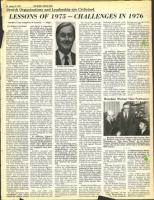
DANIEL MOYNIHAN
determined but more than
ever dependent on the U.S.
In March, the failure of Kis-
singer's Mideast shuttle led
President Ford to -call for a
reassessment of Mideast
policy, which in practice,
resulted in halting economic
and military aid.
In September, the Israel-
Egyptian accord effectively
isolated Egypt from the rest
of the Arab world and
brought Egypt closer to the
U.S. In October, President
Anwar Sadat's trip to the
U.S. was a triumph for
American policies in further
cementing relations with
Egypt, while Sadat himself
managed to secure for his
country the certainty of
large-scale economic aid,
nuclear reactors for desali-
nating sea water and the
possibility of obtaining mil-
itary aid in the future.
Another event was the on-
going Arab boycott of
American and European
firms doing business with
Israel or owned by Jews.
This provided the Arab
League boycott office with
leverage to pit Jewish_ and
non-Jewish business firms
against each other and also
tried, with not much suc-
cess, to isolate Jewish firms
from the rest of the eco:
nomic structure.
But the crowning event,
the one before which all
others paled into relative
insignificance, was the
adoption of the anti-Zion-
ist resolution. It set the
stage for legalizing and ra-
tionalizing anti-Zionist
and anti-Jewish activities
in many of the countries
that voted for the resolu-
tion.
But, more than that, it
marked an unprecedented
move in which the national
liberation movement of an
entire people was con-
demned as a form of racism
by an internationally consti-
tuted legal body, the same
body that recognized Is-
rael's right to exist as a na-
tion in 1947.
The resolution was also
unprecedented in that an
ideology representing the
highest collective political
consciousness of a people
was condemned as a form of
racism.
The resolution, although
presaged by earlier ones
during the year, stunned
Israelis and Jews around
the world. Reacting in knee-
jerk fashion to this cal-
umny, Zionist and Jewish
organizations for the most
part resorted to gimmicky
and sententious ads in
newspapers, shop-worn
cliches and the manufacture
of thousands of buttons.
They failed to seize the
opportunity to present the
historical contributions of
Zionism as a movement of
national liberation to other,
more recently evolving liber-
ation movements.
They also-failed to pre-
sent Zionism as a body of
theory dealing with the
condition of Jews in the
Diaspora, the general na-
ture and structure of Das-
pora reality and its role in
developing Israeli society.
Instead, the spate of ads
was more calculated to
win support for this or that
Zionist organization than
to deal with fundamentals.
The failure on the part of
Zionist and Jewish leaders
to rise to the occasion was
not accidental. For years
they had operated on the as-
sumption that Zionism had
been vindjcated and ab-
solved by history; their
thinking on this issue had
become stultified and cyni-
cal.
In Israel, for example, the
term tzionut was invariably
placed in quotation marks
and used as a put-down.
The reaction to those
countries that voted for the
resolution, especially those
who had been considered
friends of Israel and some of.
the Third World countries,
was one of unrestrained —
and generally unthinking —
fury. They were attacked as
being anti-Zionist and anti-
Israel without redemption.
Yet the Zionist and Jewish
leaders again overlooked
reality.
Many of the Third World
and Latin American coun-
tries voted for the resolution
more in protest -against the
U.S. than against Zionism
and Israel.
By the same token, many
of the countries that voted
against the resolution did so
not because they, were in
principle agreement with
Zionism but to protest
against the Arabs who had
brought them to their knees
,during the oil embargo.
Because the Jewish and
Zionist leaders were not
prepared to deal with the
issue of Zionism on a fun-
damental level they sought
out heroes for acclamation
and villains for condemna-
tion. The arch-hero be-
came Moynihan and the
arch-villain became Mex-
ico.
Despite the steadfast sup-
port by Moynihan for Zion-
ism, many Israelis noted
privately that his method of
defending it gratified Arne-
ican Jews but made it dii
cult for Israel to take a m
balanced approach with
some of the fence-sitting
delegations in the UN.
The year ended with an
embarrassing and disas-
trous series of snafus on the
part of the Israeli govern-
ment to notify the Knesset
and Jewish leaders abroad
that it had reached an un-
derstanding with Mexico on
the resolution in the Gen-
eral Assembly approving
the Delcaration of Mexico
City.
* * *
In addition, there are
still a number of uncer-
tainties and unknowns
that will come into play:
the extent of the financial
crisis of the cities; the im-
pact of labor negotiations;
the Presidential election;
the lagging world econ-
omy; and the mood of Con-
gress regarding spending
on foreign projects.
In fact, Israeli Premier
Yitzhak Rabin has already
cautioned Israelis that eco-
nomic aid will be rendered
more difficult. Several days
ago he stated that U.S. aid
will not continue forever at
a rate of 20 percent of Is-
rael's budget.
In broad outline, the eco-
nomic, political and diplo-
matic developments that
began to unfold in 1975 will
become more pervasive and
relentless in 1976.
A decisive factor for Is-
rael and world Jewish com-
munities will be the role and
nature of Jewish leadership.
The major ongoing need
in 1976 will be to defend Is-
rael against American
pressure for more territo-
rial concessions while de-
manding of the Arr hat,
at most, they nol Aiize
their relations with Israel.
There will also be the
need to take Zionism out of
the stalls of idolatry and
present it as a vibrant, via-
ble force for peace and prog-
ress in the Middle East, and
to transform this year's but-
ton Zionists into next year's
ideological and activist Zion-
ists.
There will be the need for
heightened awareness re-
garding aliya and less bu-
reaucratic impediments in
this country and in Israel
that turn off actual and po-
tential olim.
In 1976, therefore, the
Jewish and Zionist leader-
ships will require a major
overhaul in their apporaches
to myriad issues and a basic
re-tooling for the tasks that
lie ahead. The alternative
may be a series of setbacks
for Israel and the Jewish
people.
Brandeis Women Host Professors
Brandeis University professors Alan Levitan, Mar-
tin Halpern and Jacob Cohen will hold seminars
Wednesday on "Men About Women" for the Detroit
Chapter, National Women's Committee of Brandeis Uni-
versity. The all-day series will be held at the Bloomfield
Hills Library.
The Detroit Chapter, Na-
tional Women's Committee
of Brandeis University is
sponsoring three seminars
entitled "Men About
Women" on Wednesday at
the Bloomfield Hills Li-
brary.
Brandeis University Pro-
fessors Alan Levitan, Mar-
tin Halpern and Jacob
Cohen will discuss "The
Women in Shakespeare's
England," "Women at the
Dawn of Modernity: Henrik
Ibsen" and "Male Reaction
to Feminism in Contempo-
rary America."
Mrs. B. Benedict Glazer is
chairman, and explained
that the program includes
the three seminars and
luncheon.
Prof. Levitan, of the
' - qlish Department at
i is an authority :
on Shakespearean drama,
as well as a television lec-
turer and newspaper col-
umnist. He has taught at
Brandeis since 1960./
Prof. Halpern is 6_ _ ,iie
faculty- of the Brandeis
Theater Arts - Department,
and is a playwright, poet
and theater and literary
critic. He has also authored
two books.
Prof. Cohen has also
taught at Brandeis since
1960. A member of the
American Studies Depart-
ment, he is a former writer
and editor for the Congress
on Racial Equality and di-
rector of the Brandeis Up-
ward Bound Program.
He has also written sev-
eral national magazine arti-
cles and is a former editor of
Midstream magazine.