

rnmIM-
THE DETROIT JEWISH NEWS
48 Friday, September 26, 1975
Fascinating History About Jewish Auto Pioneers
Auto history facts relating to Jewish involvements
were revealed this week in comments from readers on last
week's special feature in The Jewish News 6n Jews in the
industry and on Siegfrid Marcus, the Viennese Jewish in-
ventor of the automobile.
Norman Birnkrant, Austrian general consul in Detroit,
said he will pursue efforts to assure widest recognition of
Marcus' pioneering work as the auto inventor.
A distinguished scientist who recently retired from
the Ford Motor Co., Frank L. Theylig, offered com-
ments, in a statement to The Jewish News, reviewing
the status of Jewish roles in the auto industry, with indi-
•
cations on reasons for rejections of Jewish participation
and to failure of Jews to make inroads in the industry.
Theylig is a great nephew of Sigfried Marcus.
Fascinating as an indication of a notable effort to pro-
duce an auto truck, under the sponsorship of a group of well
known Detroiters, at the turn of the century, is the infor-
Mation that was provided The Jewish News by Mrs. Julian
H. (Golda) Krolik, daughter of the late Bernard Ginsburg
who was part of that group.
The late Mr. Ginsburg was a community leader and one
of the top figures in Bnai Brith, having held offices here in
Pisgah Lodge. Mrs. Krolik has an interesting background in
her own right. At the Univer-
sity of Michigan she was wom-
en's editor of the Michigan
Daily. She has been active in the
Jewish Welfare Federation,
United Foundation and ,the
American Jewish Committee
which recently awarded her a
special honor.
Mrs. Krolik advised The
Jewish News that it was Max
Grabowsky who drew her father
into the auto industry. for the
manufacture of a truck.
GOLDA KROLIK-
The Grabowsky Power Wagon: GM Truck Forerunner
Max Grabowsky was a
name that flashed briefly
across the automotive sky in
the Detroit industry's pi-
oneering days at the turn of
the century. Like many of
the great automotive pi-_
oneers, his fame and com-
pany lasted only a few
years.
From Mrs. Golda Krolik's
material The Jewish News
has gleaned an interesting
look at one of the early Jew-
ish pioneers in Detroit's au-
tomobile industry. The jour-
nals, trade publications and
advertising materials of the
day, all provided by Mrs.
Krolik, show the rapid rise
and fall of Grabowsky. He
built his first one-cylinder
truck in 1902.
- The Cycle and Automo-
bile Trade Journal of Sep-
tember, 1908, stated:
The Grabowsky Power
Wagon Co., 68-72 Cham-
plain St., Detroit, was re-
cently organized for the
manufacture of all types of
power wagons, sightseeing
and municipal vehicles.
The moving spirit of this
organization is Mr. Max
H. Grabowsky, well
known in automobile cir-
cles as d pioneer and one of
the originators of the
Rapid Motor Vehicle Co.
In the new company he
acts as designer of the vehi-
cles as well as manager, and
has embodied in the con-
struction of these cars his
years of practical experi-
ence in connection with
commercial car building
and operation.
Many new and unique
ideas have been carried out
in the construction of the
Grabowsky power wagons.
All of them, however, are
based on the results of ac-
tual experiences and are not
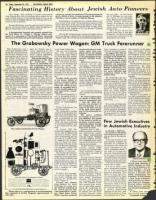
The original Grabowsky Power Wagon.
ta6e% Our, Ic
,oitt
In other words, not only
is the horse, which, of
course, is the power plant,
but every other unit of
which the vehicle is com-
posed, so arranged that it
can be readily taken out
and replaced by a dupli-
cate unit.
This interchangeability is
not, in the sense which is
usually spoken of by manu-
facturers, but is actually a
system of interchangeable
units.
* * *
Fifteen months later, the
same journal said:
Mr. Grabowsky's success
resulted in the purchase of a
large and commodious fac-
tory in Pontiac and the firm
was re-organized as the
Rapid Motor Vehicle Co.,
which was later purchased
by the General Motors, and
is still being actively oper-
ated.
In August, 1907, Mr.
Grabowsky resigned his po-
sition with the Rapid and
returned to Detroit, where,
after incorporating his lat-,
est ideas in a model truck,
he organized the company
that now bears his name.
Associated with him in the
firm are Bernard Ginsburg,
vice president; Adolph Fin-
sterwald, treasurer, and-
John Bauer, Jr., secretary.
The Grabowsky factory
on Champlain St. has been
outgrown in the second year
of the factory's history and
negotiations are now in
progress for the purchase of
a plot of land on which the
firm will erect a factory
with a capacity of 1,200
trucks annually.
* * -*
In 1910 or 1911, a newspa-
per article reported that
new factory buildings were
planned for Grabowsky
Power Wagon Co.:
LOOK WHAT CAME OUT OF GRABOWSKY'S GARAGE
asomi
in any sense theoretical.
The user who is familiar
only with horse-driven
trucks is apt to say, "Well, if
my horse gets sick, sprains
a leg or is otherwise incapa-
citated, it is only a few min-
utes' work to put another
horse in the harness and
deliver the goods." Mr.
Grabowsk ■ ,, has incorpo-
rated in the design of the
new vehicles exactly this
principle, in so far as it can
be applied to a power wa-
gon.
, 31.0y ,ecfs to
Shown above is a reproduction of an advertisement
that appeared in Forbes Magazine approximately 12
years ago.
Ground has already
been broken for three
buildings on a nine acre
site recently purchased at
Mt. Elliott and the Belt
Line (Grand Blvd.). Archi-
tect Albert Kahn, Ernest
Wilby, associate, prepared
the plans for the new insti-
tution, which when com-
pleted will be the largest
factory in Detroit devoted
to the manufacture of com-
mercial vehicles exclu-
sively.
Reinforced concrete con-
struction will be used
throughout. Perfect light
and ventiration will be fea-
tures of the construction.
The main building will be
300x62 feet. The building
devoted to body construc-
tion will be 200x40. Trans-
portation facilities are al-
ready provided for by two
special tracks; giving room
for the loading of 28 freight
cars at one time.
*
*
An automobile 'catalog in
1911 provides the following
history:
We wish to impress upon
the minds of those inter-
ested in commercial cars
— that Mr. Max Gra-
bowsky, the designer of
The Grabowsky, is a pi-
oneer in the field, and one
of the most active princi-
pals in the commercial car
industry.
His active working
knowledge of power wa-
gon efficiency was gained
in the school of actual ex-
perience, and he under-
stands the subject through
and through like a book,
from cover to cover.
Business prior to 1900 —
Making models, patterns,
and experimental machin-
ery. Began experimenting
with gas engines. Designed
numerous engines and fin-
ally completed a car, which
was one of the first built for
commercial purposes.
He then formed a co-part-
nership, rented larger
quarters and installed addi-
tional machinery. Capacity
of this plant was about 40
cars per year.
Foreign capital became
interested and this induced
Mr. Grabowsky to reorgan-
ize, increase his working
capital and move to Pontiac,
Mich., where he took posses-
sion of the Hodges Vehicle
Plant April 15th, 1905.
This institution grew by
leaps and bounds, continu-
ing the manufacture of the
same model. Conditions
changed. The demand for
cars increased. The service
cars were expected to per-
form became more severe,
and to meet these require-
ments, Mr. Grabowsky be-
gan the work of designing
an entirely new car, incor-
porating features which
past experience proved abso-
the property of the bank-
rupt Grabowsky Power
On August 15th, 1907, he Wagon Co., of Detroit, with
resigned his position as the exception of the build-
manager of the Rapid Mo- ings and machinery, and
tor Vehicle Company, in began operations in a sepa-
order to devote his entire rate plant at Wyandotte,
time and energies to the Jan. 20.
The Wyandotte plant is to
perfection and completion
of his new model, The Gra- manufacture the Gra-
bowsky Commercial Car, bowsky truck. The Seitz
which is, by actual test, company officers are to re-
the most efficient and sign and the company is to
economical vehicle on the be reorganized to become
successor to the Grabowsky
market today.
company.
Mr. Grabowsky has sur-
For the present George A.
rounded himself with a big Horner, who has been man-
staff of specially trained ager of the Grabowsky De-
men who collectively know troit plant for the creditors,
more about the manufac- will be general manager of
ture, operation and mainte- the Grabowsky plant at
nance of Power Wagons Wyandotte, in which the
than any other similar Grabowsky trucks will be
group in the world. Their manufactured.
record of actual results is
The sale of the assets to
your best guarantee that the Seitz stockholders was
the Grabowsky is the car for made by Referee Lee Joslyn,
you to buy. '
of the bankruptcy depart-
* * *
ment of the United States
But as the advertisement court at Detroit and the sale
said, times change. The Jan. has been confirmed. The
23, 1913 edition of The Auto- assets not covered in the
mobile reported: Stockhold- Seitz transaction were pur-
ers of the Seitz Automobile chased by Samuel Winter-
Transmission Co., Wyan- nitz and Company, of Chi-
dotte, Mich., have purchased cago.
lutely necessary to make it
of actual commercial value.
Few Jewish Executives
in Automoti ve Industry
By FRANK L. THEYLIG
Text of letter to The Jewish
News editor on last week's ar-
ticle on Jews in the auto in-
dustry:
Your item on Jews in the
auto industry is greatly ap-
preciated. As a member of
this group with about 30
years experience in De-
troit's automobile plants, I
can attest to its long over-
due need. I also speak as one
of the Jews who actually
held significant operational
positions until my voluntary
retirement earlier this year.
There are several points, I
should like to make:
• In all my years, I have
never encountered another
Jew in truly operational
executive positions. Ford
Motor Co. never had a Jew-
ish vice president; Dr. Jacob
(Jack) Goldman's highest
position was that of a direc-
tor in the Ford Scientific
Laboratory which is not an
operational activity, i.e. it is
not involved with the profit
or product determining
functions of the firm. Jack
left Ford to become a Xerox
vice president out of town.
FRANK THEYLIC
• There were and a–v.:
several other directors of
similar functions at Ford.
One was Al Haynes, a re-
search director — now re-
tired. Another was Bob
Layton, a director (and
briefly international vice
president) of Ford Europe
— later 'let go' to become a
chief executive at Dyna-
mite Nobel AG, Germany.
Several others could be
listed. However, none had
true decision-making posi-
tions.
• There were sever -
Jews in high position ,
(Continued on Page