

48 Friday, September 19, 1975
THE DETROIT JEWISH NEWS
A Bicentennial Feature
e
Li
Bicentennial Study of Detroit's Major Function :wirn
Auto Invented by Jew, But No Jews in Industry 'N'
the facts regarding Jewish
top auto executives remains
as portrayed in 1961 by For-
tune Magazine.
By PHILIP SLOMOVITZ
(Copyright 1973. JTA. Inc.)
Bicentennial historical
reviews will, inevitably, in-
clude industrial accomplish-
ments and the growth of
economic enterprises in this
country.
True: There have been
Jews in the engineering
departments of major au-
tomotive manufacturing
plants. One very promi-
nent physician, Dr. Jacob
Goldman, rose to the rank
of a Ford Motor Co. vice
president. But even in the
engineering departments
there have been few Jews
in relative terms.
Major in such resumes
will he recollections of De-
troit's experiences in the
development of the automo-
bile industry.
In the process, there will
be the sad admission that
Jews have been and remain
minor — almost insignifi-
cant — in the making of the
automobile in the United
States and in its advance-
ment as one of the major in
st•uments for mankind's
progress.
True, there are Jews
who are automobile dis-
tributors. Jews have been
among the naanufacturers
of parts for automobiles.
But in the larger sphere,
there have not been and
there are no Jewish mag-
nates.
The anomaly is that a Jew
was the inventor of the first
automobile. He was an Aus-
trian Jew whose great gift
to mankind merits recall-
ing.
First, however, it is neces-
sary to cite some exceptions
to the missing Jewish links
in the automobile industry
in Detroit.
Had he succeeded, the
late Bernard Ginsburg
would have been among the
historic personalities in
auto making. He manufac-
tured. a small truck in the
early part of this century.
He did not have the means
to carry on and the under-
taking failed.
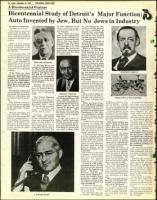
BERNARD GINSBURG
A. Edward Barit was
president of Hudson Motor
Co. But he had not begun
on the bench as the Fisher
brothers and Henry Ford
did, and his role was pri-
marily in the commercial-
distributive ranks from
which he rose to the Hud-
son presidency.
Similarly, the late Meyer
L. Prentis, who was trea-
surer of General Motors,
had risen from the accoun-
tancy and bookkeeping
ranks.
MEYER L. PRENTIS
Among the high ranking
Thus, Fortune Magazine,
Jewish
personalities in the
nearly 15 years ago, in a'
study of the auto situation, auto industry who re-
in an article entitled "Life in ceived due recognition for
Bloomfield Hills," stated: merit but did not rise to an
"Of the 100 odd executives official post was the late
— vice-presidents and Samuel N. Heyman, the
higher — who are now at Jerusalem-born, MIT
graduate, who was near
the top, none is a Jew."
the top but not the chief
Curiously, Bloomfield engineer of the Fisher
Hills, which then rejected Body Corp.
In the early days of
Jewish residential appli-
cants, now is emerging as a Henry Ford Sr. there were
major Jewish suburb to Jewish newcomers to De-
Detroit, and this month a troit who became devot-
West Bloomfield school edly associated with the
hosted Holy Day services of Ford Motor Co. Some were
the Chabad-Lubavitch. But very loyal to Henry Ford
Sr. even during his anti-
Semitic activities because,
as they testified, he
treated them exceedingly
well. But Jews have been
few on the auto making
benches and even fewer in
the assembly lines.
These are the truths in
spite of the Jewish inven-
tor of the first automobile,
,Siegfried Marcus.
Born in Mecklenburg,
Germany, in 1831, Sieg-
fried worked as a me-
chanic for Siemens and
Halske in Berlin, until he
moved to Vienna in 1852.
His inventions included a
mechanism for the dis-
charge of deep-sea mines
by electricity, the thermos
flask, telegraph relays and
scores of other articles.
His first benzine-driven
car was patented in 1864.
His second and • improved
car was completed in 1875,
when he drove it on Vien-
na's streets.
His auto patents were
registered in Germany and
the town council of Meck-
lenburg honored the inven-
tor by affixing a tablet to
the house in which he was
horn.
Some of the available rec-
ords state that his 1875 au-
tomobile was preserved in
the Vienna Industrial Mu-
When the firm of Sie-
mens and Halske engaged
in establishing the first
telegraphic communica-
tion between Berlin and
Magdeburg in 1848, Mar-
cus contributed a number
of improvements to the
development of the tele-
graph.
In 1860, he set up his own
laboratory in Vienna: His
creativeness had led him to-
the development and patent-
ing of an electric lamp in
1877. He perfected a loud
speaker microphone.
It is believed that had he
been less versatile, and had
he concentrated on the auto-
mobile, rather than spread-
ing out his Wings as an in-
ventor in many directions,
his name would have gone
down in history as the
greatest perfector of the
automobile.
He is known to have had
38 patents in Austria alone,
and 76 in a dozen other
countries. The Austrian
Academy of Sciences
awarded him a gold medal.
A prize of 2,500 gulden,
awarded Marcus for the
invention of the thermos
pillar by the Imperial and
Royal Academy of
Sciences, and the pur-
chase of the telegraph re-
lay by the Austrian postal
authorities, indicate that
the eminent Jewish inven-
tor of the last century was
well provided for.
A. EDWARD BARIT
However, he was not com-
pensated. for many of his
other inventions, including
the electric lamp.
His mechanical shop Was
a sanctuary. The biography
SIEGFRIED MARCUS
•
4F
Siegfried Marcus' First Automobile
of Marcus, written by Kur-
zel-Runtscheiner, enumer-
ates his activities and lists
the many inventions of the
Jewish mechanical geniuS.
Siegfried Marcus, as the
inventor of the automobile,
succeeded numerous others
who had attempted to intro-
duce the motor-vehicle to
the world.
Jean Lenoir made a gas
motor vehicle in 1860 and
took a trip in it two years
later. However, the gas
had to be carried in a sepa-
rate container.
Marcus, on the other
hand, solved the major auto-
mobile problems by using
gasoline as fuel, by produc-
ing the mixture of gasoline
vapor and air within the mo-
tor, and by introducing elec-
tro-magnetic ignition.
He called the mixture of
gasoline and air "carbureted
air," and his first machine,
which he made in 1864, be-
came the forerunner of our
modern automobile. The
patent for his electro-mag-
netic ignitor was awarded to
Marcus on June 21, 1864.
The "first Marcuscar" is
the name by which this first
vehicle was referred to. It
was an expensiVe experi-
ment, because gasoline had
to be imported from Ger-
man pharmacies at a high
price.
We are told that the first
Marcus automobile suc-
ceeded in completing a
trial run of 200 meters.
The second Marcuscar
was greatly advanced, suc-
ceeding- in vaporizing gaso-
line by rotating atomizers,
and traveling long dis-
tances. -
It covered 12 kilometers,
and made several sensa-
tional trips which attracted
attention. However, the pol-
ice finally prohibited its
tours because its iron
wheels made a loud racket.
Three copies of the 1875
Marcuscar model were built
— one in Marcus' shop and
the other two in Blansko,
Czechoslovakia, in the iron
factories of Prince Salm.
The latter carefully fol-
lowed Marcus sketches.
In a sense, Marcus was
shortsighted in his outlook
for the future. When he
was asked to go to Blansko
to perfect his invention, he
refused, being totally sat-
isfied that he•had - solved
the technical problems of
the automobile.
The Austrian Automobile
Club bought the Blansko-
made automobile and gave
it a place of honor in the
Vienna Technological MI: -
scum.
Two German inventors,
Daimler and Benz, in later
years perfected automo-
biles. But it is generally
conceded that the Marcus
car was superior to theirs,
and it is not known whether
the Germans were influ-
enced by the Jewish auto-
mobile creator.
In any event, it was Mar-
cus who first solved the
problem of the internal
combustion engine on the
principle of two and four
cycles.
A statue in honor of Sieg-'
fried Marcus, who died in
1898, was erected in front of
the Technological Univer-
sity in Vienna.