

U Friday, September 5, 1975
THE DETROIT JEWISH NEWS
Jewish Hole in Bicentennial: Liberty Bard's Dramatic Debut
By PHILIP SLOMOVITZ
Copyright 1975, JTA, Inc.
Emma Lazarus is a name
indelibly recorded in Ameri-
can-Jewish history. "The
New Colossus" which has
given her world fame as a
champion of rights for
the homeless is engraved for
all generations on the Sta-
tue of Liberty on Bedloe Is-
land in New York Harbor.
The basic facts are rec-
orded and frequently re-
peated as a reminder of the
'eminent poet's role as an
interpreter of Jewish ideals.
She was horn in New
York City, July 22, 1849,
wrote her first poem when
she was 14, and in 1871 her
first book of verse came off
the press. The year 1971,
therefore, marked the cen- .
tenary of her emergence as
a poet of note whose writ-
ings were commended by
Ralph Waldo Emerson and
other noted American writ-
ers.
Fifteen years later she
was to become world fa-
mous for her poem "The
New Colossus" which was
engraved on the Statue of
Liberty to be read by mil-
lions to this day.
During its Bicentennial,
this nation observes the
104th year of the appear-
ance on the American scene
of the eminent lady whose
verses grace the plaque of
the imperishable statue that
was the creation of Frederic
August Bartholdi and was
the gift of France to the
United States.
This statue is 50 feet
higher than the Colossus of
Rhodes to which Emma
Lazarus referred in the first
line of her famous poen:
Not like the brazen giant
of Greek fame,
With conquering limbs
astride from land to land,
Here at our sea-washed,
sunset gates shall stand,
she outlined a plan for the
repatriation of the Jews in
their ancient homeland.
A mighty woman, with a
torch, whose flame
In prose and in verse she
pleaded for justice to the
Jew. The vigor of her writ-
ings and the sincerity of her
pleas gave notice that a
giant advocate had arisen to
defend the rights of the
Jews. In poem after poem,
she counseled a Zion rebuilt,
depicted the tragedy of a
harassed Israel and created
word pictures which, for
prophetic and beautiful ex-
pression of the age-long cry
of the Jews, have seldom
been equalled.
Is the imprisoned lightning,
and her name
Mother of Exiles .. .
When her poem "The New
Colossus" was chosen for
the Bartholdi monument, it
was a bright occasion for
the noted poet who di-e—d—i-n
her 38th year—Nov. 19,
1887—only one year after
the poem was immortalized
on the national monument,
the Statue of Liberty En-
lightening the World.
It was on Oct. 28, 1886,
that President Grover Cleve-
land formally dedicated the
Statue of Liberty.
Emma Lazarus, one of
the unforgotten geniuses
of American Jewry, was
the daughter of Moses and
Esther Lazarus, Orthodox
Jews of aristocratic Po-
rtuguese lineage. Raised
in wealthy and sheltered
surroundings, she was ed-
ucated by private tutors
and spent her youth
among the well-to-do.
She . reached the peak of
her greatness as the result
of the awakening within her
of the Hebraic spirit. It was
always latent but was not
brought to the surface until
she was shaken out of her
reticence and literary naiv-
ete by the pogroms in Rus-
sia and Romania from 1879
to 1882. The tragedy of
these events stirred her so
deeply that she turned her
poetic genius to the defense
of her people.
Fully a decade before
Dr. Theodor Herzl con-
vened the First World
Zionist Congress in Basle,
in 1897, Emma Lazarus'
imagination was fired by
the Palestine idea and she
wrote a series of "Epistles
to the Hebrews" in which
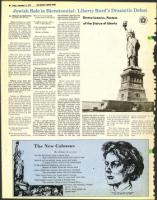
Emma Lazarus, Poetess
of the Statue of Liberty
The writing of "The New
Colossus" was a direct out-
growth of Emma Lazarus'
belated but passionate con-
cern for the safety of her
fellow Jews. Despite her
delicate health, she spent
many days visiting the hag-
gard and ragged Jewish
immigrants from Russia
and Romania who crowded
the immigration station on
War Island in 1881 and
1882.
Those were the years
when Americans were
asked to contribute to the
$300,000 fund to build the
pedestal on which the Sta-
tue of Liberty was to stand.
Money was slow in coming.
Many devices were used to
raise the fund.
Constance Gary Harri-
son was one of the group of
public spirited women who
arranged rummage sales
and sold souvenirs to se-
cure the necessary funds
for that purpose. She was
collecting poems, draw-
ings and stories for publi-
cation in a souvenir book
to be sold for the benefit of
the pedestal fund. Emma
Lazarus was not keen to
write for souvenir books
and at first declined Mrs.
Harrison's request for a
poem. But when Mrs. Har-
rison reminded Miss Laza-
rus "of the Goddess stand-
ing on the pedestal down
yonder in the bay and
holding her torch to those
Russian refugees of yours
whom you are so fond of
visiting," the Jewish poet
was galvanized into ac-
tion. "The New Colossus"
was her contribution to'
Mrs. Harrison's souvenir
book and it soon became
the poem to be fastened to
the inside of the base of the
Statue of Liberty.
It is one of the ironies of
rate that the life of the
Jewess Emma Laza-
rus. Liberty's Bard, should
have been cut short at the
age of 38.
The New Colossus has
only 14 lines, but in them
are expressed with pro-
phetic instinct all of the in-
destructible and noble
ideals symbolized by the
Statue of Liberty.
These lines, written by
Emma Lazarus 90: years
ago, remain the credo of
Americanism and a striking
memorial to their author;.
now being honored . on the
104th anniversary- ot the
publication of her first
hook.
The New Colossus
Not like the brazen giant of Greek fame,
With conquering limbs astride from land to land,
Here at our sea-washed, sunset gates shall stand,
A mighty woman, with a torch, whose flame
Is the imprisoned lightning, and her name
Mother of Exiles. From her beacon hand
Glows world-wide welcome; her mild eyes command
The air-bridged harbor that twin cities frame.
"Keep, ancient lands, your storied pomp!" cries she
With silent lips. "Give me your tired, your poor.
Your huddled masses yearning to breathe free;
The wretched refuse of your teeming shore—
Send them, the homeless, tempest-
tossed, to me —
I lift my lamp beside the
golden door!"
Emma.Lazarus, Poet of Freedom
July 22, 1849-Nov. 19, 1887