

48 Friday, April 4, 1975
THE DETROIT JEWISH NEWS
The Trials of Cairo's 200 Jews
(Continued from Page 1)
Moslem tourists; as well as
Jews, stream through the
building, listen to a guide
tell how Moses once prayed
on this spot because Cairo
itself was too full of idols,
gaze at the magnificent
stained glass windows and
hear the shamash tell how
nine hundred years ago
Rabbi Abraham Ben Ezra
came here from Jerusalem
and built this house of
prayer. Some tourists even
get a glimpse of the Torah
written on gazelle skin.
No one tells tourists
about the even larger build-
ing on Adly Pasha street
called the Grand Temple of
Ismaili and although it is
only a short walk from the
Nile-Hiltak and the Egyp-
tian Museum, few bother to
try to find it. It is on one of
the principal streets in a
posh shopping district, op-
posite a popular restaurant,
the Leban. The iron fence
surrounding the seventy-
five-year-old building is ten
feet high and the gate is fas-
tened with an immense pad-
lock. But down a narrow al-
leyway cluttered with
pushcarts and garbage
there is an unobtrusive door
guarded by a tall and very
black Egyptian who smiles
broadly whenever he hears
the password "Shalom!" The
courtyard is paved with
marble and tile mosaics. A
flight of marble steps leads
into a large room off the
sanctuary equipped with an
improvised ark and a few
chairs. Here half a dozen old
men and one woman sit
staring into space as they
mumble their prayers in a
French-Ladino-Arabic di-
alect of Hebrew incompre-
hensible to a European or
American Jew. Only some-
times on Friday night or
Saturday morning do they
have,a minyan. Or any hope
of a minyan. The men wear
faded blue berets instead of
yarmulkes. The woman
looks as if she had on all the
clothes she owns, and still
she shivers, for it is cold and
dark and humid in this
ghastly place. The men's
garments are frayed and
tattered. There is the smell
and look of decay every-
where. The eight represent-
atives of the two hundred
seem oblivious to the cry of
a mezzuin chanting the
Moslem call to prayer over a
loudspeaker with the vol-
ume turned up too high for
oral comfort. They also ig-
nore the presence of several
strangers.
The praying finished, one
of the men, after removing
his philacteries, introduces
himself. He looks eighty but
says he is just under sixty.
He has a public relations
office down the street. He
has lived here all his life. He
has few complaints. "We
have no big problem. We can
leave the country if we wish.
will die here someday and I
will be buried in our Jewish
cemetery, which they still
let us keep."
Then the old lady spoke.
"I talk Hebrew, French,
English, German and Ara-
bic. Also a little Russian. I
am born in Jerusalem, but I
came here more than sixty
years ago as a young bride.
My husband came to make
business. Then he died. At
one time we had a very good
life here. But now . . . now
it is all finished."
The sanctuary of the
Grand Temple Ismaili was
once a thing of magnificent
beauty, but now the win-
dows are too dirty for the
sun to filter through, the
red carpet the length of the
main aisle is threadbare,
the pews are thick with dec-
ades of dust, the crystal
chandelier is badly in need
of a bath. And even here the
walls too seem to shake with
the mezzuin's electronic cry.
In the old days this must
have been an elegant house
of prayer.
The real shock comes if
one is fortunate enough to
persuade some member of
the miniscule Jewish com-
munity to serve as guide on
a tour of the smaller syn-
agogues. We found a wiz-
ened little man who, in good
Of course we can take only
one suitcase with us. But we
can leave. Then if we want
to come •back we can. Some
of our people have done
both. Young people can also
get permission to go but
they cannot return. I do not
understand why not, but it
is really academic, for there
are . . . no . . . young peo-
ple here anymore. Only peo-
ple like us," and he waved
his hand toward the old lady
and the other five men. "We
get kosher meat now and
then from Alexandria and
at Passover we have all the
matzot we need. We help
each other. Yes, we get
along. I would like to go to
America if I were younger,
but what would a man of
sixty do in America? I am
too old to readjust. Israel?
We talk a lot about it. Some
have gone there, by way of
Rome or New York. But Is-
rael is also for young people.
Young people can readjust. I
have never lived on charity
and I will not begin now. I
English, said he wanted to
be called "Old Victor." He
had been brought here from
Poland seventy-five years
ago as a small boy by his
father, an Ashkenazi rabbi;
before the Nasser revolution
he himself was chief clock-
maker for King Farouk;
now he lives very sparsely —
on charity.
Old Victor took us down a
narrow, twisty street, ex-
tremely filthy, even for
ri Mohas-
Cairo, called Sha
sar al Knachab, the Street
of the Wood Cutters. This is
the way into the heart of
what was once one of the
most congested Jewish
quarters anywhere in the
world. These shops, these
houses, this whole area was
one hundred per cent Jew-
ish. Now all trace of Jews
and Judaism is gone. The
small shops are owned by
Egyptians now. There's not
a Mogen David anywhere
until you come to the ruins
of the Maimonides Syn-
agogue. Ruins? The walls
stand but last Rosh Ha-
shana the roof caved in.
Someone has cleared a space
so a visitor can stand in the
center of the sanctuary and
imagine what a jewel of a
holy place this once was. The
building was built half un-
derground. At the bottom of
a flight of stone steps is
what remains of what used
to be a tiny hospital. Old
Victor points out the
"Healing Well" and tells
how Christians and Mos-
lems as well as Jews used to
come from afar to be cured.
Often they would stay down
here overnight. "Lots of
Jewish miracles happened
here — people were made
well — miracles, you under-
stand?" On the floor
and upstairs are hunch...
of picture frames, the glass
broken but the pictures
themselves intact; cabalistic
pictures, old paintings of
the Moses for whom this
synagogue was named, Ara-
bic words in Hebrew script
— historical treasures being
trampled underfoot, and al-
most no one seeming to
care. A young Orthodox
rabbi from Boston says he is
trying to persuade the
•Egyptian Government to do
something to save buildings
like this before it is too late.
The cultural attache of the
American Embassy says
maybe the Smithsonian In-
stitution could be inter-
ested. Someone speaks of a
demoralized community.
It's more than that. It is a
community in the last
stages of utter decay. Just
fifteen years later.
Pity the two hundred!
`Reassessment' Follows Peace Talks' End
(Continued from Page 1)
Geneva peace comference.
The United States Am-
b'a.ssadars to Syria, Jordan,
Egypt and Israel were sum-
moned to Washington for a
high level conference on
American Middle East pol-
icy. The envoys met with
Kissinger at the State De-
partment.
Kissinger's talks with
Ford in California this
weekend will cover Ameri-
ca's position in Vietnam as
well as the Middle East. The
President will address the
nation on foreign affairs on
or about April 9. -
"The reassessment is
underway," State Depart-
ment spokesman Robert
Anderson told newsmen
with regard to the recall of
the U.S. Middle East am-
bassadors. He said the re-
view would be conducted
"in the normal way by the
National Security Council
machinery" and that all
agencies involved in the
Middle East will be partic-
ipating.
The State Department
confirmed Wednesday that
the U.S. Government has re-
ceived official notification
from Egypt that it seeks to
have the Geneva peace con-
ference reconvened and said
that the U.S. would he in
touch with its conference co-
chairman, the Soviet Union,
and with other parties to it
regarding a date and possi-
ble participants.
Department spokesman
Anderson said there was no
estimate at this time of a
date and that no date was
suggested by Egypt.
Qu ,'-,̀,-t-inned on reports
that the United Kingdom
and France might be invited
by Arab countries to partici-
pate in the Geneva talks,
Anderson said the U.S. ob-
v,iously would be talking
with the Soviet Union and
other parties but he would
not discuss U.S. views on
that aspect.
Department
State
sources were quoted Tues-
day as cautioning that a
Middle East peace settle-
ment would be difficult to
achieve at the Geneva con-
ference but that the U.S.
was ready to go along with
the multinational forum.
In Jerusalem, official
,sources were careful not to
react to news of President
Ford's interview in Hearst
newspapers in which he
blamed Israeli intransig-
ence for the failure of Kis-
singer's Mideast effort.
Privately, officials tended
to hope that Kissinger's
news conference last
Wednesday in Washington
in which he carefully-
avoided apportioning
blame—represented a more
up-to-date and more bal-
anced U.S. official position.
They note1 that Ford had
given his interview March
24, before Kissinger's press
conference and when the
President was reportedly
highly angered and upset by
the failure of the shuttle
effort.
Some well placed
sources here said—again
in private briefings—that
Geneva is not necessarily
the sole available option at
this stage. They mentioned
"proximity talks" as a
possible alternative.
ISRAELI PROPOSAL
EGYPTIAN PROPOSAL
Mediterranean Sea
Mediterranean Sea
∎
PORT SAP
PORT SAID
El
o '
GAZ
y.
APtski
EL APISH
o
S
E3EERSHEBA
rti
su
ISMAIt
IA
cr
0
cc
SUEZ‘j
---- •
0
SUEZ"
Su DE
SUDf
SINAI
Va
ABU /ENE
rn
ABU ZE NE,MA
:MA
0
ABU RU
\\.
Ruacl
.
Road
AK, RUC* IS
O
0
o
SAUDI A
•DAHAs
Sands
.‘A
Sands
\
Mounto ■ ns
High Mount.,
I
Swamps
—
E • 1UP
1 Mountains
E • ', UR
H. gh Mounions
1
_T Swamps
103
'
km
SMARM ESH-SHEISH
Red Sea
ke-printed from the Jerusalem Post
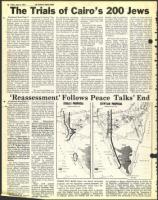
THESE TWO MAPS depict the Israel territorial
proposal, and the Egyptian counter-proposal, for
a "less far-reaching settlement" which were dis-
cussed in the latter stages of the talks.
The Israel proposal was made when it became
clear that Egypt would not agree to a full non-
belligerency pact. Israel suggested a Withdrawal
to midway across the Passes and the ceding of
the oilfields to Egypt administration in return for
an Egyptian commitment to refrain from use of
force for a fixed period, plus "elements of non-
belligerency." Egypt responded with a territorial
demand which effectively represented what Israel
had been prepared to cede in return for full non-
belligerency. Egypt also refused the "elements of
non-belligerency," such as direct flights for for-
eign tourists and moderation of the Arab boycott.