
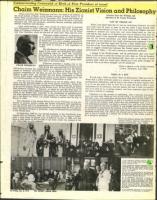

Commerorating Centennial of Birth of First President of Israel
Chaim Weizmann: His Zionist Vision and Philosophy
Chaim Azriel hen Ezer Weizmann was born, the third of 15 children, in
the small hamlet of Motol, in the Grodno province of White Russia on 18
Kislev 5634, corresponding with 27 November 1874; Despite the humble cir-
cumstances of their parents, all the Weizmann children received a university
education and, with one exception, eventually'became scientists, physicians,
dentists, engineers and educators.
Upon matriculating in 1891, when almost 18, Chaim went to Germany
and Switzerland to study chemistry, and obtained the Ph.D. magna cum
laude at Fribourg University in 1900. In that same year he met his future
wife Vera Chatzman, whom he married six years later. They had two sons.
Weizmann taught chemistry in England un-
til he settled in Manchester in 1904 on taking
up a science appointment at Victoria University.
In World War I he gave valuable assistance. to
the British munitions industry (1916) which was
in dire need of acetone, a vital ingredient of
cordite.
His attachthent to Jewish nationalist ideals
began in his youth, and throughout his student
and teaching years he came into increasing
prominence in the Zionist movement. He was
in the forefront of the opposition to Theodor
Herzl and his supporters over the Uganda settle-
ment plan in the early 1900s.
Weizmann assumed a leading role in the
CHAIM WEIZMANN
negotiations with the British government in the
First World War years that led up to the Balfour
Declaration favoring the establishment of a national home for the Jewish
people in Palestine (November 1917). In his efforts to secure wide inter-
national recognition for the plan, he met the Emir (later King) Faisal of
Hedjaz in June 1918, and attended the San Remo Conference of Allied
Powers (1920) which confirmed the intent of the Balfour Declaration. He
was elected president of the World Zionist Organization in 1920.
Over the next two decades, whether in or out of public office, Weiz-
mann was the supreme leader of the world Zionist movement. During the
Second World War it was his persistence that brought about the formation
of the Jewish Brigade Group in the British Army. In this period the Daniel
Sieff Research Institute at Rehovot, of which he was the head since its
creation in April 1934, rendered valuable service to the Allied industrial war
effort in the Middle East, especially in the production of pharmaceutical
and other chemical requirements. His younger son Michael, a flight-lieuten-
ant in the Royal Air - Force, was posted missing in action over the Bay of
Biscay M 1942.
The aftermath of the Second World War found Weiz'mann no less em-
broiled in partisan politics within the Zionist movement and negotiations
with the British and U.S. governments. It was early in 1948, while out of
any official post that he secured important concessions from the U.S. govern-
ment, and Harry Truman in particular, which accelerated the proclamation
of the Jewish state.
In September 1948 he was elected president of the Provisional State
Council and in February 1949, the first president of the state of Israel.
After a long illness he passed away at Rehovot on Nov. 9, 1952, and Was
given a state burial on the grounds of his home, where the remains of his
wife (1881-1966) are also interred.
Extracts from the Writings and
Speeches of Dr. Chaim Weizmann
"LET MY PEOPLE GO"
When I am asked these days to 'use my restraining influence' my mind
goes back some 40 years or more to the day when a poor Jewish tailor
shot the Governer-General of Vilna. We were called in by Plehwe, and com-
manded to 'restrain' our young men. lest Worse things befall us. And we
told Plehwe that, much as we deplored such acts of violence, they were the
inevitable result of the impossible conditions which Russia had herself cre-
ated for the Jewish population, and which deprived the leaders of the
community of any influence they might otherwise have possessed. Looking
back now, I see that that single shot fired by a little Jewish taller, was the
first shot of the 'Great Revolution'. Nothing could be further from m;
id
than to suggest comparisons between the Czarist regime and the
government of today — but one's memory - is sometimes irrational .. .
I appeal to the British people, and its government: Stay your hand!
There is still time to undo the wrong you have done us. You are keeping
behind bars, in Latrun and Buchenwald, those who, in the hour of your
greatest need, -when you stood alone, helped you in the great struggle for
survival. Ours is no less a struggle. Let my people go!
•
(From a speech in the Zionist General
Council, Jerusalem, July 1946)
WHAT IS A JEW
We ask today: 'What are Poles? What are Frenchmen? What are Swiss?'
When that is asked everyone points to a country, to certain institutions, to
parliamentary institutions, and the man in the street will know exactly what
it is. If you ask what a Jew is, well, he is a man who has to offer a long
explanation for his existence. And any person who has to offer an explana-
tion as to what he is, is always suspect, and from- suspicion there is only
one step to hatred or contempt.
Palestine is in the process of upbuilding, with a thriving community
here, yet even today there are Jews in the world, I do not know how many,
but quite a few, who would deny (a) that there ARE Jews; - (b) that THEY are
Jews; (c) that there is Palestine; (d) that it is necessary to have Palestine. All
this confuses the Gentile mind, which does not understand. And, if you do
not understand somebody, you begin to suspect him, and from that there is,
as I have said, but one step to hatred. It was thought that this position must
be remedied by normalizing the position of the Jews and by rendering them -
as normal as anybody else, and giving them those props and those material
attributes which they lack. Hence the attempt and ardent desire of a great
part of Jewry to build up a normal life of their own. And where could we
do it except in Palestine?
(From the address before the UNSCOP-
United Nations Special Committee on
Palestine-Jerusalem, July, 1947)
I. The historical meeting between
mann and the Emir (later King)_ Of
Iraq, at Aqaba in 1918.
IL Dr. Weizmann taking the presidential oath
administered by Joseph Sprintzak, Speak-
er of the Knesset. The historic meeting took
place in the Assembly Hall of the Jewish
Agency, Jerusalem.
72 Friday, Dec. 6, 1974
—
f/Tor
THE DETROIT JEWISH NEWS
HI. Dr. and Mrs. Weizmann in the library at
their home in Rehovot. To the extreme right
is Meyer Weisgall, chairman of the board of
the Weizmann National Memorial.
IV. Dr. Weizmann addressing a meeting of
the Jewish Agency Executive in Jerusalem
in May 1945. Seated at the table to Dr. Weiz-
mann's right is David Ben-Gurion, then chair-
man of the Jewish Agency Executive. Moshe
Sharrett (then Shertok), who headed the
political department of the Jewish Agency in
those days, can be seen at the extreme left of
the picture.
V. Dr. Weizmann interested in an experiment
carried on in his laboratory at Rehovot.