
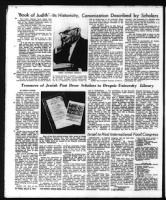

'Book of Judith'—Its Historicity, Canonization Described by Scholars
Two noted scholars have added their
knowledge to the production of another vol-
ume in the Dropsie University series of
"Jewish Apocryphal Literature."
"The Book of Judith," the new Dropsie
University volume, appears in Greek text,
with an English translation, commentary
and critical notes by Prof. Norton S. Enslin
of the Dropsie faculty.
There is a general introduction by Dr.
Solomon Zeitlin, Dropsie U. professor of
post-biblical literature.
The Hebrew and Latin texts of "The
Book of Judith" also are appended to this
work.
dith is conspicuous in all centuries. Many
are the scenes found on the walls of the
catacombs which portray incidents in the
story as we know it."
Prof. Zeitlin's share in this book is
additionally valuable. It commences with
a thorough analysis of the story—second-
ing Dr. Enslin's view that it "is an ex-
ample of Jewish fiction at its best"—and
his complete account of Judith's courage
in confronting Holofernes just before he
was to starve Jerusalem into submission,
thereupon to conquer the capital of Ju-
daea, gives the reader a splendid intro-
duction to the entire theme.
It is not only the voluminous notes by
both authors that enrich this work, but
also the excellence of the translation of
Prof. Enslin, his appended lengthy est-
planatory annotation, his descriptive in-
troduction in which he draws upon the
scholarly commentaries from Greek, Latin
and Hebrew sources.
Exclusion of "Judith" from the Hebrew
canon becomes a subject for interesting dis-
cussion by both scholars. Prof. Enslin deals
extensively with the status of the "apocry-
phal" works—describing it as "a term which
Catholic historians tend to tle for books in
neither the Greek nor IlebrKst Bibles, and
which Protestants often style 'pseudepi-
graphical.' "
Dr. Enslin calls attention to "effective
use of Judith's prowess (she beheaded Holo-
fernes while he was threatening to invade
lg. Jerusalem, in the apocryphal story), several
times." notably in Chaucer's "The Monke's
Tale," On this score, Prof. Ens lin states:
"So far as its position as canonical or
noncanonical Scripture and its use in regard
PROF. SO! OMON ZEITLIN
to church doctrine orr Practice , s concerned,
the situation of Judith is essentially -.hat
of the other writings dubbed Apocryp:ta;
but in is influence in popular circles Ju-
Dr. Zeitlin contrasts the stories of Esther
and Judith, indicating the differences which
eventually led to the canonization of the
Book of Esther while that of Judith is
classed in the Apocrypha.
He explains that Esther is not a religious
book, the name of God is never used in it,
while Judith is a religious one. The canoni-
zation of the Torah took place in the era
of Ezra and Nehemiah, in 444 BCE, and,
Zeitlin states, some sages "endeavored to
find in it (in Esther) passages that showed
that the book was 'an inspired one.' " Not
all the sages agreed. The differences are
referred to and Dr. Zeitlin points out:
"The decision to include the Book of
Esther in the Hebrew Bible was made at
the academy of Ousja, ca. 140 CE. After
its acceptance in the Hebrew Bible, the
Mishne Megila was compiled, dealing
with the laws of the writing of Scroll of
Estlt.tr and the reading of it on the days
of Purim."
Judith was excluded because of the in-
junction, "An Ammonite or a Moabite shall
not enter into the assembly of Yahwe
Ruth was :ntered, but the injunction, it is
explained, was against men.
The reasons for the apocryphal role of
Judith are more extensive and Zeitlin's ex-
planatory chapter adds scholarly research
to an interesting subject relating to Bible
canonization.
The 4th Century BCE is given as the
date of the composition of Judith, and it
is asserted that it is in all probability en-
tirely fiction.
With regard to canonization, Dr. Zeitlin
adds the following interesting data:
"The Catholics accepted the book of
Judiin as a p-rt of the Bible. The Vulgate
has, after the book of Nehemiah, Tobit, Ju-
dith and Esther. The Protestants placed the
book of Judith among the Apocrypal books.
To the Jews, the book of Judith is an 'out-
side book.' Although Judith is an extra-
canonical book it influenced Jewish thought
and literature . . There is some kernel of
history that the story of Judith was con-
nected with the victory of the Hasmoneans
over the Syrians. As a matter of fact, the
Midrash of Judith gives Holofernes as the
king of Greece. It is probable that the book
of Judith was read by the Jews in the syna-
gague during Hanuka together with the
Scroll of Antiochus."
The new Dropsie volume is dedicated to
the memory of Dr, Abba Hillel Silver (1893-
1963), and a preface by Prof. Zeitlin pays
honor to Dr. Silver as a great scholar as
well as a fighter for justice to the Jew
and as one who "exhibited great courage in
expounding his views."
Treasures of Jewish Past Draw Scholars to Dropsie University Library
By HARRY GERSH
iw
-
and in Philadelphia — are
catalogued and therefore of
immediate value to scholars.
Included in the collection
at Dropsie is the oldest
known Hagada, dating back
to the 8th Century.
Of special interest is one
of the longest and oldest
letters in the world; it runs
on for 4,000 Hebrew words
(translated into English it
would
be 6,000 or 7,000
People come from all over
the world to see in one small
corner of Philadelphia the
buildings, manuscripts, arti-
facts that make the begin-
nings of this nation come
alive. In Philadelphia's mu-
seums, in public and private
collections, can also be found
the roots of other nations and
peoples going back to the be-
ginnings of civilization.
But there's one treasure
house of the past in this city
that's far better known to
scholars at Oxford and in
Rome, Leningrad and Paris,
than to Philadelphia's own
citizens. This is the Dropsie
University Library, in which
can be found some of the
earliest writings and memor-
abilia illustrating the Jewish
past.
K. In the basem en t of this
classic college building are
three special rooms and a
walk-in vault. And in this air-
conditioned, humidity-
controlled fastness are bits
of clay and paper and vel-
lum, parchment manuscripts,
books from the first presses
to use movable type, rarities
of all kinds. Each is a link
in the chain that ties this
generation of Jews to their
ancient heritage.
For centuries before World
War I, Jewish scholars in
what was then Russia gather-
ed collections of mann-
scripts on Judaism and Heb-
raica. After the Russian
Revolution in 1917, the rani-
ties were gathered together
in Moscow and Leningrad—
and, for all practical par-
words). Written in 1064, the poses, were lost to Western
letter from a Sicilian Jew to scholars.
an unknown recipient, tells
In 1956, Dr. Katsh, then
of the writer's voyage to head of the department of
Tunisia where he faced death Judaica at New York Uni-
in a civil war among the versity, visited Russia and
Muslims, and about his busi- obtained microfilm of im-
ness affairs. portant parts of these col-
Another treasure at Drop- lections. Later visits in 1958,
sie, brought to the school in 1959, 1960 and 1969 enlarged
1967 by Dr. Abraham I. his microfilm collection. The
Katsh, is a collection of microfilms are now in the
Copy of the first printed sermon (left) given by Rabbi
Isaac Kargil at Newport, R.I., 1773. On the right is the
Baron Guenzberg Hagada, from the manuscript collection
in the USSR. Both are housed in the Dropsie University
Library, Philadelphia.
•
vault are codices of Arabic,
Hebrew, Persian, Samaritan,
Sanskrit, Coptic, Ethiopian,
Greek, Turkish manuscripts
by the hundreds. Then come
One room includes hun- the incunabula produced be-
dreds of books published fore 1500.
within a 200-year span-1500
Among the Americana is
to 1699; another has Bibles
and books on the Bible; in a piece of yellow paper, its
still another are clay tablets edges crumbled and brown,
recording in cuneiform the preserved behind a window
affairs of businessmen circa of clear plastic. It reads:
3,500 BC. Up three steps "Sermon preached at the
from the rare book roams Synagogue in Newport,
are the periodical stacks; Rhode Island, on the Pente-
ow on row, shelf on shelf of cost (Feast of Weeks) the 6th
complete files of magazines day of Sivan in the Year of
a n d newspapers, scholarly the Creation, 5533, or May 28,
and popular, dealing wit h 1773, By the Venerable
Judaica and the Middle East. Hocham, the learned Rabbi
(The rest of Dropsie's 100,- Ilaym Isaac Karigal of the
000-item library, for daily City of Hebron, near Jeru-
use by its students, is in the salem, in the Holy Land."
annex building on the second
A signature in faded ink
floor. )
shows that this first printed
Against one wall of the Jewish sermon given in an
44—Friday, March 2, 1973
microfilms of the formerly
inaccessible USSR Hebraica
material.
•
•
American synagogue belong-
ed to Benjamin Seixas, mer-
chant of the city of Phila-
delphia at the time of the
Revolution.
Perhans the greatest treas-
ure in the Dropsie vault is a
collection of 450 pieces of
paper, papyrus, vellum and
parchment from the Cairo
Geniza.
Dropsie University, the only
place in the Western World
in which they can be studied.
Studying these manu-
scripts, Dr. Katsh discovered
some significant differences
between the printed texts of
the Talmud and earlier
manuscript versions. His
findings, as noted in his re-
cently published "Ginze
Mishna," includes a talmudic
caution that rouses the ire
of women's lib. The printed
version says: "Who so en-
gages in much gossip with a
woman brings harm to him-
self, for he neglects study of
the Torah ... " The original
reading, according to a Ge-
niza fragment, is: "Who so
engages in much gossip with
a woman when she men-
struates, brings harm . . ."
etc.
Israel to Host International Food Congress
JERUSALEM — In biblical Congress will be held here 1 siwicaeterwhainted tis r g eusecie....sdoadry
ked. In
times Israel was known as June 25-July 2.
ki teaspoon salt
teaspoon
black
the land of milk and honey,
pepper
Sponsored
by
Israel's v•
dy, chopped
and in more recent years or- ministry of tourism, it will 1 t sViariscrs
n r chPo'
anges, olives, eggplant and be organized by the Chaine
1 teaspoon lime Juice
a
tomatoes
almost every other kind of des Rotisseurs, Israel's cul-
fruit and vegetable have been inary society. The congress boCcitok twhaeteurnpuenetlild teengfirlanit elenl
added to the repertory, will offer participants a and put the pulp through the
iglancd
e ern waith
miTiengeggswal nad bread.
With the mixture of cul- chance to sample and view
r•per. Stir
tures from East and West, foods from Israel's best res- son with salt and pepper.
the rich produce of Israel taurants, and includes a Be- in ‘I hietTpar'I TC'e 'atm: Pt:Id-
en S d'atilllon
ro-s
douin
lunch
in
the
Negev
IT. HouLjnout the tomatoes, be-
has been used to create
Ing careful not to puncture the
one of the most original and desert.
For Bible fans there will stt e i ns gFg.PlIlattl Ir n:inant=. cases with
varied cuisines on the inter-
serve. a.
national scene. Today Israel be a "Loaves and Fishes"
•
•
•
lunch
at the Sea of Galilee.
boasts continental cuisine of-
CHICKEN IN
Lectures
a
n
d
discussions
fered by chefs trained in the
PINEAPPLE and CHERRY SAUCE
kitchens of France, Switzer- about food and wine will be
land and Italy, as well as conducted by Israeli experts.
'ground
cSlisk i lo n onurrig7nagreee4
Arabic, Yemenite and North The highlights of the week V11 sticks
will
be
a
contest
by
the
African dishes prepared by
2 cup i k s s c hTcagna rstec k
Israeli chefs for the creation i cup brown sugar
native chefs.
,A, cup wine vinegar
of a unique Israeli menu.
Soy uce
In early pioneering days,
For adventurous chefs who 1 smalls s can pineapple, chunks
while halutzim were busy
1 sm
unat-scinan
ed
cannot make it to Jerusalem
clearing swamps and planting
red cherr,s
this summer, a sampling of
s
the chicken quarters in
trees to make the desert
unique Israeli recipes "At half. Rinse
inse and dry well. Sprin-
bloom Israelis had no time
7, irtohwngirilngerr,,,a dr,tinine flour
the Table of Israel" by Sandy
to experiment in the kitchen. Lesberg to be published in and
e.
t flameproo
h
I
e p oo f n dcaysi s n eergoalre . n Co mbine
Gradually a new interest in 1973 b
in
sauce - .
istock a nd
Peebles Press, is as
Dan. Add soy sauce according to
gourmet cooking developed. follows:
taste. Pour the resulting mixture
To help celebrate Israel's
EGGPLANT-STUFFED
over the chicken. Add pineapple
O Nl AT 0 E S
25th anniversary year, an
with syrup and cherries. Cook
It was in the geniza (burial
crypt for books) of the Cairo
Synagogue that for some
1,300 years accumulated the
books and records of the
Jewish community of Fostat
(Old Cairo).
Since its discovery by
scholars in the late 1800s,
some 250,000 separate items
of writing were uncovered.
Unfortunately, most of the
Geniza material is unorgan-
ized, undeciphered, unpub-
lished, even uncatalogued
Only the collections in Ox-
THE DETROIT JEWISH NEWS ford, New • York, Budapest- International Gastronomic
I pound eggplant
T
2 eggs hard cooked -
ove
s
r r ,..
medium
Ium flame for ifs hour.