

Elijah's Role in Jewish Traditions1Barbados—Smallest
Visitors to the Hebrew Union
College Museum on the Cincinnati
campus of the Hebrew Union Col-
lege-Jcwish Institute of Religion
acquire a renewed sense of what
Passover has meant in Jewish life
and history. The museum's collec-
t ion inc u es numerous objects
which reflect the observance and
significance of the Passover fes-
tival.
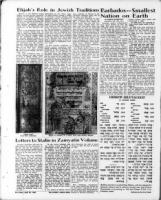
There is an engraving from the
Mantua Hagada, dating back to
1568. It shows the prophet Elijah
before the doors of a house sound-
ing the messianic shofar, while
the Messiah himself, pictured, in
the words of Zachariah 9.9, "riding
upon an ass," precedes him. Above
the illustration are the relevant
passages from Psalm 79.6: "Pour
out Your wrath upon the nations •
that do not know You," recited
on Passover eve when opening
Me door to greet Elijah. the mes-
sianic guest.
The most prominent place in
Jewish folklore, art and customs
is g iven to Elijah. Savior, guar-
dian angel, and compassionate re-
deemer. he has special signifi-
cance during the Passover, for it
is he who is to bring tidings of
redemption on the Seder night.
To make Elijah's coming a reality
at Passover, various customs and
ceremonial objects developed in
Medieval Europe. One of the most
popular customs is the opening
of the door for Elijah, during the
Seder, a practice which seems to
have arisen in 15th Century Ger-
many. No doubt, it was prompted
by the persecutions, -vilifications,
and ritual murder accusations to
which the Jews of Medieval Ger-
many were subjected. In response
to these miseries, they fervently
hoped and prayed for the coming
of the Messiah who %would offer
them a needed escape on the tra-
ditional night of redemption, Pass-
over night.
rope, probably an illusion to the
sacrificial Passover lamb and to
. the song "An Only Kid."
Prominently displayed on most
Seder tables is the "Cup of Eli-
jah," a custom that cannot be
dated earlier than the 16th Cen-
tury. Larger usually than t h e
other cups, this special wine cup
was made of silver or glass and
often carried a depiction of Elijah
and the Messiah on his ass. The
Cup of Elijah, well represented by
some fine examples in the Hebrew
Union College Museum, was an-
other inducement for Elijah to be
present at the Seder and to lead
every household of Israel to the
promised redemption. Israel Zang-
w i ll 's s stor!., "Elijah's s o ,"
vividly recaptures the significance
It also became customary to of ija at e
fashion special decorative hand
But Elijah's goblet stood in the
towels, faithfully and lovingly em-
Every
broidered by the women of the center of the table untasted.
time
the ritual cup-drinking came
house. Hung at the entrance of
at
the Seder room, the towels were round, the children had glanced
sometimes intended for Elijah, so the silver goblet placed for the
Prophet
•
of
Redemption.
Alas!
the
that he could dry his hands after
the prescribed ritual handwashing brim ming raisin wine remained
and take his honored place at the ever at the same level.
They found consolation in the
Seder table. One such towel in
the Hebrew Union College Mu- thought that the great moment was
seum carries the name of its still to come—the moment of the
owner, Abraham Bluemche. It was third cup. when, mother throwing
made in Southern Germany in open the door, father would rise,
1821 and has in its center a scene holding the goblet on high, and
of a man leading a lamb by a sonorously salute an unseen visitor.
N
ation on Earth
By PHILIP SLOMOVITZ
(Copyright, 1967. JTA, Inc.)
Barbados gained independence
from Great Britain on Nov. 30,
1966. This most easterly of the
Caribbean islands has the distinc-
tion of being the smallest nation
on earth. The 166-square mile ter-
ritory has 250,000 inhabitants and
is the most densely inhabited in the
Western Hemisphere — with 1,500
people to the square mile.
It is one of a number of British
colonial possessions to have gained
independence recently—the others
being Jamaica, Trinidad and Toba-
go in 1962 and Guyana in 1964.
Presently, this former British
West Indies island has approximate-
ly 100 Jewish residents. There is
a synagogue but no school. There
are about 40 Jewish children of
school age and about a dozen of
them attend Christian schools.
The Barbados Jewish Center is
located at 256 Bridgetown. There
is a WIZO chapter with 35 mem-
bers.
Nevertheless Barbados has a long
history of Jewish settlement. The
island was first colonized in 1625
an d the Jews believed to h ave
been among the earliest settlers
dating back to 1628. There is on
record a letter that was written
by Abraham Jacob. Sept. 22. 1628 ,
to the then owner of the island,
Earl of Carlisle, and there is a
Barbados Jewish tombstone dated
1658.
Records show that Jews gained
equal rights on Aug. 12, 1656. But
when England waged war with
Holland in 1667, Jews were ac-
cused of illicit trading with the
Dutch and their merchandise was
ordored seized. Vessels from Am-
sterdam carrying merchandise for
Jewish traders were seized and
confiscated in 1669.
In 1660 Jews are reported to
have owned sugar works in Bar-
bados.
In 1668, Jews were restricted to
hold only one slave each, but a
petition for the removal of res-
trictions on Jews was circulated
in 1669 and was granted soon
thereafter.
In 1670 there were 184 Jews
in Barbados — 54 of them adults
who were recorded as having pos-
sessed 163 Negro slaves- -slavery
having been legal for Caucasians.
- Records also show that there
were 260 Jews in June 1681.
there were 147 synagogue mem-
bers in 1792 and the numbers
began to decline is IV• shell it
was reported that Bat. had
71 Jews — 38 of them sy • *see
members.
It was the decline in the corn
munity's numbers that caused the
filing of a petition for relief from
taxation in 1873 and the request
was granted in 1874 .
In 1899 the number of Barbados
Jews declined to 17 or 18. includ-
ing women and children.
Congregation K a h a I K ad osh
Nidhe Israel of Barbados had a
number of religious ministers which
had been selected by the Spanish
Portuguese Synagogue of London.
In spite of the few remaining
Jews there, for a number of years
the venerable E. S. Daniels kept
the house of worship open on Sab-
baths and holidays, even when he
often was the only person in at-
tendance.
The independence of Barbados
and the expected revival of eco-
nomic activities there poses the
problem anew whether this island
may again attract Jewish settlers.
HEBREW SELF-TAUGHT
BY
side
tsand
right
yah-rneen
left
emohl
smoke (m.s.)
neah-shehn
sleep (m.s.)
sah-shehn
Elijah towel
from HUC collection.
Elijah at entrance of a borne, from 1568 Mantua Hagada
Letters to Stalin in Zamyatin Volume
Yevgeny Zamyatin will long be
remembered for his dedication to
his art and for his courage to
speak out in protest against preju-
dice in Russia and for his appeal
to Stalin in his own and his art's
defense.
His works first were published
in Russia in 1913. He returned •
from London in 1917 and com-
menced his writings anew and his
literary criticisms, but even Trot-
sky. before he himself was de-
ported, criticized him and called
him "an internal emigre." Stalin
condemned him to "a literary
death" and in June 1931 Zamyatin
wrote an appeal to the Russian
dictator in which he stated:
"To me as a writer, being de-
prived of the opportunity to
write is. nothing less than a
death sentence. Yet the situation
that has come about is such
that I cannot continue my work,
because no creative activity is
possible in an atmosphere of
systematic persecution that in-
creases in intensity from year
to year .; • .
64
—
Friday, April 21, 1967
"In the Soviet criminal code
the penalty second to death is
deportation of the criminal from
the country. If I am in truth
a criminal deserving punish-
ment, I nevertheless do not think
that I merit so grave a penalty
as literary death. I therefore
ask that this sentence be changed.
to deportation from the USSR—
and that my wife be allowed to
accompany me. But if I am not
a criminal. I beg for at least
one year, with the right to re-
turn as soon as it becomes pos-
sible in our country to serve
great ideas in literature without
cringing before little men, as
soon as there is at least a par-
tial change in the prevailing
view concerning the role of
the literary artist. And I am
confident that this time is near,
for the creation of the material
base will inevitably be followed
by the need to build the super-
structure—an art and a litera-
ture truly worthy of the revolu.
tion."
It was thanks to Maxim Gorky
that-Zamyatin was able to leave
Russia in 1931. He died in France
in 1937.
If it were only for the complete
text of the letter to Stalin, in-
cluded in the collection of 15 of
Zamyatin's stories, published under
the title "The Dragon," by Ran-
dom House, this volume would be
worth more than its price. But the
collected stories, very ably trans-
lated by Mirra Ginsburg, repre-
sent a total portrait of the author,
mirroring his stature as a literary
artist, his evaluative powers, his
skill at depicting religious themes.
"The Dragon" is the shortest
of the stories in the book—it is
a compactly narrated tale in less
than two pages. The themes, the
spirit of Russia emanating from
them, throw light on the merits
of a symbolic type of Russian
literature.
Miss Ginsburg's introductory
essay helps enrich the volume as
an informative explanation of the
author whose works she translated,
his works and their significance in
THE DETROIT JEWISH NEWS] relation to Russian literature.
TY
AHARON ROSEN
place
mah-kohn.
air
alt-veer
sun
she-mesh
hero
gee-boltr
.266
r?: .267
,10311.,
6
.268
.269
neighbour
.270
■
rx rating/ run ntrx -
?nnix nnx xingi ,ntfx;;I
:1-mn nand -
rufg wig!" 1 -'71rig '7171 "
•ytgi p -Aitv `min
urriV?P rir,1 7,1
n7:7 rIV? ,r?P
•ri7rligL?P ntmx
Titint# '7tg aninn na-
shah-khehn
.261
.262
.263
.284
.265
,Mptg-ron4:, 13'1.70i1 watt
•
Thorns ,n in clipn'?
1 :17134
•
an
n17n4
vaR
intsi .nb np: Ana
niron rthOn
nxii nix nb 0701
nx
nx ;1411
Arnu
"1.;" nx1 1 im4r1 rtept#
Titek7 =i0
- nxin nr)x
Is» pr'n rat rrlinp; nb
nimnm rim .310 n:;1 22'7
nb nnin nib: ni,tmitrr
rig) 0121? •••te71 ig:tg
rzipvg ,z7xbtr? Ix» pniq
-.074-rp4n
nnx ;rim)
.1v1In Klno nxii
. 1k4
'14t4 ilt -
rItimv? , znqtr4 rung rx
nnirl rig I?: 13?? nx iti
?trrItOz?P'7
IsP Tio7S D17 n urn
unlit; nnx xintg ,nrektu "7
`717 nnln .z7xbtt:
Tr.5 ,pr
Mil ill
, Ht ir)?1,7 rilry)
•RODP3.
Reailing material in vocalized Easy Hebrew, anif also material for
advanced students may be obtained through your local Hebrew
Organization or by writing to: Brit Ivrit Olamit, P.O.B. 7111,
Jerusalem, IJrael,
Published by Brit [nit Olamit