

Religious Editors of All Faiths
Study Pluralistic Society Roles
A i that killed more than 250 per- patched to aid the stricken city.
NEWARK, N. J., (JTA)
The Americans gave first aid
New Jersey Jewish physician led sons.
Capt. Harry N. Shaklan of and drugs to victims, helped
the first medical aid team to
Hillside, N. J., headed a four- search the debris for other vic- (Special to The Jewish News)
arrive at Al Marj, the city in man parachute team from the tims and helped move the in-
NEW YORK — The urgent
Libya demolished by earthquake 1Weehlus Air Force base dis- jured to a Libyan army hospital. need to understand the view-
points of spokesmen for other
faiths and to be able better to
evaluate differences in Ameri-
can life were reviewed in a
three-day conference on "The
Religious Press in a Pluralis-
tic Society," held last week at
the St. Moritz Hotel here.
Called together by the Na-
tional Conference of Christians
and Jews, with the cooperation
of the American Jewish Press
Association, the Ass o c i a t e d
Church Press and the Catholic
Press Association, the partici-
pants included editors of Catho-
lic, Jewish and Protestant jour-
nals.
Discussions were geared to ac-
quire knowledge about the func-
tions of the religious press, the
influence it exerts upon its
readers, the pressures that are
being exerted upon editors; as
well as such subjects as "legis-
lation of morality," the prob-
lems relating to education and
the controversies over requests
for public funds for parochial
schools.
Sharp differences of
opinion arose over the status
of the English-Jewish press
and its influence in the func-
tions of the American Jew-
ish community.
Dr. Ira Eisenstein, editor of
the Reconstructionist, who gave
"a descriptive evaluation" of
the Jewish press, was skeptical
about the future of the English-
Jewish press and declared that
it "reflects and reports the pre-
vailing views of denominational
groups and Jewish organiza-
tions." He expressed the view
that "rarely can it be said
that the press influences the
denominations and the organi-
zations," that: "In this respect
the press is extremely weak.
One may almost say impotent."
In contrast, the Catholic and
Protestant spokesmen envision-
ed a progressive future for
their periodicals.
Philip Slomovitz, editor of
The Detroit Jewish News, dif-
fered with Dr. Eisenstein, con-
tending that the two surviv-
ing Yiddish dailies, with a
total circulation of 120,000,
still exert a great influence
upon the. Yiddish-reading pub-
lic, and that the English-Jew-
ish press, which now plays
the major role as the domi-
nant American Jewish press,
is influential in a score of
communities throughout the
land.
Joseph Weisberg, president
of the American Jewish Press
Association, similarly claimed
that the English-Jewish press
plays a decisive role in Ameri-
can Jewish life, and he pointed
to the developments over the
Sabbatarian issue in Massachu-
setts to indicate how his paper,
the Jewish Advocate of Boston,
succeeded in drawing wide at-
tention to a grave issue.
Weisberg also emphasized the
role of the Jewish press in
other matters involving legisla-
tion in a discussion that again
brought to the fore the role of
the press in public contro-
versies.
Last week's editors' confer-
ence was part of the project
"Religious Freedom and For-
eign Affairs," designed "to raise
the general level of public un-
derstanding and discussion on
issues of public concern about
religious groups differ."
The main objectives of the
project are described as being
"to analyze the practical and
theoretical problems involv-
ing political actions and re-
ligious freedom; to effectuate
a greater understanding of
the significance of those re-
ligious commitments that af-
DISTRIBUTED BY
fect public policy; and to
lessen needless conflict cre-
ated • by different religious
approaches to social prob-
lexns."
TO 5-1566
15391 Idaho, Detroit 38 Mich.
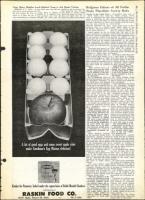
A lot of good eggs and some sweet apple cider
make. Goodman's Egg Matzos delicious!
GOODMA
Kosher for Passover, baked under the supervision of Rabbi Mendel Chodrow
RASKIN FOOD CO.
,
Nevertheless, there were, at
the editors' sessions, expres-
sions indicating differences of
opinion, especially on matters
involving the pressures in sup-
port of public financing of paro-
chial schools.
Rabbi Joseph Klein of Wor-
cester, Mass., editor of the
Journal of the Central Confer-
ence of American Rabbis, de-
clared that "the Jews of the
United States are almost unani-
mous in their opposition to the
teaching of religion, or any
form of compulsory practice or
indoctrination, in the public
schools of the This op-
position includes the recitation
of prayer in any form, the read-
ing of the Bible in the class-
room under the coercion of
state law, the celebration of
Christmas, Easter, Hanukah and
Passover."
Rabbi Klein added that there
is a small group of Orthodox
Jews that favors the reciting
of religious prayers in the pub-
lic schools and that has joined
in requesting public support
for their parochial schools.
Rabbi Arthur Gilbert, staff
consultant of JCCJ, who or-
ganized the Press Institute,
and Miss Lillian Block, editor
of the NCCJ Religious News
Service, presided at two of
the sessions.
Dr. Lewis Webster Jones,
NCCJ president, and Dr. Du-
mont F. Kenny were among the
active participants.
Jewish spokesmen who joined
in the discussions included
Rabbi Samuel Dresner of Wor-
cester, Mass.; Rabbi David Sil-
verman of New York, Rabbi
Norman Lamm of New York.
Nationally prominent Chris-
tian editors who shared in the
conference sessions included
James O'Gara, editor of Com-
monwealth; Rev. James M.
Flanagan, editor of the Chris-
tian, St. Louis; Harold E. Fay,
editor of Christian Century;
Wayne Cowan, editor of Chris-
tianity and Crisis; Msgr. Daniel
Moore, St. Louis Review editor;
Prof. Roland E. Wolseley, Syra-
cuse University School of Jour-
nalism; and a number of other
prominent religious editors. The
representation included 31 edi-
tors of Jewish, Catholic and
Protestant periodicals published
in cities from coast to coast.
The responsibilities of the
religious press are greater in
a pluralistic society where
there are many viewpints than
in a monistic society where
there is only one religion,
Prof. Wolseley said.
He added that in a pluralis-
tic society like that in America
the religious press has greater
responsibilities than the secular
press, because the secular preSs
is exempted by tradition or
more from some responsibili-
ties that are taken seriously by
the religious press.
As an example, Prof. Wolse-
ley said, the major part of the
daily press "is given to fre-
quent use of- news stories that
emphasize conflict without much
thought to the social conse-
quences."
He listed seven responsibili-
ties which the religious press
should fulfill—to serve God, to
inform, to educate, to interpret,
to persuade, to reconcile and to
develop loyalty.
Prof. Wolseley said the ma-
jority of the religious press
was strongest in the areas of
persuading and developing loy-
alty.
Formation of a religious press
association to deal with com-
mon problems of Protestant,
Catholic and Jewish publica-
tions and to make a united im-
pact in the area of social de-
velopment and social morality
was urged by Msgr. Richard H.
J. Hanley, editor of the Long
Island Catholic.
Weisberg said, "We should
be the pace-setters where the
social order is concerned."
1 3 THE D ETROIT JEWISH NEWS — Frid ay, M arch 15, 1963
Capt. Harry Shaklan Leads Medical Team to Aid Quake Victims