

'The Tragedy
of Yiddish':
Sad Facts
and a Measure
of Optimism
Commentary,
Page 2
E %'
.11 WISH NEWS
:„tiz\
A
Michigan's
. Vol. XXXVI, No. 1
i, 1, et, ''‘ ' c0 ''-'`:b
‘ v. \'
A C)
106
el
of Jewish Events
,(1 Newspaper--Incorporating The Detroit Jewish Chronicle
Population
Errors in
Church Report
Israelis
Excel in
American Quiz
Boris Smolar's
Column, Page 2
W. 7 Mile Rd.—VE 8-9364—Detroit 35, September 4, 1959 $5.00 Per Year; Single Copy 15c
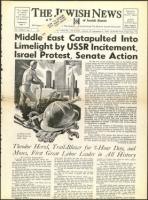
Middle' East Catapulted Into
Limelight by USSR Incitement,
Israel Protest, Senate Action
r>,•?;„,
<.<-
...•••••••••••••••••••••••••
On the eve of the exchange visits of the heads of the
United states and the Soviet Union governments—President
Dwight D. Eisenhower and Premier Nikita Khrushchev—the
Middle East issues were suddenly catapulted into the lime-
light by a number of developments involving Israel and the
Arab nations.
Renewed attacks on Israel by Moscow Radio, a pro-
Nasser statement by Senator J. W. Fulbright, chairman of
the U. S. Senate Foreign Relations Committee, and protests
taken to the United Nations by the Israel - government
against Egyptian seizures of mail addressed to Israel and'an
the Suez Canal issue involving freedom of the seas, were
the major issues that arose this week.
Meanwhile, efforts were being made in New York, by
an ad hoc conference of Jewish organizations, to secure an
audience with Khrushchev during his visit in this country.
With heads of 18 national Jewish organizations meeting "in
a spirit of general unity and agreement," it has become evi-
dent that the American Jewish Committee still is abstaining
from participation in the unified program of action. In New
York, on- Tuesday, Dr. John Slawson, speaking for the Com-
mittee, stated, however, that the Committee was working
with the conference of. national Jewish organizations whose
heads are united in a Presidents' Club.
In a repOrt from Washington, JTA quotes a spokesman
for the Soviet Embassy as stating that he was unaware of
any invitation to Jewish groups for a meeting with Khrush-
chev. The USSR spokesman said that the Embassy in Wash-
ington received "several" letters from various Jewish or-
anizations requesting a meeting with Khrushchev and the
p ossibility was acknowledged that such a meeting may be
cheduled, but so far no arrangements had been made by
Soviet authorities to include a meeting with Jewish leaders
on Khrushchev's agenda.
JTA learned on Tuesday, in Washington, that Philip M
Klutznick, chairman of the President's Club, had formally
requested the Soviet Embassy to arrange for a meeting with
Khrushchev on behalf of the heads of the 18 organizations
he represented:
From London, JTA reports that Moscow Radio told its
Arab listeners that Israel was speeding construction of a
ipeline to carry oil-from the Red Sea to the Mediterranean
to "sour Israel's war plan." In its inciting broadcast, Moscow
.
A Salute to the
Wage Earner on
Labor Day!
-
. -
(Continued on Page 32)
Theodor Herzl, Trail-Blazer
Hour Day,
. , and
Moses, First Great _L abor Leader Zn ill Thstoty •
•
BY DAVID SCHWARTZ
(Copyright, 1959, Jewish Telegraphic Agency, Inc.)
Theodor Herzl wanted the flag of the Jewish
State to have seven stars for the seven-hour work-
day which he hoped it would pioneer for the world
as Moses had blazed the way for the seventh day
• of - test from labor.
Moses was the first g seat labor leader of history.
He organized the E.F.B.L., the Egyptian Federation
of Brick Layers, the first great bricklayers union.
He negotiated with Pharaoh for better working
conditions, but Pharaoh, instead of improving the
conditions, made them harder. They were to make
as many bricks as before and, besides, would have
to find their -own straw.
"This is the last straw, - said Moses, and the
bricklayers staged a walk-out.
_Moses not only gave labor a weekly day of rest
but every seventh year a sabbatical vacation for an
entire year. He also gave them all the good that
Henry George promised labor from the Single Tax,
for every man was to • get his portion of the land.
Every workingman was his own landlord. And labor
was protected from loan sharks by the prohibition
of interest on money.
"Behold," says Ben Zoma in the Talmud "hnw
much labor did Adam, the first man, have, before
he found a garment with which to clothe himself:
He sheared the sheep, whitened the wool, dispersed
it, spinned it, dyed and sewed; only after doing all
these things did he find garments to clothe himself,
but I rise in the morning and find everything done."
We are all indebted to those who labor with
their hands.
Reb Chiya said: "He who enjoys life through
the labor of his hands is greater than he who
fears God."
Working-men built the Talmud. Hillel was a
woodchopper; Jose ben Chananyah, a charcoal
burner; another, Reb Jose, was a shoemaker; Akiba
was a shepherd. We don' t get so many labor men
in Congress today to make the laws.
When the Messiah comes, says the Talmud,
ready-made clothes and bread will -grow from trees.
Think of eating a slice of bread fresh from a
pumpernickel tree.
One sage of the Talmud tells us that in the
world to come the wolf will spin flax and the dogs
will open gates. "This world," says the Talmud,
not like the world to come: In this • vx
there is a
ggle to collect the grapes and press
4„1,.;
,
brought in a wagon from which the entire support
of the house will be secured."
That those great days are coming we may be
sure from the advances already made by labor.
To obtain further advances for labor, the
laborer must -be educated as well as the employer.
Apropos of this, one of the most prominent labor
leaders of New York's East Side recalls an interest-
ing anecdote of some 40 years back. The unions had
won their fight for an eight-hour day and it was
abdut to come into force. This particular union
leader felt that the eight-hour day would mean a
renaissance' of home life. The workingman, coming
from his labors, would have time to devote to his
household.
The union leader made a glowing speech about
the promised revolution in domestic life, but only
one of his audience applauded. Well, he was happy
that at least one workingman saw the vision. He
approached the man and said, "I see that you
understand .the meaning of the eight-hour day in
revolutionizing home life."
"Oh no," said the workingman, "I was thinking
that with the eight-hour day, I would he able ht