
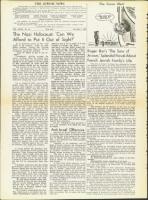

The Nasser Bluff
THE JEWISH NEWS
incorporating the Detroit Jewish Chronicle commencing with issue of July 20, 1951
Member American Association of English-Jewish Newspapers, Michigan Press Association, Nation]
Uitorial Association.
Published every Friday by The Jewish News Publishing Co., 17100 West Seven Mile Road, Detroit 35,
XVI,ich., VE 8-9364. Subscription $5 a year. Foreign $6.
Entered as second class matter Aug. 6, 1942 at Post Offic,, Detroit, Mich.. under act of Congress of March
3871%
PHILIP SLOMOYITZ
SIDNEY SHMARAK
CARMI M. SLOMOVITZ
Editor and Publisher
Advertising Manager
Circulation Manager
C
FRANK SIMONS
City Editor
Sabbath Scriptural Selections
This Sabbath; the twenty-fifth clay of HeSh,V0A, 5719, the following Scriptural selections
will be read in our synagogues:
•
Pentateuchal portion, Hoye Sarah, Gen. 23:1-25:18. Prophetical portion, I Kings 1:1-31.
Licht Benshen, Friday, Nov. 7. 5:01 p.m.
VOL. XXXIV. No. 10
Page Four
November 7, 1958
The Nazi Holocaust: Can We
fford to Put it Out of Sight?'
In an historical review of the "Last
Fight in the Ghettos," under an addi-
tional heading "Facing the Terrible
Facts," in the London Observer, Edward.
Crankshaw posed the question:
"Can we afford to put it out of
sight?"
Crankshaw's stirring account de-
serves retelling. What he related were
not new facts. They are well known. They
should be in the minds of all the people
of this generation, in order that the
Nazi atrocities should not be forgotten.
The account is of the 15th anniver-
sary of the destruction of the famous
Jewish community of Bialystok in Rus-
sian Poland. The Warsaw ghetto had al-
ready been razed and the Nazis' S.S.
began to move to cordon off the Bialy-
stokers whom they aimed to lead to con-
centration camps and to gas-chambers.
* * *
Up to August of 1943, Jews had be-
lieved, when the S.S. criminals began
to herd them together to take them to
extermination centers, that they were to
be "resettled." "Even when they ar-
rived at their destinations," Crankshaw
wrote, "the terrible little railway sta-
tions, built at the ends of special spur
lines, were disguised as ordinary sta-
tions, and the new arrivals thought they
had come to be put to work. Even when
they — or all those not robust enough to
be put on productive work until they
were worn out — were taken to the gas-
chambers and made to undress, they
thought at first that they were being put
through a special delousing bathhouse."
Since "the atrocious truth could not
be hidden forever," an active revolt be-
gan and "small groups of brave and
defiant youngsters set to work to or-
ganize combat groups and persuade their
comrades to go down fighting." Tragical-
ly, the majority submitted. There was
fear, there was hope for escape by cun-
ning, "by luck, by skill, by bribery," but
60,000 fought. It was one of "the most
horrible and macabre of battles"—young,
rebellious Jews—"the starved and suf-
focated mass of men and women"—
"armed with nothing but home-made
grenades and Molotov cocktails (bottles
filled with petrol), and a few rifles and
revolvers," fighting against the S.S. and
its armored cars, tanks and artillery.
* * *
A young Jewish lad, Mordecai Ten-
enbaum, was the hero of the organizing of
Bialystok, Vilna, Warsaw and other com-
bat groups. They fought from the sew-
ers where they were hidden. They lost,
but at least they put it an record that
a minority' of brave Jews refused to per-
mit the S.S. to exterminate them like
rats.
Crankshaw comments that the Polish
government's report on the Battle of the
Warsaw Ghetto had not been put in evi-
dence at Nuernberg, but that the Bialy-
stok anniversary "is a good moment to
reflect that these deeds were committed
only the other day by one of . the most
advanced peoples of Europe." He adds:
"We talk about Western values with
the greatest of ease; but the extermina-
tion of several million human beings
because they were different was no
less a part of Western culture than
Goethe was a part of it .. .
"It is hard to comprehend this fact.
The whole story is so sinister that our
wider consciousness rejects it. Can we
afford to put it out of sight? It is not
enough to exclaim "Oh; Hitler . . .
and leave it at that. Hitler found will-
ing hands among outwardly respect-
able Germans. His worst killers, more
often than not, were Austrians. In
Russia, Poland, Hungary and Romania
he relied on traditional and deep-seated
anti-Semitism. Ukrainians, Lithuanians,
Latvians,_ Romanians, did some of his
most abominable work for him (always
under German or Austrian command).
The Polish Home Army, while cover-
ing itself with glory in its own later
fight for Warsaw, largely stood by and
let the Germans have their way with
the Jews of Poland. There remains still
the question whether Britain and
America could have saved more Jewish
lives than they did.
"Fifteen years is not long. It is
much too soon to forget. Perhaps it is
still too soon to start remembering. But
until we bring ourselves to face this
whole operation in all its evil, we are
really refusing to face ourselves."
Indeed, the Western powers could
have done much more than was done to
rescue many among those who were ex-
terminated . . . There was no need for
"coffin ships" on their way to Palestine.
Democracies were blind to realities . . .
Even so humane a person as the late Pope
Pius XII did not believe that a wholesale
massacre like Hitler's was possible. (He
was Cardinal Pacelli when he minimized
the Nazi danger—and he later referred
to his error as a mistake of his youth) .. .
But one thing is certain: it is much
too soon to forget. It must never be for-
gotten. The Nazi crimes must be en-
graved in the minds of young and old so
that they will labor with all their might
against their repetition.
Are we "refusing to face ourselves"?
Let it be repeated: It is much too soon
to forget.
Anti-Israel Offensive
Sparked by Soviet Russia and used
by Gamal Abdel Nasser as another means
of blinding the Arab masses to the reali-
ties of Middle Eastern economic trage-
dies, a new offensive has been launched
-against Israel.
Contrary to all evidences, and in
spite of Israel's denials, the Communists
and the Arab potentates are accu s ing the
Jewish State of seeking to annex a' piece
of Jordan's territory the moment the
British troops evacuate from there.
The fact is that the entire Middle
East would have been in complete chaos
were it not for the deterring factors of
Israel's ability to prevent infiltrations
into Jordan.
A New York Times observer, in his
analysis of the situation in Jordan pend-
ing the withdrawal of British troops on
Nov. 11, stated: "Aside from Israel, the
British observe, there is no force in the
Middle East to restrain President Nasser.
. . . Israel's clear opposition to any move-
ment of Egyptian troops into those areas
of Jordan contiguous to Israel is seen as
a restraining factor."
This should be an invitation to praise
for Israel and support of her position. But
that would, not be in the interests of
disruption aimed at by both Khrushchev
and Nasser. Therefore, a new attack has
been launched upon Israel, based on
false accusations. But, as usual, the truth
will out.
Roger lkor's The Sons of
Avrom,' Splendid Novel About
French Jewish Family's Life
"The Sons of Avrom," by Roger Ikor, published by Putnam,
(210 Madison, N.Y. 16), is one of the leading novels of our time.
In a splendid translation from the French by Leonard M. Fried-
man and Maxwell Singer, it deals with Jewish characters in
France and may be giving us some insight into the life of a
large sector of the Jews in France.
The story is more about one of the sons of Avrom—Yankel
—than about any one else, but it also describes the reactions
of the grandsons of Avrom, their assimilation into French life,
their disappearance from Jewish ranks.
Ikor, who was born in Paris in 1912 and is himself the
son of parents who had fled from Czarist pogroms, should be
considered well qualified to write about people of like lineage.
The author's childhood was spent in Paris and he knows his
native city and his country well, and it should be assumed that
he knows French Jewry. He studied philology at the Gymnasium
Mistral in 'Avignon, entered the French army in August of
1939 as an infantry lieutenant, was taken prisoner at Lille and
was in a Pomeranian prison camp for five years. Since then he
has worked on literary magazines, taught at Carnot Gymnasium,
and has written an earlier novel and two non-fiction books.
He is married to a doctor and they have four sons.
"The Sons of Avrom" won the highest French literary
prize, the Prix .Concourt, and the German Albert Schweitzer
Prize. In the English translation, it is worth equally high
acclaim.
The Prologue and the Epilogue of the novel are most
sympathetic approaches to the interesting characters in the
story. In the prologue, Yankel Mykhanowitzki meets Baptiste
Saulnier, his son's father-in-law, at the grave of their grandson,
Jean-Claude Saulnier Mykhanowitzki, who was shot by the
Germans. They share a common grief, but in different fashion
—as different as Jew is from Christian.
Pangs that afflict a Jewish grandfather at the grave of a
half-Jewish grandson are evident in this moving narrative. But
in the Epilogue, which pictures the retired Yankel, aged yet
ageless, who outlived his non-Jewish mechutan, the hero of the
story is reconciled with his fate. He is part of his son Simon's
life and his non-Jewish family.
Yankel is described "stealing" • across the Russian border
into Germany, on his way to France. He sees in many obstacles
the evidences of anti-Semitism, and often he is wrong in his
prognosis and fear. He aspires to become integrated into French
life. He glories in Victor Hugo and Voltaire and the Revolution.
But he will not change his name. He adhered to his Jewish
background.
His wife and child arrive in Paris from their home town of
R.akwomir which always creates nostalgia for him. He must stop
his dreaming to support his, family. He begins to prosper in his
capmaking business.
But the children are thoroughly French. Simon marries,a
farmer's daughter. He has no interest in Jews. Most of the other
children, and certainly the grandchildren, are lost to Jewry,
There is total assimilation. But the name Mykhanowitzki remains.
Thus, when Yankel nostalgically looks through a Paris tele-
phone directory, he finds the names —
Mykhanowitzki, Guy, jeweler
Dr. Mykhanowitzki-Dubreuil, senior resident in the Paris
hospitals.
Mykhanowitzki, Joseph, gabardines of all kinds . . .
• In the Doubs directory he finds "Mykhanowitzki, Jene, min-
ister" and in the directory for Seine-et-oise "M and Mme Myk-
hanowitzki, Four Winds . . ." •
Thus, in the process of three generations' developments,
there is nothing left for Jewry, but the family has supplied
tradesmen, craftsmen and professionals for their communities,
and even a Christian minister.
It is a revealing story. Avrom himself is described in inter-
esting fashion after his arrival to join his children in Paris.
He is a fanatical and tyrannical man, and his extremism in his
blind and often foolish attitudes even creates a hatred in him
for Zionists. He settles in Palestine, squanders his money, begins
to mulct his children and dies with hate of Zionism in his heart.
The repulsiveness of Avrom is never translated into dislike
by children and grandchildren. Like all the other details in the
story, the old man is accepted as a phenomenon to be ignored —
by generations that intermarry and leave the Jewish fold.
"The Sons of Avrom" throws new and interesting light on
certain aspects of Jewish life in France. It is a well-told story
worthy of high places among long-lasting works and best sellers.