
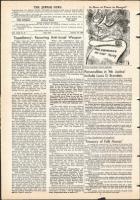

Is Dove of Peace in Danger?
THE JEWISH NEWS
Incorporating the Detroit Jewish Chronicle commencing with issue of July 20, 1951
Member American Association of English-Jewish Newspapers, Michigan Press Association, National Editorial
Association.
Published every Friday by The Jewish News Publishing Co., 17100 West Seven Mile Road, Detroit 35, Mich.,
YE. 8-9364. Subscription $5 a year, Foreign $6.
Entered as second class matter Aug. 6, 1952, at Post Office, Detroit, Mich., under Act of March 3, 1879.
PHILIP SLOMOVITZ
SIDNEY SHMARAK
FRANK SIMONS
Editor and Publisher
Advertising Manager
City Editor
Sabbath Scriptural Selections
This Sabbath, the twenty-fourth day of Shvat, the following Scriptural selections will be
read in our synagogues:
Pentateuchal portion, Mishpatim-Sheka/im, Ex. 21:1-24:18, 30:11-16. Prophetical portion,
1 Sam. 20:18-42.
Licht Benshen, Friday, Jan. 25, 5:20 Pan.
VOL. XXX No. 21
Page Four
January 25, 1957
'Expediency': Recurring Anti-Israel Weapon
Twenty years ago, when British For-
eign Office officials were conferring, in
London, simultaneously with Arab and
Jewish leaders, on the Palestine question,
Britain's government leaders admitted to
the late Dr. Stephen S. Wise, who was a
member of the Jewish delegation at the
round table sessions with the Mandatory
Power, that justice was on Israel's side
but that "political expediency" compelled
'them to make concessions to the Arabs.
Thereupon, immigration of Jews to
Palestine was further restricted, the Bal-
four Declaration pledges were additionally
whittled down and it became evident that
Great Britain had abandoned its obliga-
tions to world Jewry and to the then
League of Nations as the. Mandatory Power
over Palestine. The emergence' of the
State of Israel resulted almost entirely
from Jewish efforts, primarily motivated
by the despair of a harrassed people, in
spite and in defiance of British appease-
ments.
Much as we dislike making the com-
parison, we are now inclined to the belief
that history is repeating itself; that a
policy of "expediency," similar to the
frustrated plans of the British, now is
being adopted unrealistically and rather
cruelly by our own Government.
* * *
A most dispassionate review of the
events in the 1930s will reveal that none
of the concessions made by the British to
the Arabs had brought any positive re-
sults. The Arabs collaborated with the
Nazis and would have moved into the
Hitler corner had the turn of military
events gone against the Western demo-
cratic nations. The Arab leaders were
uncompromising in all their dealings.
They kept on selling land to Jews in
Palestine at exorbitant prices, always with
the view eventually of acquiring all Jew-
ish possessions by driving the Jews into
the sea. Such an attitude created the Arab
refugee problem.
Arab strategy remains the same today.
We must qualify it by pointing out that
it is the strategy of the Arab effendi rulers
who, while fighting Israel, are determined
also to oppress their own impoverished
masses by keeping them in squalor and in
ignorance. It is not the way of life of the
masses of the Arabs, the poor fellaheen
whose status is the lowest in the world.
Only in Israel do the Arabs possess polit-
ical, economic and cultural freedom. It has
been pointed out with justice that there
are only two places where Arabs have a
right to vote unhamperedly and freely in
democratic elections: in Israel and in the
United Nations. And the Israeli Arabs
enjoy the highest economic standards of
the Arab peoples anywhere in the world.
Anti-Israel and anti-West strategy
among the Arabs has not changed, in spite
of all the privileges accorded them, in
spite of all the appeasing gestures. But
expediency" remains the dominant factor
in the suppression of just rights for the
Israelis. The position taken by our Gov-
ernment on the latest United Nations
resolution, sponsored by the Afro-Asian
bloc, proves the point. The U. S. Chief
UN Delegate, Henry Cabot Lodge, Jr., had
yielded to anti-Israel demands for an im-
mediate withdrawal of Israel troops—
without assurances to Israel's safety.
Ambassador Lodge, pursuing the "ex-
pediency" policy of. our State Department,
knows full well that Egypt had not, even
for a single moment, evidenced a desire
to comply • with the UN resolution of 1951
which called upon Egypt to end its block-
ade of the Suez against Israel. But in spite
of a six-year abuse of Israel's just rights,
Mr. Lodge went along in support of a
resolution giving Israel five days in which
to withdraw from areas that were pre-
viously used by murderous terrorist gangs
against Israel's security.
•
"
Where will "expediency" lead our
country? Is it possible that our State De-
partment has not learned the lesson of the
British? The latter kissed the Arab hands,
and were slapped in return. We are bend-
ing backwards to satisfy Nasser, to rebuild
the dictator who for a passing moment
was crushed by the Israelis, but the dic-
tator's • followers s li o u t "Long Live
Khrushchev." How long can this go on?
In the name of "expediency," spelled
"oil" in industrial terms, we are conced-
ing everything to the Arabs, and Israel's
safety is endangered. There is a manner
of inconsistency which calls for revision,
and we sincerely hope, at this late hour in
a battle for the life of a small fraction of
the peoples involved—the 1,900,000 Israelis
—and of the endangered peace of the en-
tire world, that new attitudes may find a
way into the hearts of the statesmen who
control the situation.
* * *
Then there is the element of justice in
the following statement made at the UN by
the Australian delegate, Sir Percy Spender:
"Egypt cannot have it both ways. If
prior to the Israeli invasion of Sinai a
state of war in truth already existed
between the two countries, then Egypt
should be obliged, together with Israel,
to desist from all acts of war .. .
"The aim surely of the United Na-
tions should be to bring to an end the
hostilities which have occurred, but at
the same time to create conditions which
will make the various questions involved
susceptible of a final and equitable solu-
tion."
In line with which we must address
ourselves to the Chief U. S. Delegate to
the UN, Mr. Lodge, and to inquire: "What
has happened to the resolution you spon-
sored in the second week of November,
calling for consideration of peace moves
between Israel and her neighbors? Isn't
that the first objective in an effort to end
all strife? Is it more expedient to mollify
Arab war-mongers than it is to get all
elements to sit down, together, and to talk
peace. That was your policy, Mr. Am-
bassador Lodge. What has happened to
it since?"
It is a long question, and we hope that
it will bring a positive answer. We have
no objection to its being called a prayer
for peace, and we hope it will not be turned
into a vain aspiration for justice and amity.
While we are dealing with "elements
of justice," it is essential that we should
take into consideration also the attitudes
of the governments whose spokesmen at
the United Nations did view with sympa-
thy the position of Israel. We have just
quoted the statement of the Australian
delegate, but his vote was on the side of
injustice.
In addition to the delegate from United
States, spokesmen for Canada, New Zea-
land, the Dominican Republic, the Nether-
lands, Ireland and Portugal indicated that
they recognized the validity of Israel's
demands for security in the withdrawal
issue. But their votes again indicated
expediency" rather than firm adherence
to policies of fair play.
Only Guillaume Georges-Picot of
France voted with Israel against the
shockingly unjust UN resolution. Costa
Rica and Cuba gave evidence of their
resentment by abstaining. Even so fine
a friend of Israel as Prof. Enrique Rodri-
guez Fabregat of Uruguay failed to raise
his voice against a grave injustice that
threatens the very existence of Israel
and voted for the resolution.
Which compels us, as an encouragement
to Israel•and as a rebuke to her adversaries,
to remind statesmen in striped pants of the
admonition of Plato: "To do injustice is
more disgraceful than to suffer it."
"
Nine Supreme Court Justices
Personalities in 'Mr. Justice'
Include Louis D. Brandeis
Eighty-nine men have served as justices of the United States
Supreme Court in the highest court's history. Many biographies
have been written about individual judges, and much has been
written, especially lately about the court as an entity.
The personality sketches of nine of the Justices, written by
authorities in the legal profession, appearing in "Mr. Justice,"
edited by Profs. Allison Dunham and Philip B. Kurland, and
published by University of Chicago Press (5750 Ellis Ave., Chi-
cago 37), add great interest to the combined subject of high court
and its justices.
It is quite appropriate that the colorful Mr. Justice Holmes
should head the list of the men delineated in this volume. Francis
Biddle wrote the Holmes sketch. Chief Justices Marshall and
Stone are dealt with by William Winslow Crosskey and Prof.
Dunham. Charles Fairman authored the story of Mr. Justice
Bradley. . • . •
Prof. Paul A. Freund; Of. Harvard, in a warm deliheation of
Mr. Justice Brandeis, points out that he possessed two requisites
to be regarded as a philosopher: that "he had the sense that
speculative issues ought to be referable to human affairs, even
as speculation itself is a human enterprise"; and "he had an acute
sense of the human comedy and the human tragedy in mortal
striving."
Prof. Freund points out about Mr. Justice Brandeis that as
a lawyer "he was in the habit of lecturing his own clients on the
need to recognize what was right in their adversaries' case."
Brandeis' biographer recalls that "Sidney Hillman, on a visit to
Justice Brandeis in his later years," parted "from the interview
with the amiable remark, 'Mr. Justice, I think you are a conserva-
tive.' The Justice replied with equal affability, 'I have always so
regarded myself.' "
Brandeis' is described as having exercised a great deal of
self-discipline. Prof. Freund writes: "In him, as Justice Frank-
furter has said, Hebraism and Hellenism were fused.
Sutherland, by J. Francis Paschal; Hughes, by Merlo J. Pusey;
Rutledge, by John Paul Stevens, and Taney by Carl Brent Swisher,
are the other Justices described in "Mr. Justice," the collective
articles of which make it an outstanding work on our high justices.
`A Rare Confection of Laughter'
'Treasury of Folk Humor'
In making his selections for "A Treasury of American Folk
Humor," published by Crown (419 4th, N Y 16), James N. Tidwell
applied two tests: selections chosen for inclusion must be funny
to an American of 1956, and must be folk" humor. "Whatever the
source," Tidwell says about his selections, "they were chosen
because I felt they represented the American people and their
laughter."
There is plenty in this 620-page book to amuse the reader,
and it is admittedly, as stated on the cover, "a rare confection of
laughter" — containing all types of merriment, tall tales, jests, etc.
This Treasury is not only entertaining, it is also instructive.
Furthermore, guidance like that provided in the Mark Twain
essay "How to Tell a Story" is as- validly delightful today as it
was nearly 60 years ago.
Samuel Goldwyn plays a role in this collection in the section
of Goldwynisms. The movie magnate clearly has earned a place
in American folklore.
Roark Bradford's "Little David and Ole Goliar" is a genuine
spiritual.
There is an anecdote, "Hell and Texas," that proves there
is nothing new under the sun. The anecdote as it appears in the
Tidwell collection:
"General. Sherman is often credited with saying that if he
owned both Hell gnd Texas, he would rent out Texas and live
in the other place.
" 'That's right, every man for his own country,' the Texan
is said to have retorted.
Which is reminiscent of the anti-Semite who saw a rabbi
in a public library and asked if he knew that no dogs and Jews
were permitted there. "Then we must both leave," the rabbi
retorted.
Wise sayings, short and long tales, hundreds of good stories
are incorporated in this well-selected anthology.