

+NIS
A nniversary of 'Poet in Exile'
Kaddish Urged for Heinrich Heine
•
Today, the 100th anniversary of the death
of Heinrich Heine, draws attention anew to
the great German-Jewish poet and contro-
versial figure of a century ago.
- Heine was the man with Many conflicts.
Born Dec. 13, 1797, at Dusseldorf on the
Rhine, he died in Paris, Feb. 17, 1856. In an
evaluation of "Heine's Homecoming," in an
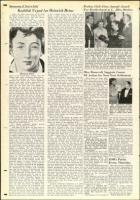
HEINRICH HEINE
essay in the Jewish Book Annual, Prof. Sol
Liptzin made these interesting- observations:
"On the centenary of Heine's death, the
Germans still regard their finest nineteenth
century poet, their wittiest prose-writer, the
continuator of their great Goethe, as a step-
child. But the Jews view him, despite his
aberrations, as their own, a wayward child
but still their child, flesh of their flesh and
soul of their soul. When Heine lamented that
on his Yahrzeit no mass would be sung for
him and no Kaddish would be said for him, he
was but half right. No mass is being sung
for him. But every Jew who has survived the
lure of alien hearths and. who has come home
to his father's fireside recalls with poignant
sorrow this early victim of a mirage that
dazzled hundreds of thousands of Jews
throughout the past century, the mirage of
Germanization, Russification, Polonization, or
assimilation to Anglo-Americanism, a mirage
from which Heine emerged crippled in body,
wounded in his pride, but clear in thought.
On Heine's hundredth Yahrzeit, - Kaddish ought
t4 be said for this son of Israel who' left his
father's house but who saw the error of his
ways long before others did and who atoned
by the creation of great Jewish works, which
will long be treasured among the immortal
Products of Jewish genius."
Dr. Liptzin 'evaluated Heine's Afewish
interests and devotions as follows:
"The pupil of the Heder,. he early came in
contact with Catholicism in a French lycee at
. Dusseldorf, when this town was temporarily
dominated by French troops, French administra-
tors, and French culture, and his appreciation
of Catholic religious fervor led him to compose
The Pilgrimage to Kevlaar, one of the finest
Catholic lyrics in the German topgue. Although
Heine was, in the 1820's, a colleague of
Leopold Zunz and a co-founder of the Gesell-
schaft fur Kultur and Wissenschaft der Judea,
he nevertheless turned apostate during the
epidemic of baptism which characterized that
decade in Germany. He was converted to
Lutheranism, even while working on his Rabbi
von Bacharach, a novel which was to idealize
medieval Jewish life. As a lover of Hellenism
and as an aesthetic worshiper of Venus and
Apollo, he wrote during his robust, sense-
intoxicated days inspired hymns to the gods
of Greece and to the heathen heroes who
preferred beauty to truth. However, in his
years of affliction, writhing in his mattress-
grave, he reverted to the God of -the synagogue
and to the Princess Sabbath of his childhood;
he rediscovered his affinity with ancestors
who wept by the waters of Babylon and with
- '4111" the Sephardic troubadours Ibn Gabirol, Ibn
Ezra, and especially Yehuda Halevi, whom he
hailed as the flaming pillar of song at the-
vanguard of Israel's suffering caravan in the
desolation of exile. Jerusalem became the
final home of his longing, after Berlin and
Athens had failed him and he lay dying in
Paris. The truth of Torah then rated higher
with him than the beauty of Phidias and
Homer or the mockery of Aristophanes and
Voltaire. Scornfully he wrote of those whose
supreme achievement lay in fashioning works
of art out of brick and granite. He had learned
to prefer the Jewish artist Moses who built
human pyramids, who carved human obelisks,
r who took a poor tribe of herdsmen and formed
it into a people .which was to defy the cen-
turies, a great, eternal, holy people, God's
people, which could serve as a model for all
mankind. He had found consolation for the
loss of his German fatherland in the redis-
covered portable fatherland of his coreligionists,
the Bible. 'A book is their fatherland, their
estate, their ruler, their . joy, and their mis-
fortune. Within the well-fenced borders of
this book, they live and exercise their inalien-
able rights as citizens; here they cannot suffer
expulson or scorn; here they are strong • and
admirable ; Buried in the reading of this
book, they little noted the Changes taking place
in the- real world about them. Nations arose
and perished, states, blossOmed and became
extinct, revolutions swept across the face of
the earth. But they, the Jews, sat bent over
their book ; unaware of the wild- chase of -time
that swept above their heads'."
A biography of the great satirist and lyric
poet, "Heine, Poet in Exile," by Antonina Val-
lentin, published by Double_day, similarly. deals
at great length with many of Heine's problems
and with the • anti-Semitic issues of the day.
Mme. Vallentin's ability as a writer and as
an historical researcher is well established.
There are, however, a number of references in
her work that are subject to question. For
instance, when she writes that , Heine must
have experienced that sexual impulse which
exists before puberty and is now recognized
by psycho-analysts, and qualifies it by saying:
"A precocious sexual instinct is not uncommon
among Jewish boyk and Harry Heine was no
exception in this respect," we must question
her viewpoint. We wonder: would Freud
especially have selected Jewish youths for so
uncommon a sexual trait?
The Vallentin book is, however, a deep his-
torical study. For an understanding of the
cOnditiont of the time in which Heine lived,
her hook •has great- value. It delves ably into
the background of Heine and his family.
We learn from Mme. Vallentin that Heine,
in his early youth, "wasted his time in such
frivolous occupations as the translating of
Homer and Ovid into Yiddish." One thing is
certain: his poetic urge was in evidence 'from
very childhood. • •
Heine had befriended the great writers of
his time. During his "exile" in Paris, he was
the friend of Baizac, the - great Jewish actress
Rachel, Ferdinand Lassalle, George Sand, Karl
Marx, Ludwig Borne and scores of others. He
was accepted in the salons, admired by the
women, loved for his poetry. • -
Especially interesting are the references to
Lassalle and to Marx. Arnold Ruge is quoted
as having said: "It was- I and Mark who
/introduced .Heine to political satire," but Mine.
Vallentin asserts: "Marx only strengthened a
tendency which Heine had -already possessed
before their meeting."
There also is the history of another Jew
who embraced. Protestantism—Ferdinand Las-
salle who saw "himself heading the • fight for
liberty on behalf of the oppressed Jews."
Heine's marriage to his Mathilde is skilfully
explained in this biography. • About this mar-
rage, Mme. Vallentin wrote: "As a Protestant
marrying a Catholic, he had to sign a declara-
tion that any children resulting from the
marriage would be raised in the Catholic faith.
He signed the paper with' a wry smile, for
he knew already that he would never be a
father . . . Heine wiped the perspiration from
his face and tried with his customary sallies
to shock the solemnity of the participants in
the ceremony. 'I have made my will and left
everything to my wife, but naturally on -one
condition—that she marries again immediately
after 'Thy death. In that way I shall be sure
that at least one man will regret my passing.'
Mathilde joined in the laughter, but neverthe-
less, when she replied, it was very earnestly:
`Joke away if you like, but you know very
well that I shall never desert you, either in
life or in death, and that if you were to die
tomorrow I should never marry again.
Mine. Vallentin points out that "the personal
God in whom Heine came to believe in spite
of himself was the God who tormented Job,
the same pitiless Deity whose avenging shadow
had lain across his early childhood. He would
remark sarcastically that 'neither priest nor
rabbi introduced him to God,' but it was never-
theless to Jehovah that he returned: his pagan-
ism ended by submitting to the faith of his
ancestors. Heine would only admit this to his
closest friends, and then only to those of his
ourn blood and faith. This Judaism, which he
concealed so carefully from Mathilde, re-
mained one of the few things which were
sacred to him . . ."
Antonina Vallentin's biography is a good
work. It adds new information to the known
fact about Heinrich Heine, and the compilation
of the new and the old is skilfully linked to
provide us with an excellent biography on
the day of the anniversary of the death of the
great poet, whom Germany rejected, but whom
she now accepts and honors again.
Probus Club Gives Annual Award
For Brotherhood to C. Allen Harlan
, Mrs. C. ALLEN HARLAN admires the plaque given to her
husband by the Probus . Club at a banquet earlier this month
in the Sheraton-Cadillac Hotel. Pictured, left to right, are
HARVEY WILLENS, Probus Club president who made the
award; MRS. WILLENS; Gov. G. MENNEN WILLIAMS, guest
speaker; Mrs. Harlan and • C. ALLEN HARLAN. Probus
Club, a social, civic and philanthropic organization of 85
Jewish business and professional men, gives the annual award
for outstanding achievements in Brotherhood work. Harlan haS
contributed scholarships to Brandeis University and gave a
major portion of the funds' for the university's Protestant
Chapel. Previously, he won the Michigan Democratic Legacy
Award of the Anti-Defamation Leaguia of Bnai Brith. .
Mrs. Roosevelt Suggests Course
Of Action for Near East Settlement
When Bonds for Israel tabu-
lates the results of the bend
drive conducted during the past
month by Cong. Shaarey Zedek,
the totals will probably come
close to the $200,000 mark.
A good part of the results of
this successful campaign will
justifiably be attributed to the
appearance of Mrs. Eleanor
Roosevelt, who spoke laSt Sat-_
urday evening, in the syna-
gogue, at the drive's culminat-
ing event.
The warmth, charm -and sin-
cerity of Mrs. Roosevelt, which
has earned her the, title of "The
Mrs. ELEANOR ROOSE-
First Lady of the World," were
much in evidence, as she. told VELT converses -brjefly with
her' audience of nearly 1,000 HYMAN SAFRAN, vice-presi-
people that "more than as a dent of Conga Shaarey Zedek,
contribution to Israel, Bonds for _prior to speaking at the
Israel are a contribution to the Shaarey Zedek's Israel Bond
stability of the whole Middle rally.
East" because the "development€
of Israel is the heart of the de- were Samuel Kovan, the chair-
velopment of the whole Middle man of the synagogue drive;
East."
Dr. Leonard Sidlow, who. greet-
The entire- Near East ques- ed Mrs. Roosevelt for the cons
tion, Mrs. Roosevelt charged, is gregation; and Rabbi Morris
not just between Israel and- the Adler, who introduced the guest
Arabs, but a struggle between speaker.
the Free World, and the Com-
Rabbi Milton Arm gave the in-
munists.
vocation and benediction, while
"Certainly," Mrs. Roosevelt Cantor Jacob H. Sonenklar led
said, "the Soviets are willing in the singing of the national
to help the Arabs because their
anthem. Hy Safran reported on
leaders have no concept of what
the progress of. the drive, which
democracy means."
will be .continued unofficially
While she called for arms
through next week when a
aid for Israel to "equalize the scroll of bond purchasers will
balance of power" destroyed
be sent to Mrs. Roosevelt.
by the Czechoslovakian-Egyp-
Mrs. Roosevelt was presented
tian deal, Mrs. Roosevelt said
with a bouquet of roses by the
that the "prime objective
congregation's Sunday school,
should be to keep down bord-
and also with a gold-bound edi-
er aggression."
She pointed out that a neu- tion of Chief Rabbi. Hertz'
tral force employed in the areas "Pentateuch and Haftorahs,"
of tension could best be utilized which is used regularly at the
for this accomplishment. Main- synagogue's services.
taining present borders and
halting aggression is the first
step toward getting both sides
to sit down together to work
out their problems.
She stated that-proposals such
The annual Purim celebration
as the Jordan Valley Authority of the Zionist Organization of
plan, which would provide irri- Detroit will be held next Thurs-
gation to Arabs and Israel alike, day, 8:30 p.m., at the Zionist
would go a long way toward House, Linwood and Lawrence.
clearing up the troublesome
The film, "Man On A Bus,"
refugee issue.
made in Israel with well-known
Mrs. Roosevelt said that the Hollywood stars, and two other
Arabs are being kept there only films from Israel will be shown.
as an "eyesore," and added that A program of songs by • Israeli
the refugees "must be resettled students will be an added fea-
quickly now or they will not ture. Purim refreshments will
be resettled anywhere."
be served.
"This is a question not
Morris M. Jacobs, program
alone for the Jewish world, chairman, is in charge of ar-
but for all peoples interested rangements. All ZOD members
in the survival of the free and their families are invited.
world," Mrs. Roosevelt con
28—Detroit Jewish News
eluded.
Friday, February 17, 1956
Participating in the program
ZOD's P twin'
Event, Thursday