

7 Am A Harp for Thy Songs'
6—DETROIT JEWISH NEWS
Friday, September 11, 1953
Yehudah Halevi-Zion's Poet Laureate
By MAX SIMON
tors, although in their youth they had
he was insensitive to sadness and in- evi's idea of defending the Jewish re-
lived comfortable lives.
justice; he was romantic, and the only
In the course of his travels, Yehudah sufferings he perceived were those of ligion was not by showing its identity
Halevi arrived in Seville. That city was the lover, the only tears those of love. with rational truth. He saw that the
also renowned as a center of culture; But when he grew older. he no longer Jewish religion was not reducible to
Moses Ibn Ezra once called it "the city saw the world as he saw it in his youth. series of abstract propositions. Proposi- a
of poetry." He was there accorded a His poetry .became more earnest and
in philosophy can always be de-
warm welcome and enjoyed the refined more searching. It was then that he tions
and cultured environment after the suf- wrote many of his religious songs, con- bated both ways; and even at their best
ferings which preceded his arrival in sidered by authorities the gems of the they never pierce deeper than the plane
Seville. He did not remain there long, whole liturgy. He brought such artistic a of argument. He tries to vindicate for it
securer place. a. place beyond all rea-
and proceeded to Cordova. This city was simplicity and beauty into the most pro-
still the cradle of Jewish culture in • found thoughts that all could under- son. The great scene at Sinai puts the
Spain. There he found himself in a con- stand them. Many of the religious poems Jewish religion in possession of the
genial environment. There were many he composed — whether confessions of truth. As the doctrine there imparted is
young intellectuals in the city who de- man's littleness or surging hymns of the sole source of religious truth, so the
voted their time to Hebraic and general praise to God—were included in the syn- people chosen to be its bearer is alone
studies and received him with great ad- agogue ritual during his lifetime, for the capable of realizing the religious life,
It was destined that Halevi's congregations of that day were not con- and is therefore the core and heart of
Gerniany's great poet Heinrich miration.
great
genius
should penetrate the whole tent merely to repeat the religious poetry mankind. Sinai being the one authentic
Heine, paying tribute to the genius of world from Cordova.
event in religious history, Christianity
of earlier ages. There is profound—al- and Islam are necessarily derivative and
the Spanish poet, in behalf of a later
It was then customary to hold poetic most mystical—emotion in his yearning imitative. But with all that they are
age, declared that when God fashioned
contests. Poetic skill was tested by hav- for God:
Halevi's soul, He Kissed it and the
assigned a high place. Israel has indeed
music of that kiss echoes through all ing a poem read and having the con-
To meet the fountain of true life a central place in history, but Yehudah
testants
write
something
on
a
different
the songs of that consecrated poet.
I run;
Halevi 'robs the idea of chosenness of all
Across 800 years Yehudah Halevi's theme using the same form, metre and
hate
and intolerance, and in the broad
Of
this
so
vain
and
empty
life
I
voice rings out, clear, restrained and yet rhyme scheme. Halevi frequented many
tire.
humanism
of his Messianic conception.
profoundly passionate, warm with all of these contests, and once suggested
To see my King's face is my sole he leaves far behind him the limitations
th'at
the
contestants
try
to
imitate
a
the warmth of a human being honestly
desire . .
of Mediaeval feeling. The two world re-
revealing himself. "Israel is the heart of poem of Moses Ibn Ezra. None of them
ligions perform a function in their place
Would I might see His face within
succeeded.
They
could
all
begin
a
poem
and time, and in the end will be con-
the. nations," he had said in his great
my heart!
after
the
given
model,
but
none
could
philosophic work, the "Kuzari," and Is-
verted to the truth.
Mine
eyes
would
never
ask
to
look
rael to this day thinks f him e complete it. Finally the contestants
_beyond.
True enough, Yehudah Halevi was
heart of the nation, the supreme artistic urged him to show them how to go about
In much of Yehudah Halevi's relig- critical of metaphysical philosophy, but
completing
the
work.
After
persistent
expression of the nation's innermost
urging, Yehudah Halevi succeeded in ious poetry, God is not only the Lord of he did not deny the value and the
feelings and aspirations.
the difficult poem by writing the universe and of all mankind, but beauty of philosophic thought. What he
Born in Toledo ,in 1080. Yehudah imitating
very specifically, the God of Zion and of did oppose was the application of meta-
one
in
praise
of Moses Ibn Ezra.
Halevi was brought up by his father who
his people, Israel, who are "rejected of physical speculation to the mysteries of
He
sent
the
poem
in
a
letter
to
Moses
used his substantial, though modest,
their neighbors but sought of their the universe. In Halevi's view the major
wealth to give his son the best educa- Ibn Ezra explaining the circumstances Lord." Israel is "the bride that longeth error of the philosophers was that they
tion possible in those days. Like all of under which it had been written. Moses for Thee."
proclaimed the supremacy of reason and
his contemporaries, Yehudah Halevi Ibn Ezra, the most renowned figure in
claimed for it power to answer all ques-
She
is
abashed
each
time)
She
Jewish
literature
at
that
time,
recog-
studied the art of poetry, but unlike the
tions of human existence. They held
would
be
going
up
the
holy
nized
the
genius
of
Yehudah
Halevi
and
others, he used the study as an expres-
that man could attain perfection by
mount,
invited
the
young
writer
to
reside
with
sion of his genius, a full, competent and
sharpening his intellectual faculties, and
For she seeth that strangers go up,
immortal expression. He may have re- him in Granada. The poet accepted the
that the more knowledge man acquires
but not she.
ceived his poetic training and encour- invitation of the elder great and stayed
And the demand the poet made of the more ethical and purer he becomes.
agement from his father, who is also at the home of Ibn Izra. While in God
He, however, thought that philosophy
was very clear and direct.
Granada
he
took
up
the
study
of
medi-
said to have been a poet, although this
did not have the necessary ingredients
Thou
who
kna
west
our
sorrows
and
is not certain. When he was 14 or 15 cine, his purpose being to achieve eco-
for the setting up of an absolute philos-
bindest
up
our
wounds,
years old, he was seized with the desire nomic independence. However, he was Turn again our tens of thousands to
phic system on a sound, solid basis. In
for study, and a knowledge of the world not a successful doctor, and could not
spite of their continual studies, specula-
the land of our abodes.
and the people who lived in it. So, al- establish a practice. For, even while he
tions and examinations, the philoso-
They
ask
the.
way
to
Zion—they
pray
stayed
at
the
home
of
Moses
Ibn
Ezra,
though still a young boy, he left his
phers failed to arrive at one universal
to
ward
her—
home and went out into the world. This he constantly made many trips through
solution of the problems of metaphysics
The ,children exiled from her border.
step was probably taken with the con- Spain. But after several years of such Slaves
or at a single truth subscribed by all.
bear
rule
over
them,
but
they
sent of his parents who wanted their wanderings through Spain, he finally
The riddles confronting them in Halevi'*
will
never
cease
to
call
Thee
took
up
residence
in
Granada
for
a
only son to get a full education, and
day were the same as in antiquity.
Until Thou turn our captivity, and
were confident that he would achieve number of years.
However, Yehudah Halevi insisted,
comfort
our
waste
places.
greatness.
One of the most popular persons in
God not only chose Israel, but also
The "Kuzari," Yehudah Halevi's phil-
Armed with a solid knowledge of se- the city, no festivity or gathering was
made the Land of Israel his holy land.
cular and Jewish subjects, young Ye- complete for the Jews of Granada with- osophical masterpiece, is not a disinter-
In that land prophecy was born. The
hudah Halevi set out on his jour- out Yehudah Halevi. With his ready wit, ested system of philosophy written in
city of Jerusalem where the Temple
ney to acquire more learning. His his humor, his beautiful songs, h i s the detachment of leisure and at the in-
and
the Holy of Holies stood is the
stigation
of
the
speculative
urge.
It
is
a
first stop was in the then famous charming personality, he wrote works
most sacred spot in the world. The
city of Lucena. There Rabbi Isaac Al- which graced all sorts of occasions. He book of defense, as the full Arabic title
Jewish people cannot function nor-
states, a defense of a despised religion;
phasi, the famous Talmudic scholar, wrote many epigrams, among them:
mally or attain perfection in other
despised
not
merely
by
the
world,
by
the
had founded a Yeshivah which attract-
The first grey hair
countries; since only Palestine is cap.
two
great
religious
powers,
Christianity
ed the finest and ablest young men in
which appeared in my head
able of bringing out all the powers
and Islam, who between them divided
Spain. It was into this brilliant society
I plucked out quickly.
with which the Jewish people hat*
the inhabited globe, but secretly also by
that the young, gentle, sensitive and
Very well, the grey one said to me,
been endowed: that is why this land
the educated and powerful among its ad-
cultured Yehudah. Halevi came. He soon
you succeeded easily
was selected for God's own people.
herents.
All
the
Jewish
intellectuals
of
made friends with everyone in the city.
overcoming me when I was the day had gone through the school
Palestine, however, has not any of
They all held him in _
for his
alone.
these great attributes with respect to
of
Arabic
philosophy.
The
educated,
en-
sound and diversified knowledge, for
Will your success be as easy
other nations who settle there.
lightened,
and
superior
people
of
that
his honor, and his ability at anecdotes
when all my brethern come
Yehudah Halevi also considered the
generation had insensibly substituted a
and epigrams, an ability which was to
in their large grey hosts?
set of metaphysical propositions for the question of why nations inhabiting
win him friendships later. Evidently the
Palestine are noted neither for wisdom
Soon Yehudah Halevi left Granada.
young man was not satisfied merely He had had his fill of pleasure and ancestral religion. In any case its old nor for goodness characteristic of the
vigor
had
slackened;
its
great
texts
al-
with studying the TalmUd. He thirsted honor, and the time had come to settle
(Continued on Page '7)
for wider knowledge, for further investi- down to practice medicine, and establish legorized and symbolized. Yehudah Hal-
gations in the various fields of science. himself independently. He was not sure
He absorbed whatever Arabic culture whether his restless nature would permit
had to offer in the fields of philosophy, him to remain in one place long, but
literature a n d science. Wherever he he decided to try. He now returned to
visited in later life everyone was amazed Toledo where he had spent his youth.
A Page
at the scope and intensity of his know- He soon acquired a reputation as a phy-
ledge of the sciences and philosophy.
From
sician and gained a large practice. He
After spending several years in Lu- spent much of his time, as much .as he
cena, Yehudah Halevi left the city and could spare, in teaching, mainly in a
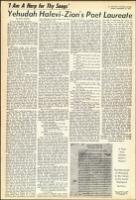
Yehudah
went on his wanderings to see the world. higher institute for the study of the
These years of wandering were a great Hebrew language which he founded_ in
Haievi's
pleasure to him. He got to know the Toledo. The time that he lived in Toledo
outstanding intellectuals, the most im- was a prosperous one. He carried on his
"Kuzari"
portant scientists and learned men, the medical practice, his teaching at the a-
poets, the Statesmen and the princes of cademy, and his poetry.
his day. He moved 'freely in all the in-
At that time Yehudah Halevi was
fluential circles of society. He was the already
famous as a poet. Since the day
favorite of the fair sex and of the high he wrote his first poem and sent it to
aristocratic circles with his sunny Moses Ibn Ezra, his fame grew until he
The Manuscript
humor, his ready and often sharp wit, became recognized as a great poet in
of Philosophy
his brilliant personality, his keen mind all the Jewish communities of Spain
and his ability at repartee. However, he and in some communities beyond his
in the Library
also lived through bitter days. It ap- land. Naturally, Yehudah Halevi did not
pears that at that time he lost his par- always write the same songs. His poetry
of the Jewish
ents and was cut off from monetary was not the same when he was young
support. He was beholden to strangers as when he grew older.
Theological
who acted as patrons, and this situation
His youthful poeMs reflect the gay
often drove him to further wanderings. young man's fondness for wine a n d
He could not remain long in the same feasting with friends, and he often sang,
Seminary
city. But he was not the only one to both flippantly and seriously, of love:
undergo this. This bitter, wandering life
My law is love and I to her belong;
was also the lot of Solomon Ibn Gabirol,
I drew her perfumed breadth when
Photo Courtesy Jewish
Abraham Ibn Ezra, Moses Ibn Ezra, and
I was young.
Museum of Jewish
later Yehudah al Harizi. All of these
Theological Seminary
A profound spiritual and artistic
4.4 America.
great poets were forced to a nomad change took over Yehudah Halevi as he
existence said dependence on benefac- reached middle age. When he was young,
"I am a harp for thy songs . ."
So wrote the poet of Zion, Yehudah
Halevi, in the Middle Ages. The Muses
of Europe still slumbered in dark med-
ieval forests when Hebrew poets on
Spanish soil were already awake and
singing. Of the golden triad of Spanish
poets—Solomon Ibn Gabirol, Moses Ibn
Ezra, Yehudah Halevi — Yehudah Hal-
evi has been regarded as the greatest.
The enthusiasm for his poetry ran high
while he was yet alive; and about fifty
years after his death, the Hebrew poet-
critic, Harizi, stated that Yehudah Hal-
evi entered the treasurehouse of song.
took away all, and going out, he locked
the door.