
Warrior With
A Dreanit
I6—THE JEWISH NEWS
Friday, July 9, 1948
Tie First Instaftrnen't in the Life
Story of Dr. Chaim Weizmann
•
(Continued from Page 1)
-
They might walk in leaking
boots and threadbare coats, but
it did not matter. Their fore-
heads were touched with the
-glory of ancient Israel; they
.heard in their ears the wondrous
words of the Law, and they kept
high their hope in the Messianic
-promise that they would be free
men in Israel again.
They were bitter because Pinsk,
-for all its tradition of Jewish-cul-
ture, was • in the heart of the
notorious Pale of Settlementa
fringe of hundreds of towns and
:villages on the edge of Russia
prober, contemptuously set aside
by the authorities as the only
*Places where the Jews of Russia
were allowed to live:
They could live here, and no-
*here else. The indignities and
'humiliations they suffered—and
nearly • six million, or half the
Jes of the world then liVed in
the Pale of „ Settlement—were
many and hard. They were pro-
hibited from travelling outside
the Pale into Russia proper; they
could not own land, nor farm it,
nor, live on the land.
" They were not permitted to
hold pOsitions in the . government,
the civil service, the army, the
Schools, the banks, the post office;
they could not be clerks or white-
-collar workers; the universities
were virtually closed to them;
and they were constantly taxed
by government offiCials,. who
took it for granted that all Jews,
howeyer poor,, were really 'rich.
Claims Humble Birthplace
Here, persecuted by the most
ruthless of Czars, forbidden near-
ly all means of livelihood save
trade and commerce, surrounded
by illiterate, superstitious' Rus-
sian- peasants, many of whom
still believed Jews practiced
black magic, lived the remnant
of the People of the Book.
And, here, in the district: of
Pinsk, in a hamlet of some 200
families called Motele, on Nov..
27, 1874, there was born to Ozer
Weizmann, a lumber merchant,
arid his wife, Leah Rachel, a boy,
the fifth of 15 children. They gave
him the name, "Chaim." The
word is Hebrew, . and means
"Life."
-
Well, we might ask, what are
we. to expect from this boy? His
father, from all we can learn,
seems to have been a charming,
'absent-minded, pious and sChol-:
arly man, more inclined to ponder
•the fine points of religion in the
synagogue than settle accounts
over. the merchant's table. There
,are_ stories that the elder Weiz-
mann, confused by his enormous
familyeight daughters, seven
-sons—often:mistook one daughter
for ' another. The girls •looked
alike, and, in the midst of a con-
, 1 -irersation with one of them, he
would suddenly clap his' hands to
forehead and cry:
"And which are you? Have I
been talking to Anna or to Gita?"
It was Chaiin's mother, a wo-
.man of piety and practicality,
wild saw to it that the books were
balanced and that there was
.bread enough to go around._She
was adored by her children, and
often overwhelmed by their in-
tellectual vigor. The Weizmann
parlor would resound as brothers
and sisters eloquently settled the
•problems of the universe, and
Mrs. Weizin.ann, listening, would
steal into the kitchen, fuss over
the stove, and re-enter the parlor
bearing a plate piled high with
boiled Potatoes.
"Poor children, they simply
'wear themselves out, they get so
excited with their ideas," she
-.would say. "One is going to build
a new Zion, another is' going
. to
,create a Utopia, a. third will end
'poverty---." She would shrug her
:shoulders.
"-`Let them have their dreams,'
she would add. "At least, I can
•-boil them • potatoes so they will
have strength enough to argue a
little more."
* *
We can expect certain things
'from young Chaim Weizmann.
Being the son •of a Jew from
cRiask, he will be like the others,
proud and bitter'.
Detroiters, New Chalutzim, Find Jewish
Nation 'A Progressive Going Concern'
•
Visions,of Freeing His People
. He will be steeped in the mag-
nificence of the Jewish past,
when the Kings of Israel were
among . the mighty of the world,
and this will be his only armor
against the hates and suspicion
about him. ,He will have read of
the pogroms in Odessa and War-
saw, when for three days and
three nights Jews were beaten
in the streets—of, the dread ac-
cusations of Jewish ritual mur-
ders and all the old wives' .tales
of horrid witchcraft — and in
mingled fury and helplessness he
will promise himself: -
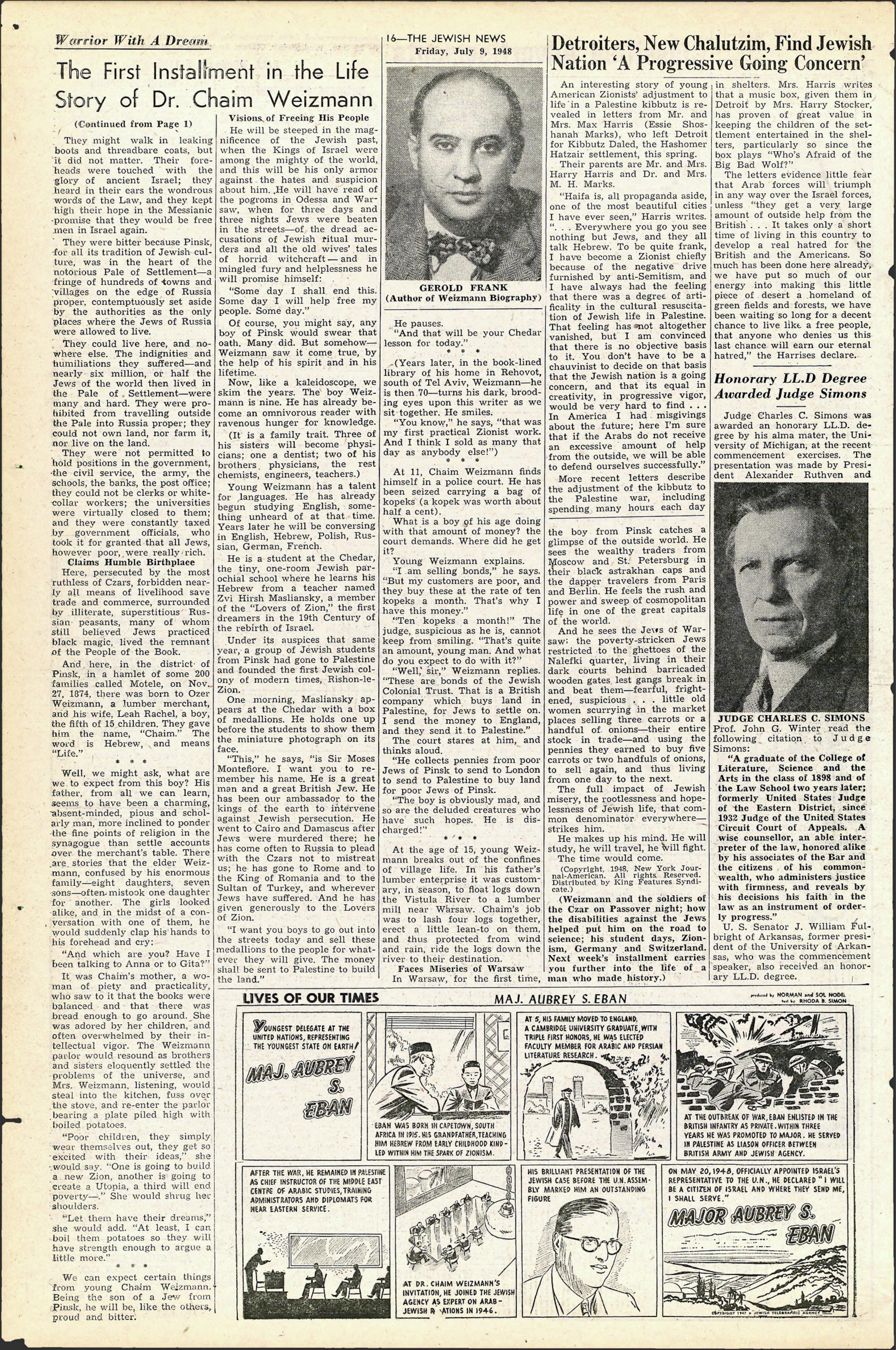
GEROLD FRANK
"Some day I shall. end this.
Some day I will help free my. (Author of Weizmann Biography)
people. Soine day."
Of course, you might say, any
He pauses.
boy of Pinsk would swear that
"And that will be your Chedar
oath. Many did. But somehow- lesson for today."
Weizmann saw it come true, by
the help of his spirit and in his -(Years later, in the book-lined
lifetime.
library of his home in Rehovot,
Now, like a kaleidoscope, we south of Tel Aviv, Weizmann—he
skim the years. The' boy Weiz-* is then .70—turns his dark, brood-
mann is nine. He has already be- ing eyes upon this writer as we
come an omnivorous reader with sit-together. He smiles:
"You know," he says, "that was
ravenous hunger for knowledge.
(It* is a family trait. TlFee of my- first practical Zionist work.
his sisters will become 'physi- And I think I sold as many that
else!")
cians; one a dentist; two of his day as anybody
* * 44
brothers, physicians, the rest
At 11, Chaim Weizthann finds
chemists, engineers, teachers.)
Young Weizmann has a talent himself in a police court. He has
been seized carrying a bag of
for ,languages. He has already
kopeks
(a kopek was worth about
begun studying English, some-
thing unheard of at that time. half a cent).
Years later he will be conversing s What is a boy 9f his age doing
in English, Hebrew, Polish, Rus- with that amount of money? the
court demands. Where did he get
sian, German, French.
it?
He is a student at the Chedar,
Young Weizmann explains.
the tiny, one-room Jewish par-
"I am selling :bonds," he says.
ochial school where he learns his "But my customers are poor, and
Hebrew from a teacher named they buy these at the rate of ten
Zvi Hirsh Masliansky, a member kopeks a month. That's why I
of the "Lovers of Zion," the first . have this money."
dreamers in the 19th Century of
"Ten kopeks a month!" The
the rebirth of Israel.
judge, suspicious as he is, cannot
Under its auspices that same keep from smiling. "That's _quite
year, a group of Jewish students an amount, young man. And what
from Pinsk had gone to Palestine do you expect to do with it?"
and founded the first Jewish col-
"Well; Sir," Weizmann replies.
ony of modern times, Rishon-le- "These are bonds of the Jewish
Zion.
Colonial Trust. That is a British
One morning, Masliansky ap- Company which . buys land in
pears at the Chedar with a box Palestine, for Jews to settle on.
of medallions. He holds one up I send the money to England,
before the students to show them and they send it to Palestine."
the miniature photograph on its
The court stares at him, and
face.
thinks aloud.
"This," he says, "is Sir Moses
"He collects pennies from poor
Montefiore. I want you to re- Jews of Pinsk to send to London
member his name. He is a great to send to Palestine to buy land
man and a great British Jew-. He for poor Jews of Pinsk.
has been our ambassador to the
"The boy is obviously mad, and
km
' of the earth to' intervene so are the deluded creatures who
against Jewish persecution. He have such hopet. He is diS-
went to Cairo and Damascus after charged!"
Jews were murdered there; he
has come often to Russia to plead
At the age of 15, young Weiz-
with the Czars not to mistreat mann breaks out of the confines
us; he has gone to Rome and to of village life. In 'his father's
the King of Romania and to the lumber enterprise it was custorn-
Sultan of Turkey, and wherever 'ary, in Season, to• float logs down
Jews have suffered. And he has the Vistula River to a lumber
given generously to the . Lovers mill near Warsaw. Chaim's job•
of Zion.
was to lash four logs together,
"I want you boys to go out into erect a little lean-to on them,
the streets today and sell these and thus protected from wind
medallions to the people for what- and rain, ride the logs down the
ever they will give. The money river to their destination.
Faces Miseries of WarsaW
shall be sent to Palestine to build
In Warsaw, for the first time,
the land."
-
LIVES OF OUR TIMES
An interesting story of young
American Zionists' adjustment to
life • in a Palestine kibbutz is re-
vealed in letters from Mr. and
Mrs. Max Harris (Essie Shos-
hanah Marks),•who left Detroit
for Kibbutz Daled, the Hashomer
Hatzair settlement, this spring.
. Their parents are Mr. and Mrs.
Harry Harris and Dr. and Mrs.
M. H. Marks.
"Haifa is, all propaganda aside,
one of the most beautiful cities
I have ever seen," Harris writes.
". • . Everywhere you go you see
nothing but Jews, and they all
talk Hebrew. To be quite frank,
I have become a Zionist chiefly
because of the negative drive
furnished by anti-Semitism, and
I have always had the feeling
that there was a degree of arti-
ficality in the cultural resuscita-
tion of Jewish life in Palestine.
That feeling has *not altogether
vanished, but I am convinced
that there is no objective basis
to it. You don't have to be a
chauvinist to decide on that basis
that the Jewish nation is a going
concern, and that its equal in
creativity, in progressive vigor,
would be very hard to find .. .
In America I had misgivings
about the •future; here I'm sure
that if the Arabs do not receive
an excessive amount of help
-from the outside, we will be able
to defend ourselves successfully."
More recent letters describe
the adjustment of the kibbutz to
the Palestine war, including
spending_ many hours each day
the boy • from Pinsk catches a
glimpse of the outside world. He
sees the wealthy traders from
oscow and St.' Petersburg • in
their black astrakhan caps and
the dapper travelers from Paris
and Berlin. 'He feels the rush and
power and sweep of cosmopolitan
life in one of the great capitals
of the world.
And he sees the Jexcs of War-
saw; the poverty-stricken Jews
restricted -to the 'ghettoes of the
Nalefki quarter, living in their
dark courts behind barricaded
wooden gates. lest gangs break in
and beat them—fearful, fright-
ened, suspicious . . • little old
women scurrying in the market
places selling three. carrots or a
handful of- Onions—their entire
stock in trade—and using the
pennies they earned to buy five
carrots or two handfuls of onions,
to sell again, and thus living
from one day to the next.
The full impact. of Jewish
misery, the rootlessness and hope-
lessness of Jewish life, that com-
mon denorninatOr everywhere-
._
•
strikes him.
He makes up his mind. He will
study, he will travel, he will fight.
The time would come.
(Copyright, 1948, New :York Jour-
nal-American. All rights. Reserved.
Distributed by King Features Syndi-
cate.)
.
(Weizmann and the Soldiers of
the Czar on Passover _night; how
the disabilities against the Jews
helped put him on the road to
science; his student days, Zion-
ism, Germany • and Switzerland.
Next week's installment carries
you further into 'the life Of _a
man who made history.)
.
in shelters. Mrs. Harris writes
that a music box, given them In/
Detroit by Mrs. Harry Stocker,
has proven of great value 'in
keeping the children of the set-
tlement entertained in the shel-
ters, particularly so since the
box plays "Who's Afraid of the
gig Bad Wolf?"
The letters evidence little fear
that Arab forces will triumph
in any way over the Israel forces,
unless "they get a very large
amount of outside help from the
British . . .. It takes only a short
time of living in this country to
develop a real hatred for the
British and the Americans. So
much has been done here alreadY,
we have put so much of our
energy into making this little
piece of desert a .horn.eland of
green fields and forests, we have
been waiting so long for a decent
chance to live like. a free people,
that anyone who denies us this
last chance- will earn our eternal
hatred," the Harrises declare..
Honorary LL.D Degree
Awarded Judge Simons
Judge' Charles C. Simons was
awarded an honorary LL.D. de-
gree by his alma mater, the Uni-
versity of Michigan; at the recent
commencement exercises. The
presentation was made by Presi-
dent Alexander Ruthven and
JUDGE CHARLES C. SIMONS
Prof. John G. Winter read the
following citation to Judge
Simons:
"A graduate of the College of
Literature, Science , and the
Arts in the class of 1898 'and of -
'the Law School two years later;
formerly United States Judge
of the Eastern District since
1932 Judge of the United States
'Circuit Court of Appeals. A
wise counsellor, an able inter-,
preter of the law, honored alike
by his associates of the Bar and
the citizens , of his common-
wealth, who administers justice
with firmness, and reveals by
his decisions his faith in the
law as an instrument of order-
ly progress."
U. S. Senator J. William Ful-,
bright of Arkansas, former presi-
dent of the University of •Arkan-
sas, who was the commencement
'speaker, also received an honor-
ary LL.D. degree.
.
'
SOL NODE
,,'$ ur RHODA R. SIMON
.pt..4...a by NORMAN and
MAJ. AUBREY S. EBAN
AT 5, HIS FAMILY MOVED TO ENGLAND.
A CAMBRIDGE UNIVERSITY GRADUATE,WITH
TRIPLE FIRST HONORS, HE WAS ELECTED
FACULTY MEMBER FOR ARABIC AND PERSIAN .
p
1
LITERATURE RESEARCH .
OUNGEST DELEGATE AT THE
UNITED NATIONS, REPRESENTING
' THE YOUNGEST STATE ON EARTH/
-741
ILIAJ
`;'L
,
414
Ai ifite
ii 41110
I
EBAN WAS BORIS IN CAPETOWN, SOUTH
AFRICA IN MS. HIS GRANDFATHER,TEACHING
HIM HEBREW FROM EARLY CHILDHOOD KIND-
LED WITHIN HIM THE SPARK OF ZIONISM.
•
MINI -
/
Wgia :KW
",was*
AT THE OUTBREAK OF WAR, EBAN ENLISTED IN THE
BRITISH INFANTRY AS PRIVATE . WITHIN THREE
YEARS HE WAS PROMOTED TO MAJOR. HE SERVED
IN PALESTINE AS LIASON OFFICER BETWEEN
BRITISH ARMY AND JEWISH AGENCY.
HIS BRILLIANT PRESENTATION OF THE
JEWISH CASE BEFORE THE U.N. ASSEM
BLY MARKED HIM AN OUTSTANDING
FIGURE
AFTER THE WAR, HE REMAINED IN MESTINE
AS CHIEF INSTRUCTOR OF THE MIDDLE EAST
CENTRE Of ARABIC STUDIES,TRAiNING
ADMINISTRATORS AND DIPLOMATS FOR
NEAR EASTERN SERVICE .
sea Salt
40- aga ° a°
.0. MIR= a 4
4111
11111111 3•1
4 4
ON MAY 20,1948, OFFICIALLY APPOINTED ISRAEL'S
REPRESENTATIVE TO THE U.N. HE DECLARED " I WILL
'
BE A CITIZEN OF ISRAEL AND WHERE
THEY SEND ME,
I SHALL SERVE."
itafn
itYa
AT DR. CHAIM WEIZMANN'S
INVITATION, HE JOINED THE JEWISH
AGENCY AS EXPERT ON ARAB -
JEWISH 14 \ATIONS IN 1946.
.
4