

.THE JEWISH NEWS
Friday, September 14, 1945
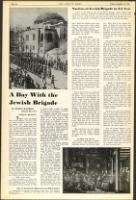
Nucleus of Jewish Brigade in Tel Aviv
A part of the original units of the Jewish Brigade, which officially was
activated in Palestine in March of 19 44 and which fought with the British 8th ,
Army in Italy. Other Jewish units saw service with Gen. Montgomery's 8th
Army from beginning of hostilities in Africa through the Italian Campaign.
them. When the Brigade rode across
Germany enroute from Italy to Bel-
gium, they had signs on their trucks
reading: "Die Juden kommen . . .
Kein Volk, Kein Fuehrer, Kein Reich."
(The Jews are coming. No people,
No Fuehrer, No Reich.)
Look Least Jewish
"Today is V-J Day," says one
young lieutenant. "Of course you
know that means: Victory for the
Jews." "You mean Victory over the
Jews," objects an older captain. But
that isn't enough to start a political
discussion. There are no political
discussions here. This is an officers'
mess like all officers' mess, with jokeS,
card games, drinks and "shop" talk.
Some look very British indeed, and
the most Palestinian look least Jew-
ish. It takes some effort to realize
that the men sitting around the table
were born in places like Vienna, War-
saw, Prague, Vilna and Jerusalem.
Some have had an easy life, and
have been in Europe to study medi-
cine or engineering. Some have led
in Palestine the adventurous, toilsome
and still carefree life of the free-lance
immigrant. They have been in suc-
cession athletic instructors, nev,rspa-
per vendors, r es t a u r ant waiters,
butchers, bakers and candlestick mak-
ers. They have worked in stone quar-
ries and on road construction. Now
they are officers.
A Day With the
Jewish Brigade
By GEORGE BLUMBERG
(Copyright, 1945. Jewish
Telegraphic Agency, Inc.)
TOURNAI, BELGIUM—•
T
HESE ARE SOLDIERS
like all other soldiers. An army truck
on a road of Northern France is noth-
ing special. The white and blue
mark on it, with a golden Mogen Da-
vid, is hardly anything special. Moro-
ccan units in the French army also
have the Mogen David as their dis-
tinctive sign, which is called here,
for no known reason, the Seal of Solo-
mon.
One of the soldiers driving the
truck, a young Yemenite, looks Moro-
ccan enough.. And his broad and gut-
teral Hebrew sounds Moroccan enough
too. "Eisig!" he shouts. Eisig is his
comrade. He was born in Poland and
came to Palestine as a little boy. All
his family remained in Poland, and
he never heard from them - after the
war broke out. Yes, he also has rela-
tives • in America. But he does not
know their names nor where • they
live. There are hundreds like him in
the Brigade, and thousands every-
where else.
Eisig and the Yemenite are pals.
They have been to Paris on a two-
day leave. The first day, they went
to a restaurant, and to the Folies-
Bergere, and to a cafe, and enjoyed
it. The second day they were invited
to some Jewish affairs, and liked
them somewhat less, they say with
a somewhat contemptuous grin. These
are soldiers like all other soldiers.
Fairly Large Town
Tournai, Belgium, is a fairly large
town just over the French border. It
has everything a town in that part of
the world should have. A whole sec-
tion blitzed by the Lutwaffe in 1940,
a railroad station wrecked by Allied
bombing in 1944, factories, a beautiful
old Cathedral, and barracks.
A Belgian regiment was stationed
there before the war. Now it's a bat-
talion of the Jewish brigade. The
greater part of the Brigade has al-
ready moved into Holland. So there
are few soldiers on the almost empty
streets. Here's one of them, a little
fellow. He seems to have been cele-
brating and sings a Russian song at
the top of his voice: "Moyi dieti zad-
urieli" (My children went crazy) .. „
"Why did • they?" we ask him.
He seems startled at first to be
addressed in Russian by "an Ameri-
can," but some Yiddish and Hebrew
complete the acquaintance. So he ex-
plains and apologizes: "I have been
drinking just a little . • ."
"You see, all my family remained
in Poland. I also was in Poland and
a soldier in the Polish
army, and was taken pris-
oner by the Russians in
1939, and sent to .a POW
camp in Siberia."
No, they do not think
the new. British govern-
ment will mean a change
in the Palestine policy.
What interests them most
is what is going to happen
to the Brigade. Now they've
being sent to Holland, to
guard some SS prisoners.
They seem to anticipate
some satisfaction from the
job, but it seems also that
they might be just as happy
to return home.
Tournai at night is, of
course, nothing like Paris.
Still our soldiers date the
girls and dance and seem
to get along very well with •
the local population. "It's
largely because we have
the same feelings about the
Germans," said one of
Day of Atonement Observance in 18th Century:
Photograph, reproduced from -Picart, of the year 1723, shows a
Day of Ater r!r-- . observance more than 200 years ago according
to AShkenaz:::
One of them shows me around the
barracks. "Have you ever seen Jew-
ish guns?" Truly enough, here are
the 25 pounders of the Brigade's ar-
tillery, neatly arrayed, cleaned and
covered. The same things one sees
in the inner square of any barracks.
There is the chow line. Most happily
this is a day when nothing unusual
happens. No parade, no flag raising,
no speech of the commanding officer.
Just plain everyday military life. It
looks and smells like all barracks the
world over. Cots and thick army
blankets. Grease smelling rifles. Some
of the signs and notices are • in He-
brew. Well what of it? They have
a kosher kitchen too, for the 57 men
in the battalion who insist on eating .
kosher.
"The orthodoxies are more fanatic
fighters," says our officer. Soldiers
come to him with various requests.
Of course they say: "Adoni" instead
of "Sir."
No Other Unit Like It
It all looks so perfectly, so refresh-
ingly normal. One forgets this is
something entirely out of the ordin-
ary. Why, this is the Jewish Bri-
gade. It looks like any other army
unit, but there's no other army unit
like it in the whole world. And it's
V-J Day. A war is over. The 25-
pounders are still here, but I under-
stand the anti-tank guns were turned
in yesterday. It's a day of farewell
to arms.
The Jewish Brigade isn't 100 per-
cent Jewish. There is a sprinkling
of British officers and men. This
must be one of them. Over six feet
tall, red haired and skinned, with
huge head, hands and feet. He looks
bulkier than the Jeep he drives and
burrs like a true Caledonian. His
home is in Glasgow, although he was
born in Ireland. How did he get into
the Brigade? "Well, in 1938 I tried to
enlist in the British Navy but they
wouldn't have me because my par-
ents were Russian. Name is Goldie.
Ian Goldie. Ian stands for Israel."
So there's our Scot.
One officer looks decidely Jewish.
He's the one who speaks in the most
English way. He's an English Jew,
and a Zionist. I ask him about his
post-war plans. "Back to my law-
yer's practice in London," is the reply.
• Result of Misconception?
One Zionist leader recently said
the Brigade was the result of a mis-
conception. 'Maybe he meant there
shouldn't have been a Brigade of Pal-
estine Jews, but a whole army, coin-
posed of Jews from all over the world,
comprising a Jewish force to fight
in the name of the Jewish people
against the worst and most powerful
tormentors Jewish history has ever
known. Maybe it could have been
done, with a certain amount of civic
courage, on top of military valor. But
it didn't happen. -
The men are proud of the Brigade,
but in a quiet and unassuming way.
T h e y. don't consider themselves
heroes, because • true soldiers don't be-
lieve in heroes. They've done their
job well, and they register with satis-
faction whatever recognition comes to
them for it.. They've had very few
casualties, and they're glad of it.
Now the Jewish Brigade is pro-
ceeding to Holland. They will be
stationed between the North Sea and
the Zuyderzee, "be malkhut ale yam
arpalli," in the realm of 'the foggy
sea, as one Hebrew poet puts it. That's
about as far as any place in Europe
can be from Palestine. And that's
in a country where only one out of
10 Jews remained alive.