

' Page 'Fourteen
THE J -EWISH NEWS
Friday, March 30, 1945
Do the Jews of France Have a IFtature
By VICTOR M. B1ENSTOCK
death. Thousands of others had to
flee, patriots, victims of denunciation
and others. The government promul
gated an ordinance on Nov. 14 to per
mit these peo,ple to repossess their
homes.
But so many categories of excep-
tions were set up—new tenants who
could not be dispossessed, such as vic-
tims of bombings, those who had
members of their family deported to
Germany, families of prisoners and a
dozen other categories—that the law
actually offers no relief to the dis-
possessed.
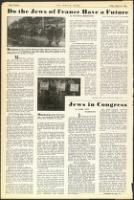
Group of Jewish Maquis parading through a French town after
H eroes: its
liberation by the Allies. They later joined regular French
army troops or U. S. and British units. The Maquis played an important role in
preparing for the invasion of France.
M
ORE than a half-year
after their liberation, France's disil-
lusioned Jews are still awaiting enact-.
inent of measures that will permit
them to-reconstruct the economic bases
of their existence and rebuild lives
shattered by four years of persecu-
tion.
First Jewish community on the
European continent to be freed from
the Nazi yoke, with the exception of
part of Italian Jewry, its survivors
cannot understand the ironical fact
that France, with all her traditions,
should lag so .far behind her liberated
neighbors—Belgium and Luxembourg
—and still waits while even Romania
and Bulgaria adopt laws for restora-
tion of Jewish property.
The Jews of France today total be-
tween 150,000 and 180,000—about half
the Jewish population of the country,
in June, 194,0. They appear to consti-
tute the largest Jewish community
surviving on the continent outside of
Russia and Romania. .
Half of the Jewish survivors are
French citizens born of French Jewish
families. A large proportion of the re-
maining half is composed of people of
foreign nationality who settled here
in the years before the war. The re-
mainder is made up of refugees from
Nazi-occupied countries and refugees
who fled to France in May, 1940.
sympathetically facilitate this. While
others, the unlucky ones, have been
arrested for possessing false papers.
Still others find piles of red tape and
legalistic obstacles.
The chief factors which make the
Jewish position in France so difficult
are the failure of the government to
enpct legislation which will restore
homes and property to the despoiled
Jews, and an apparent reluctance on
the part of most goernment agencies
Some of them who were able to
arrange to keep their property out of
the hands of Vichy's Commissariat for
Jewish Affairs, are now recovering it.
The few thousand who were in gov-
ernment service—in the Conseil d'Etat,
the judiciary system, the civil service,
the professional army—have been re-
stored to their posts.
Those who were practicing profes-
sions had their rights and privileges
restored immediately. For most of
those in commerce and industry, how-
ever, there is a long, hard period
ahead.
For the Jewish immigrants, libera-
tion has meant release from fear of
death, and not . a very great deal more.
They are considered foreigners in a
country incredibly crippled by loot-
ing and the destruction of battle, a
country suffering from an economic
crisis, a country unable to provide
millions of its inhabitants with food,
shelter and clothing and almost 'with-
out the means of setting its own re-
construction in progress.
Immigrants' Position Is Obscure
They are a small fraction of the
3,000,000 immigrants settled in France
before the war whose position, too,
is obscured by the government's fail-
ure to regulate their status on a na-
tional scale. But these Jewish immi-
grants are in a far worse position for,
as Jews, they were classified by the
Nazis as enemies and ruthlessly hunt-
ed down.
During most of the occupation, these
immigrants were homeless refugees
hitting under false identities. Now that
the need for camouflage is gone, they
are having trouble establishing their
real identities. In some departments of
France, new, post-liberation officials
It must be remembered that in the
lower brackets, at least, the govern-
ment personnel today is almost iden-
tical with the personnel of the Vichy
regime. Thus, the same men who en-
forced the Vichy discriminations, to-
day are largely the men who are ex-
pected to remove them.
Hundreds of Jews in Paris now
seeking to re-establish the economic
basis of their
existence by re-
suming their
former profes-
sional, commer-
cial or trade
. pursuits, a 1 s o
find themselves
up against red-
tape and admin-
istrative reluc-
tance which can
be surmounted only after interminable
delay, an exhaustive expenditure of
energy and no little expense.
The ordinance of August 9, 1944 re-
establishing republican legality in
metropolitan France cancelled all
these laws and, presumably, such dis-
criminatory acts as removing the
names of Jews from the commercial
registers.
But the experience of those who
have tried to have their right to do
business restored has been one of
heartbreak and frustration. The com-
mercial registers and tribunals in the
Paris area—where half the surviving
Jews of France now live—require
weeks and months for what, under
the circumstances, should take but a
few minutes.
Meanwhile, the applicant is con-
demned to inactivity. He cannot start
his business' until he has been regis-
tered with the commercial tribunal
and filed notice of his registration
with the police prefecture. When he
finally obtains his registration, it is
quite likely that he will have fur-
ther difficulties in being readmitted
into his professional or artisans' cham-
ber.
The fundamental trouble here is the
absence of any positive desire or af-
firmative instruction to correct this
situation. The government declared
the discriminations from which these
people suffered to be illegal and of no
validity. But it has not proceeded to
the logical step of eliminating the ef-
fect of the discriminations in practice.
These conditions found in Paris are_
not necessarily countrywide. In many
cities Jews have been reinstalled in
possession of their homes without
great difficulty. In some, the Regional
Commissioners and departmental pre-
fects turned over to them, without
awaiting action by Paris, businesses
and properties remaining in the hands
of the Vichy-appointed administra-
tors.
(Copyright, 1945, Jewish Telegraphic Agency. Inc.)
Jews in Congress
.
French Citizens More Successful
As a rule, the Jews of French
origin and citizenship are having more
success in re-establishing themselves
than the others. All the discriminatory
legislation of the Vichy regime which
struck at their legal and civil rights
has been expunged.
Jews' Homes Barred to Them
Many former Jewish homes are not
occupied by "sinistres" or other ex-
empt categories. But that doesn't mean
that the former Jewish tenant can re-
possess his old domicile. There is an
elaborate, involved, expensive and
tedious legal procedure to go through.
So far, no case has been reported to
central Jewish organizations of any
Jew regaining possession of a domicile
under this law.
Jewish Telegraphic Agency Correspondent
By lvtURIEL LEVtN
WASHINGTON
gr
Martyrs: of French
r of e n f the h e e graves
Jews
J
who were murdered by the Nazis
during their occupation of France.
to accept the fact that the Jews, hav-
ing been singled out by the German
occupants and their Vichy instruments
for special persecution, labor under
greeter disabilities than their neigh-
bors.
The present French governmentibe-
fore its return, undertook to restore
to the Jews the property stolen from
them under the arbitrary and dis-
criminatory legislation enacted by
Vichy.
The French National Liberation
Committee signed, on Jan. 5, 1943, the
declaration of the United Nations
under which the signatory govern-
ments reserved the right to consider
as null and void property transfers
effected by the enemy in occupied
territory. And, on Nov. 12, 1943, it is-
sued an ordinance making retroactive
the nullity of acts of sale.
The Jews here quote the various
government statements issued at dif-
ferent times to re-assure themselves
of the government's intentions. But
in the months that have elapsed since
the provisional government of France
was installed at Paris, measures to
implement these promises are yet to
be forthcoming.
Observers here note a general re-
hIctarice in official circles not only to
do • anything to remove the disabilities
against the Jews, but even to discuss
them. The official attitude is, ap-
parently, that the government, having
removed all legal disabilities affecting
the Jews and having placed them on
the same legal footing as the rest of
population, there is consequently no
need for special measures.
But take, for instance, the housing
question. Most Jews had to quit their ...
homes during the occupation to escape
surest, deportation and probable
I
F American Jews had
"minority status" in the U. S. as in
some of the European countries where
the "melting pot" ideal has not exist-
ed, there would be, on the basis of
population, 20 Jewish representatives
in the House and at least three in the
Senate. Those Jews who are elected,
however, win their seats as Americans,
and the eight men in the 79th Con-
gress are of widely different back-
grounds, interests—and merits.
They have in common the fact that
all are Democrats representing dis-
tricts where there is a heavy concen-
tration of Jews. Five are from New)
York, one from Chicago, one from
Hartford, and the eighth was elected
from Allegheny County, Pa., which in-
cludes the city of McKeesport.
Dean of the House with a record of
39 years of service is white-haired,
white-mustached Adolph J. Sabath
of Illinois who will be 79 in April. He
is chairman of the powerful Rules
Committee without whose consent no
legislation can come up on the floor
for consideration. He is highly re-
garded by Jewish and non-Jewish
groups for an impressive and _solid
record of liberal legislation.
Born in Czechoslovakia
Born in Czechoslovakia the year
Lincoln was assassinated, Sabath mi-
grated to the U. S. alone at 15, arrived
in Chicago with $1.35 in his pocket!
He subsequently brought over his
parents and five brothers. Working
as a salesman• in a department store,
he studied law at night at the Chicago
College of Law and Lake Forest Uni-
versity, was active in Czech and po-
litical organizations. Before the turn
of the last century, he had become a
power in Chicago political circles.
He served in the city council, as
Justice of the Peace, and as Police
Magistrate. As judge he advocated and
helped establish the juvenile court and
the parole system for first offenders.
It was in 1906, when Teddy Roosevelt
was president, that he was first elect-
ed to Congress.
....... _.
Rep. Sabath fathered workmen's
compensation legislation; and the
parcel post and postal savings act was
adopted largely because of his efforts.
He championed the rights of the im-
migrant on the Immigration -Commit-
tee for 24 years, was never chairman
because the Republican party was in
ascendancy when he was eligible, and
finally gave up that assignment for a
position on the Rules Committee.
Sabath, married late in life to May
Ruth Furst, has no children, quietly
lends his time, money and influence
to many.
*
*
Rep. Sol Bloom, who spent his boy-
hood in the slums of San Francisco,
is going back to the Golden Gate City
in a few weeks—to represent the U. S.
at the United Nations Conference. He
will be one of the eight American
delegates; the job is the drafting of a
world security league.
Bloom Born of Immigrant Parents
Born 75 years ago in a little town
in Illinois of Polish immigrant
parents, he worked in a brush factory
in San Francisco at eight, sold pro-
grams in a theater at night, played
kid parts. When he was 22, having
risen to treasurer of the Alcazar
Theater at 16, he decided to see the
world. He got as far as Chicago where
the World's Columbia Exposition was
about to open. He found construction
of the amusement area was behind
schedule, took a hand, and won a
diamond medal for his efforts. He gave
the world the "Hootchy-Kootchy"
when, as barker for "Little Egypt", he
hummed to advertise his wares.
From there, he took up music pub-
.14shing, moved his enterprises to New
York and opened a chain of phono-
graph stores. Then he drifted back to
construction, building some of the
most famous of the New York theaters.
It wasn't surprising that Tammany
boss Charles F. Murphy should ask
him to run for Congress in 1922. The
fact that he won in a normally Re-
publican district was a surprise; the
race was so close that his election was
contested and it was only after a
year=long lapse that he was seated.
.0entinued;!en .Page. 39 .
-