

Page Sixteen
THE JEWISH NEWS
Friday, September 15, 1 944
.
Dr. Israel Moses, Surgeon
Fighting Hero of the Civil War
By BURRILL B. CROHN, M. D.
gical operation and prescribe. for the
sick, I don't attend any ladies!"
From Williamsburg, Virginia, they
are "on to Richmond," and the Penin-
sula Campaign is in full swing.
Shortly he speaks of being wounded,
but of paying little heed to his injury
of the previous day.
The transfer of Colonel Nelson Tay-
lor, the Commanding Officer, 'to an-
other Brigade, and his replacement by
a stranger, seemed to have a determin-
ing influence in the next step of his
career. For in October of that same
year, 1862, Lieutenant Colonel Moses'',
of the Third Excelsior Brigade, be-
comes Dr. I. Moses, Surgeon of Volun-
teers stationed at Finley Hospital,
Washington, D. C.
EDITOR'S NOTE: This fascinating article about one of the most inter-
esting figures in the War of the States served as the text of an address
delivered by Dr. Burrill B. Crohn of New York at the 50th anniversary
meeting of the American Jewish Historical Society at Dropsie College for
Hebrew and Cognate 'Learning. in Philadelphia,- Fa., on June 14, 1942.
This paper was published in the January-February, 1944, issue of the
Journal of the Mount Sinai Hospital of New York.. The Jewish News is
pleased to be able to reprint it with the special permission of Dr. Joseph
11. Globus, editor-in-chief of the Journal of Mount Sinai Hospital. Dr.
Crohn :s the brother of Lawrence W. Crohn, one of Detroit's outstanding
Zionist and community leaders.
to mold the true
principles of inter-
national affairs in
London, Paris,
Ghent and Geneva.
In such a capacity
he was represent-
n g Governor de
Witt Clinton . a n d
the State and the
City of New York.
He was present at
the negotiations
leading to the sign-
ing of the Treaty
of Ghent.
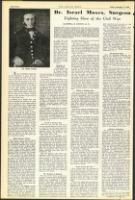
DR. ISRAEL MOSES
I
T IS A FITTING TRIBUTE
to this individual to grant him the
title of surgeon, for most of the active
years of his short career were dedi-
cated to the task of surgery. His roles
included that of Military Surgeon to
the United States Forces in the Mexi-
can War, first surgeon on the staff
of the - then recently incorporated
Jews' Hospital, New York City, sur-
geon to- the United States Volunteers
in the War of the States, surgeon
again in civil practice to the end of
his abbreviated days.
A fighting but a kindly man, cul-
tured, educated and sensitive, he spent
most of his life in army camps and in
public institutions with a longing that
was evident in his letters and corre-
spondence, for the happiness of a
life,'never fully to be achieved.
In the year of •his birth, in New
York City, in 1823, the family name of
Moses had already been well estab-
lished for probity and for public acts,
both in that City and in Philadelphia.
l is illustrious g r a-n d f a t h e r, Isaac
Moses, had immigrated from Germany,
in 1742, settling first in New York and
marrying there his cousin, Reyna
Levy. Resenting the intrusion of the
British during the Revolutionary War,
he, with other patriotic Jews, fled to
Philadelphia, to which the seat of gov-
ernment had been removed. Some time
later he returned t,g New York to
spend the latter part of his useful life
es a prominent citizen. -
Robert Morris's Partner
The quiet but highly patriotic efforts
tif Isaac Moses during the period of
the Revolutionary War have received
but insufficient attention and recogni-
tion. He was a partner of Robert Mor-
ris, a member of the militia who ad-
vanced to the United States 20,000
pounds in Specie in exchange for Con-
tinental dollars" to finante the Canada
Expedition, for which he among oth-
ers was thanked by John Hancock.
The energy and capability of this man
are seen in his many public accom-
plishments. He helped. raise hinds for
Instituting the first Fire Department
in Philadelphia; his efforts helped in-
stitute the first Bank of the United
States; through his appeal to the State
Legislature in behalf of 50 merchants
of Philadelphia and New York, the
first Custom House was established in
the latter city. He was honorary Col- .
onel of the Militia during the Revolu-
tionary War; and founder and member_
for 30 years of the New York Cham-
ber of Commerce. Benjamin Franklin
referred to him as "my friend of aus-
tere culture and • true knowledge," a
tribute of veritable merit from the
tongue of that most wise of men and
most frank of critics.
App'arently his son Joshua carried
on the tradition of the Moses family
as honorable merchants and as men of
affairs. The existence of an embossed
invitation and card of admission to
the coronation of the Emperor Na-
poleon I in Paris, bespeaks his rec.
ognition as an
He helpad
Heritage of
Good Name
Israel Moses, one
of the seven sons
of Joshua Moses,
entered life in 1823
with the heritage of a good name, the
scion of a family of recognized. culture
and fortune.
The school days of Israel Moses seem
to have been those of any boy born
and bred in the metropolis; but on the
day of his graduation from Columbia
College as a Bachelor of Arts (1841)
he was awarded two medals, one for
"proficiency in Latin," and one : for
"merit in English." His diploma as a
Master of Arts followed after three
years. During that period he was un-
doubtedly serving under the precep-
torship of a recognized practitioner of
medicine, for in 1845 he received his
degree of Doctor of Medicine from the
College of Physicians and Surgeons,
an engraved diploma of exceptional
elegance, bearing among others the
signature of -the illustrious Dr. Valen-
tine Mott.
-His internship at the New York Hos-
pital probably represented as fine a
practical course of training as was
afforded anywhere in this country, for
that institution, founded in 1767, one
of the three existing hospitals in the
metropolitan area, represented then as
it does now a standard of unexcelled
scientific merit.
Served in Mexican War
Tha—t very year saw the outbreak of
the war against Mexico; in fact, within
a • month of the day upon which his
two diplomas had been granted as a
graduate intern, the battles of Palo
Alto and Resaca de la Palma were
being fought (May, 1846).
The spirit and .the strength of his
forbears seemed to inspire the matur-
ing physician; rather than enter civil-
ian practice in a time of national crisis,
he elected to serve in the minute corps
that represented the nucleus of the
medical department of the small stand-
ing army of that day. Appointed sur-
geon, Jan. 187 1847, he served with the
army of occupation (Vera Cruz and
Toluca, Mexico) from July, 1847, to
September, 1848.
After the signing of the peace con-.
eluding the Mexican War, his services
with the Army continued. His regi-
ments covered a wide range of terri-
tory including such far-flung encamp-
ments as Wisconsin, Fort Leavenworth,
Missouri, with a Rifle Regiment and
with the First Artillery in Oregon, and
the then Washington TerritorieS as
well as in Texas. His. application for
sick leave was granted . -in 1855 and
was soon followed by his resignation
because of ill health.
The Building of _Hospitals
• The City of New York,'in 1855, was
reputed to number about 510,000 souls;
included in this census were 25,000 to
30,000 Jews, constituting a rapidly
growing, respectable, and proSperous
nucleus within the community, But
not all . were prosperous, for the abor-
tive revolutionary outbreaks in Eu-
rope in 1848 had initiated a wave of
immigration to the freer soil of the
New World; in this wave of immigra-
tion were included many of the in-
telligentsia of Germany, worthy but
impoverished by their trek. The large
and growing metropolitan city, for its
size and population, was as yet poorly
provided with hospitals.
Old Bellevue Hospital, founded in
1736, had already served the masses
for well over a hundred years, as had
also the New York Hospital, the proto-
type of the private hospital of its day,
with its chosen staff and meticulous
careful efficiency.
The need for new hospitals for the
growing city became apparent at the
turn of the half century; one notes the
foundation of St. Vincent's Hospital
(1849), a sectarian institution, and of
St. Luke's Hospital (1850), based sim-
ilarly on a selected creed. To Sampson
Simson and his co-workers is credited
the foundation of the Jews' Hospital,
in 1852, a small building housing 45
beds for the care of the sick; sin-Tie
and unassuming in design and concep-
tion, sectarian too, in basis, as were
all but the public city hospitals of
that day. Medical and surgical beds
and wards. were not yet divided, the
specialties in practice not yet recog-
nized. Soon after the doors of the Jews'
Hospital had been opened to receive
the sick, Dr. Israel Moses, Surgeon,
recently retired from the United States
Army Medical Corps, was appointed
an Attending Surgeon to that institu-
tion. --•
-
Enlists as Fighting Man -
The very first case admitted to the
_ new hospital was one of fistula-in-ano,
operated successfully, and so recorded
by Dr. I. Moses, Surgeon. From that
date to the outbreak of the Civil War
the surgical achievements of Moses are
written into the records and books of
that office, • operations covering every
field of the human anatomy from in-
fections to hernia, from trephining to
amputation.
The clarion call for volunteers enun-
ciated by his President, Abraham Lin-
coln, results in a stern purpose_ and
in a resolute decision of unusual
nature.
Incredible as it may seem to us, with
our conception of highly specialized
functions allocated in times of national
emergency, Dr. Moses answers this call
for freemen and is mustered in, not as
a surgeon, not in his capacity of a
medical man or health officer, but on
July 23, 1862, as Lieutenant Colonel,
.second in command, of the Third Reg-
iment, Excelsior, or Sickle's- Brigade,
of the United States Army, a fighting,
man, stationed at Camp Scott, Staten
Island. At the age of 3$, Lt. Col._ Moses
is whipping into shape a regiment .of
raw recruits gathered from: New York
City, from various sections of the
State, and some few companies', from
neighboring New Jersey. Nor is he
alone .of his family represented in, ,tlie
Federal Service, for his older brother
Isaac is also enrolled as Major and
as Assistant Adjutant General in the
United States Volunteers.
The summer heat of New York Bay
is already forgotten in the shivering*
blasts and wet mists that cover the
camp on the Potomac, 50 miles_belOw .
Washington. The regiment ;is. •. -being
trained as part of Hooker's Division of
the Army of. the .P'otOinac. 1VIOclellan
is a stern disciplinarian, the enemy is
in strength, and the stigma of Bull
Run must be erased. _
Almost Forgot His M.D.
Four months later the regiment is
still encamped; his bookcase, for he
must have a bookcase, is a biscuit box
turned upside down;• his library con-
sists of•twenty or more books of a de-
cidedly warlike character. An empty
gun-chest serves as a chair; he reads
himself to. sleep every night by candle
light.
Years in the army have carried him
far from his sheltered and educated
boyhood, but the old memories and
tenderness are still there, for his let-
ters to his sister-in-law and family
are always affectionate and beautiful.
"I am so in the habit of writing my
name as above (I. Moses, Lt. Col.)
_that I have unconsciously done so. I
have almost forgotten the M.. D .;
though I occasionally perform a sur-
.
'
His Practical Mind
After the Peninsula Campaign, the
lack of true efficiency in the Medical
Department of the Army was more
fully recognized than ever.
It is therefore not strange that at
this time Moses heeds the call of the
administration for more and more doc-
tors for the rapidly growing forces of
combat.
The scene of activities now - shifts to
Eastern Tennessee. The warring days
of late December, 1862, saw the Army
of the Cumberland, under Rosencrans,
facing before Murfreesboro the gray,
tattered Army of the Tennessee under
the Fabain Bragg. Both armies 'lay in
the trenches in the rain, in the coldest
winter nights of many a year. Supplies
were late in coming; the improvised"
shelters of the Sanitary Commission,
however, were well stocked.
During the cold weather, Dr. Moses
with his usual foresight and thought-
fulness for the comfort of the sick and
wounded, had all the ice-houses in the
post filled to - their utmost capacity
with a good quality of ice. A perusal
of the surgical reports of the Army
shows to what extent fresh cold water
was utilized as the routine dressing of
wounds and injuries.
Another hobby of the Medical Di-
rector is to institute gardens and tilled
areas wherein the convalescents may
work and live and raise fresh vege-
tables for the boys in the hospital.
Already in 1864, the American Jour-
nal of the Medical Sciences Published
a paper entitled "Surgical Noteg of
Cases of Gunshot Injuries Occurring
During the Advance of the Army of
the Cumberland in the Spring of
1863," by Dr. I. Moses. Every type of
gunshot wound of face, head, extrem-
ities, body cavities, is amply covered
with sketchy but intelligent details
and remarks. The results are often
surprisingly good, conservative treat-
ment is encouraged at all times.
Opposed Amputation
. •
Dr. Moses has an aversion to am-
putation, except in urgently clear in-
dications on the field of battle. In the
more quiet atmosphere of his base
hospitals his natural scientific logic and
his innate conservatism come to the
- fore. He has saved thiee out of four
cases of gunshot wound of the upper
extremities without amputation; all
-the : wounds of the forearm and hand
recovered without sacrifice of the limb.
For the first' time he publishes his
views on the conservative treatment
: of gunshot wounds of the knee, He
Criticizes the disappointing reSultS
limn amputation; he puts in a clarion
call for open incisions and free drain-
. age and encourages a more conserva-
tive and preventive course aimed at
-.saving a functioning extremity.
The -long inactive spring of 1863 has
passed; the Army of the Cumberland
is again on the march, Bragg has been
Outwitted and outflanked, and has by
necessity evacuated the small -city of
Chattanooga and gathered his forces
in the hills and impregnable moun-
tains south of the Tennessee River. In
September, Moses receives his orders
to take charge of the hospitals and
medical facilities freed by their re-
treat. He is Surgeon-in-Chief of the
General Hospital and Medical Director
of the Post of Chattanooga. He will
take charge of that host of wounded
and injured, derelicts and broken men
that
sbe gathered to him during
the succeeding three months of bit-
terly contested battles in the passes
and on the slopes of Chickamauga, of
Lookout Mountain, and of Missionary
RiI In
dge-t
-the first few days of September'
the Union losses were well over-13,000
men and officers killed and , wounded.
(Continued. on Paw' 19),