

American ffewisli Periodical OW
Thursday, October 5, 1950
DETROIT JEWISH CHRONICLE
Page 4
Detroit Jewish Chronicle
' With a Prayer on Their Lips
Published WeeM ■ by the Jewish Chronicle Publishing Co., Inc.
WOodward 1-1040
2827 Cadills; T.n‘ cr. Delmt 26. Michigan
SUBSCRIPTION:
$3.00 Per Year, Single Copies, 10c; Foreign, $5.00 Per Year
Entered as Second-class matter March 3, 1916, at the Post Office at
Detroit, Mich., under the Act of March 3, 1879.
By GER1IARDT NEUMANN
THE COURT JEW by Selma
Stern (Jewish Publication So-
ciety of America, Philadelphia,
213 pp., $4).
SEYMOUR TILCIIIN
Publisher
GERHARDT NEUMANN
NORMAN KOLIN
Editor
Advertising Manager
Thursday, October 5, 1950
Tishri 24, 5711
Working for Peace
The report of the trustees of the Ford Foundation, which
was released last week, makes for interesting reading and de-
serves the intensive study of everyone interested in the cause of
peace and progress.
The Ford Foundation is primarily concerned with the fur-
therance of the humanistic sciences. It is built on the belief
that a deeper understanding of all social factors will lead up to
valid conclusions as to the best ways of achieving peace.
Peace and prosperity, in the opinion of the trustees, cannot
exist one without the other. The report names poverty and
disease, the tensions which result from unequal standards of
living and economic insecurity, and racial conflict as the main
causes for war.
"Even in this country," the report states, "persons of all
races and colors do not have equal access to education."
While all these statements hardly reveal any new truths,
it must be acknowledged that the thinking of the trustees is
about as advanced as the present level of the social sciences
permits.
It is especially significant that the report takes cognizance
of the ever-changing character of society:
"In times of uncertainty there is a tendency to resist
change out of an illusion that free institutions arc made more
secure by an unchanging order . . Democracy must do more
than.declare its principles and ideals: it must constantly trans-
late them into action . . . It is man's faith in this dynamic
ability which assures the survival of democracy."
The report stresses the conviction that it is basic for
human welfare that all men are accorded equal rights and
opportunities and that tolerance and respect for individual
social, religious and cultural differences must become a generally
accepted practice. "It can be most fruitful where free men
work together in confidence and mutual respect."
To our way of thinking, the concept of the ever-changing
society is of paramount importance and should be followed
through to its logical conclusions.
Most conflicts arise where individuals as well as nations
insist upon maintaining their way of life without seeing that
its continuance is no longer an expression of the actual needs.
It could be argued that it is nobody's business how a nation
wants to conduct its affairs or regulate its life. Unfortunately,
this argumentation is full of holes.
What most people still do not understand fully is the fact
that in modern life there is an interdependence within a nation
as well as among the nations. If the ways of thinking are con-
flicting too strongly, they will lead to revolution internally, or
to war externally.
It is therefore no empty phrase if social science believes that
the way to peace lies on the road to human understanding.
This is not a new insight. The Jewish prophets never tired of
seeking this understanding. Their visions culminated in the hope
that some day all differences would be resolved and all enmity
disappear.
This is the root of Jewish thinking. This is the reason why
Jews always have stood in the forefront in the fight for free-
dom and progress. This is why Jews have always been known as
optimists: they believe in mankind.
However, it must not be overlooked that optimism must be
qualified. The prophets qualified their optimism by saying that
the great age of peace would arrive if all people accepted certain
basic beliefs and adhered to them.
The difficulty of our time is to find a solid ground for op-
timism. Everything seems so shaky and hopeless, and man no
longer seems to believe in the possibility to escape disaster.
This general hopelessness makes it so difficult to persuade
people to work for peace as earnestly as they do for their
livelihood.
If through such efforts as that of the Ford Foundation the
basis can be laid for a new and more positive outlook on life,
peace will no longer appear an illusion but become a reality.
Bunche and Israel
The award of the Nobel Peace Prize to Dr. Ralph Bunche,
mediator of the armistice between Israel and the Arab states,
calls for a few remarks about the labile situation in the Near
East.
It goes without saying that Dr. Bunche's ability to induce
the Arabs to come to terms with a nation they pretended did
not exist was admirable. It was a demonstration of his skill,
wisdom and impartiality. The Nobel Peace Prize could not have
gone to a more deserving man.
However, the question that has been troubling Israel ever
since the armistice was signed in February, 1949, is: when will
the armistice make way for a real peace settlement?
We have our doubts whether the question can be settled
by a debate in the United Nations. What is needed is a genuine
rapprochement between Arabs and Israelis. This cannot be
forced upon them by any resolution of the big powers.
The present situation, however, does not look too hopeful.
The Arabs continue to keep up the illusion that they emerged
triumphantly from the war and that the state of Israel is non-
existant. This adamant attitude, unrealistic as it is, is the key
to the political difficulties in the Near East. The whole area is
seething with unrest because the Arabs cannot reconcile them-
selves to the fact that a new power has arisen in the Near East.
"Pride and Prejudice" would be a good caption over the picture
of their policies.
The result is that Israel is forced to keep a large army and
thus divert its manpower from the job of reconstruction. If the
reclamation of the desert or the adjustment of the newcomers
could be made under peaceful conditions, not only Israel but the
whole area of the Near East would benefit materially and
culturally.
Court Jews
Typify Fate
of Pioneers
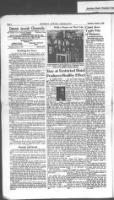
Jewish servicemen of the 7th Division are holding Rosh Ilashana
services aboard an army transport ship as it approaches Inchon,
Korea, for an amphibious landing operation.
Stay at Restricted Hotel
Produces Healthy Effect
The mail looked almost dev-
By ALFRED SEGAL
He was full of apologies,
MY FRIEND JOE wasn't brag- asted.
like
a
man who had suddenly
I
Mil ging about the matter.
discovered an error of his ways.
wouldn't be writing about friend
Joe's vacation if he were one of
those people
who make
proud boast that
they managed
to get into ho-
tels where Jew-
ish people are'nt
wanted.
The period of absolutism and
mercantilism (17th and 18th cqi-
tury) produced a type of Jew
such as the world has never seen
and, we hope, will never see
again: the court Jew. Selma
Stern, a historian of distinction,
not only brings this type of Jew
back to life, but also reveals with
deep insight the motives which
led to such a development.
"The organization of the gov-
ernment," she says, ''had not yet
developed to the extent that it
could dispense with entrepreneurs
and intermediaries who stood
outside the hierarchy of officials.
Prince Eugene characterized the
epoch very aptly when he wrote
that one could see almost every-
day examples where a charming
woman, or a black-robed church-
man, or an Imposingly-bearded
Jew decided the fate of whole
nations."
And this is indeed what hap-
pened. As commissaries, court
contractors, financial agents, cab-
inet factors, commercial agents
or mint masters, some wealthy
Jews of that period played a de-
By way of making amends, he cisive role in diplomacy, war, the
insisted that Joe's wife and financing and industrialization of
daughter must meet his family. the states (mainly the German
They played ping-pong later.
states) as well as the value of
It got around the hotel that a the silver currency.
The court Jews enjoyed many
Jewish family was among the
guests. People seemed to be go- privileges that were not enjoyed
ing out of their way to be nice— by ordinary Jews, but the author
not in an offensive way but with shows that they were Tar from
the idea of being decent in this happy. In fact, most of them died
In thatewease I
hotel that, according to the ad- in poverty if they were lucky
would have said,
vertising, was designated as re- enough to escape the gallows.
Joe, you are an
The autocrats of the 17th centu.ry
stricted.
obnoxious p e r-
Segal
Joe's family gave no sign of figured that a Jew was good
son, please ex-
to help them, but that
cuse the expression. Where's feeling that they were in the enough
were under no obligation to
your self-respect? Maybe you wrong place. This hotel was they
pay what was coming to him.
thinly, you are better than other where, as Americans, they had a
The expedient way of getting
peopile who haven't been ad- right to be. There was nothing rid of the Jew when he had done
mitted to that hotel. In my book assertive in this attitude. Sure his duty was to accuse him of
you are far less than they—a they were Jews and that was fraud, theft and many other
miserable beggar who enjoys the nothing to feel apologetic about. crimes against the state, includ-
crumbs that fall from the table They didn't retire to a shadowed ing blasphemy.
of those he regards as his superi- corner. They were as good as
Their existence, the author
or. You arc no friend of mine anybody in the place and their Writes, was "dreamlike and un-
self-respect was appreciated.
hereafter. -
real" because they constantly
Joe's family took part in all moved "between two poles which
But friend Joe was just being
philosophical. Joe was mention- the entertainment. Joe could feel had no connection with one an-
ing the matter of his having been the more proudly Jewish because other." They did not, like their
a guest at a so-called restricted by reason of the character of his Christian contemporaries, look
hotel by way of bringing up the family, he had become accepted upon man "as a machine whose
Jewish problem in relation to so- in the "restricted" hotel. Every- actions and reactions could be
body there knew they were Jews, explained in mechanical terms."
cial life.
was
He didn't know that he was yet there was no one there to The basis of their existence
still the Talmud.
getting into that kind of hotel make the least of that fact.
"While they founded compa-
When, after several days, Joe's
when he registered for himself,
nies, factories, banks and mo-
his wife and daughter. He knew family departed, there was re-
nopolies and seemed to be enter-
it only as a very respectable, nice gret among all the friends they ing the economic and political
looking place and was happy to had made. Joe felt he had done life of the people whom they
well by his Jewish identity. Hos-
be sheltering his family there.
served, they longed for their re-
Only a short while later he tile people (they must have been turn to the Promised Land."
hostile
to
have
chosen
this
re-
found out that it was one of those
They were in fact used as tools
hotels that carry the title "re- stricted hotel for their vacation) with which the absolute ruler
stricted." That discovery didn't had been brought around to see sought to "destroy the feudal and
disturb Joe. He , is a man proud that people are people—good or patrimonial forces of the Middle
of himself and tis family and to bad—and their racial or religious Ages which stood in his way."
discover that he had landed in a connection had nothing to do
Because of this role of creating
hotel called restricted could not with it. Joe wasn't feeling any something new, the Jew became
diminish his worthy pride. Ile messianic pride of a missionary, for the reactionary forces the
could feel that he belonged but he could regard it as a happy symbol of revolution. "Though
wherever people were decent. accident that had brought him to they accused him of being an
Why should he run away from this hotel and thereby had caused enemy of Christ, it was in reality
there? He was not an inferior. a group of people to perceive how not their church and not their
He would stay there, through the wrong they were in social judg- religion that they sought to pre-
several days he had planned.
ment.
serve, but rather the guild sys-
• • •
tem, the doctrine of fair price,
He wasn't going to conceal his
"WHILE NOT 'TIDING the the patrimonial state government
Jewish identity if the occasion
arose. He came upon an oppor- fact that we were Jews, we did and the medieval society of
tunity the same evening. A man not let ourselves feel different or estates."
Thus, when they had completed
with whom he had become make any show of being different
friendly asked him where he was or ghettoize ourselves in a cor- their assigned tasks, these court
going from there, Joe said he and ner of that hotel porch. We just Jews fell victims to the hatred of
his family would be traveling to stood on our self-respect as a dying world which still was
Jews."
a certain hill region.
Joe admitted it is pleasant to
"Oh," the man said, "I should
tell you: There are a lot of Jews a Jew to stick closely to the Jew-
ish group — "In that way you
down there."
have no problems," he said. "It
• • •
avoids all the distressful conflicts.
JOE ASKED HIM, what gr of You are among your own and no-
that? That may be good or it body is going to floor you by em-
may be bad. Jews, he said, were barrassment. It's a luxury and I
like all other kinds of people— like it."
good or bad. You can't judge a
Well, that's Joe's story of his
whole group of people by the vacation and I am not arguing it
faults of some of them.
one way or another. I am just
"You see," he said, "I know handing it on to all the canasta,
that because I myself am Jew- gin and poker parties for discus-
sion.
ish."
more powerful than their influ-
ence.
The author's final words seem
to have a timeless meaning in
Jewish history:
"The court Jew has a symbolic
significance for the fate of the
Jew in all ages. For time and
again the Jew has helped pre-
pare the way for a new era, only
to find himself ground between
the old forces which had out-
lived their day and the new
which, with his help, were giving
the world the promise of a bet-
ter future."