

Friday, November 30, 1945
Personal Problems
So They Tell Me--
By LOUIS W.
By W. A. GOLDBERG, Ph.D., Director, Counselling Service
DOES MILITARY SCHOOL HAVE VALUES?
(Et)1rows. Nom
pages or by mall,
:■t t . ' '' :11-
t1
l'■ ■ • •i ;r?.1e
I't
perFonal prelI
an fat—ts ilesA ihle. Send v og
' 1: HIS
41% h tor rs'
; (1 tio el
ae
sh
iV-Itt it( u tretsi es de,
I oetiolt 26, Mleh.,
"We have heard that a military school is an excellent place to
send our eleven-year-old boy who is misbehaving. We a are
het
e btom
o lde,the
he will be disciplined and trained and, when he. comes
will be a better child. What do you advise?"—Mrs. L. L.
r
Page Five
DETROIT JEWISH CHRONICLE and The Legal Chronicle
The best military school, that is, one completely staffed will
teach a boy obedience to rules and submission to orders. It should
teach him to keep himself neat and clean and gi ve him a military
bearing. It may take him away from others who are influencing
him toward objectionable conduct.
Sending a boy to military sch:,o1 or to any other kind of school
just because he is misbehaving is a form of rejection. It is one way
of telling the youngster that you are pushing him
aside. It is in effect den;ing the youngster the
very thing he seeks and which his conduct dem-
onstrates that he wants, i.e., love and affection,
being loved for himself rather than roe his acts,
good or bad.
In every human's life there is a time for a
demonstration of the beautiful phrases which par-
ents use toward children, love, affection, respect,
pride, etc. In the maturation process of adoles-
cence, boys and girls are torn between terrific
physical and mental changes which they nay rot
understand and often have no basis for knowing
and the joys and indifferences of youth. Here is a
Dr. Goldberg
half-child and a half-adult. Here is a body which is
slowly becoming,a person, that is, a person plus social experience.
Here are the wishes, urges, desires of an adult and the judgment
and experience of a child.
Parents find it necessary to demonstrate their love to the child
and to his satisfaction and comprehension. Words alone are insuffi-
cient. Words must be proved and proved again and again.
The Meaning of Love
Hence, if you love your child. you must love him for himself
not for what he does (if acceptable) and even in spite of his ac-
tions (if not acceptable). Therefore the oft-repeated advice to par-
ents. You tell your child that you love him at all times although
you may have occasion to disapprove his conduct. It may take the
patience of Job on the part of parents to demonstrate that their
words make sense to the child. No matter how firmly parents feel
their love, it remains ineffective until firmly established in the
child's mind.
The adolescent struggle for love and affection is a major bat-
tle. Adolescence is an unpleasant time, full of vagueness and urg-
ings which the child is often at a loss to explain. Your patience may
show an initial improvement in the child. If parents relax at this
time, their work is lost because the child will find situations to test
parents, to test your statement of love against your actions.
In one case, a young man was raised in an orphanage and WAS
forever in difficulty. He was finally told to make his own way in
the world. The circumstances of his mother's death had raised
serious questions in the boy's mind of his mother's morals. His
father and sister saw him only when they wanted money. His fam-
ily, in short, kicked him out. The counsellor was a new experience
to him. lie offered to help. This was puzzling to the young man.
There must be a catch in it somewhere since, in the past, everybody
who offered help demanded more in return. So he tested the coun-
sellor in many ways. He promised to work and was given money in
advance. He did no work, he stole, he lied, he was absent. Each
time he needed help the counsellor was there. In three years, our
young man learned the meaning of friendship. He wanted to be-
lieve in humanity but humans had failed him. He had been fooled
too many times to accept any offer at its face value. He required
a moral crutch and, having re-established his faith in man, was
able to go his own way unaided.
Special Circumstances
Now back to the military school problem. The psychological
values of military school are many, especially under certain condi-
tions. A child knows he is loved. A home situation may be unusual
and solvable in no other way such as where there is an ailing
mother, the absence of the mother due to death or divorce or the
case of the father who travels considerably or has irregular busi-
ness hours. Such situations may be ideal for a boy. A military
school is also of considerable help where family prestige is en-
hanced by attendance as when an older brother or close relatives
are alumni or attend, where there is a love of adventure or
physical training has a special appeal. There is value also if the
child is not overly sensitive and will not miss the home touch.
If a sensitive child is sent away from home, there is serious
danger. A child who has been over-protected at home, who has not
learned to compete with other children, who cannot tolerate the
give-and-take atmosphere, all such children will undoubtedly be
subject to more insecurity and the use of a military school merely
reinforces his feeling of rejection.
The Age of No Miracles
Responsible parents sometimes expect to accomplish miracles
in it child's behavior by turning him to someone else. They forget
that a child is the product of his home and his environment. There
is no magic manner, no miraculous drug to insure success and to
be the antidote that counteracts bad training. It requires under-
standing and long work to effect a change. The treatment of a mis-
behaving child involves both parents and the child. Often parents
shut their part out of consciousness.
Counsellors reject as unfruitful most cages where parents wish
to go their merry way while the child is "treated." The counsellor
may help the child by protecting him against the parents or by
hardening him against parental rejection, especially where the par-
ents offer little promise of change in themselves.
Buying a Child's Love
Parents often speak of their love and try to prove it by point-
ing to the money they have spent on the child. These people fly in
the face of known facts of child psychology, that the love of a
child cannot be bought but must be won. Perhaps some day there
will arise a generation of parents who have been educated to feel
no guilt about children's behavior but, with other parents openly
and without fear realize that knowledge of human reactions is
quite specialized. They will seek to strengthen themselves in the
problems of child raising by seeking professional advice early and
often.
Having determined that the child will not be harmed by being
sent to a military school or having been helped in that decision, the
next job is to assure one's self that the school selected is compe-
tent. That involves a serious check-up of the competence of the
school and its faculty and equipment. This cannot be overlooked.
Progressive child-caring agencies have rejected the institutional
atmosphere as best for all children. We too reject the military
school as a panacea for all misbehaving children. For some children
there is perhaps no better solution. For other children, there may
he definite harm.
reperved.
by W. A. f;oldherg. Ph. I) All rights
(veyrisia 1111111ed (pt. 1915.
MAN OF TIHIE WEIEE
ENFIELD
My friend is named Mike and
he dearly loves his little nip. He
is a very good fellow and is fond
of doing a favor to all who ask.
One day a pal of his asked for
such a favor. This pal was of the
religious persuasion that sits up
all the first night with the body
of one who has just died. He had
to sit up with such a corpse and
he didn't feel like sitting up alone.
Mike, being a very obliging sort
of a fellow, agreed to sit up
with him.
They whiled away several hours
playing seven up and two-handed
poker. When midnight came, they
both felt the need of a little
liquid stimulant so they decided
to go out for a drink. Since it
was wrong for the corpse to be
left alone, they decided to take
it out with them.
Accordingly, they put some
clothes on the stiff and hauled it
out with them to a bar on the
corner. The stiff had a cap pulled
over its eyes and with one man
at each arm, they lugged it in
the saloon and propped it up
against the bar. They ordered
three drinks and, when the bar-
tender's back was turned, Mike
sluiced down the odd drink. They
did this several times, alternating
in downing the odd drink.
"We got to go out for a while,"
said Mike to the bartender. "My
friend here will pay for the
drinks and any others he wants."
Then Mike and his pal walked
out and stood peeping in at the
window to see what would happen.
For a few minutes nothing hap-
pened. Then the bartender spoke.
"Will you have another drink?"
he said civilly. The corpse did not
answer.
"I said will you have another
drink?" said the bartender a lit-
tle more loudly. The corpse con-
tinued to say nothing.
The bartender was annoyed.
"If you don't want anything
more, then pay me for your drinks
and go on home," he said testily.
The corpse remained silent.
By this time, the bartender was
really angry.
"Look here," he shouted. "Are
you going to pay me for those
drinks or do I have to run you
in?"
The corpse said never a word.
Whereupon, the bartender walked
around his bar and grabbed the
other by the shoulder. The corpse
fell to the floor with a crash and
remained there.
The bartender reached down,
touched the stone cold face and
fell in a dead faint beside the
corpse. Then Mike and his pal
came in, took their corpse and
hauled it back home where they
sat up quietly the rest of the night
as the old custom required.
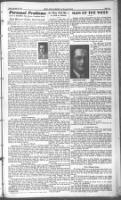
Energetic, polished, urbane Rabbi Leon Fram of Temple Israel,
who celebrates his fiftieth birthday on December 12, is saluted by
the Chronicle as the Man of the Week. Rabbi Fram was born in
Rosienny, in the province of Kovno, Lithuania. At the age of six,
he was brought to this country by his widowed mother who settled
in .Raltimore.
' Irr high school, Fram became very proficient in chemistry and
won a scholarship in that field at Johns Hopkins University. While
he was there, he had occasion to listen to a sermon by a Rabbi
William Rosenau which so impressed him that, at the age of eighteen,
found himself at Hebrew Union College studying for the rab-
he enae
bintNe.
He also studied it the University of Cincinnati and has now
been a rabbi for twenty-five years. Busy at his work all the time,
he just never found time to get married. Asked about being an
eligible bachelor, he dismissed the subject with a wave of his hand..
"I'm married to my work," he said with a smile.
When asked what he thought
was most interesting about his
work, Rabbi Fram answered with-
out hesitation.
"First, I find the opportunity
to guide youth most interesting.
Next, I am most interested in the
opportunity for communal leader-
ship."
In exercising this communal
leadership, his first love, outside
of Temple Israel, is Zionism. He
is now president of the Zionist
Organization of Detroit and at the
convention last week he was elect-
ed a member of the national ex-
ecutive board of the Zionist Or-
ganization of America. He is vice
president of the Jewish Commun-
ity Council and chairman of the
community relations committee.
This committee combats every
form of anti-Semitism, tries to
establish good relations between
the Jewish and the non-Jewish
community and tries to counter-
act vigilantly every form of anti-
Jewish propaganda and discrim-
RABBI LEON FRAM
Jewish education of the
He is a member of the commission
Union of American Hebrew Congregations. As chairman of the
schools committee of this commission, he is called on to review and
approve in manuscript every text book offered for religious schools.
On Many Boards
He is on the executive committee of the commission on justice
and peace of the Central Conference of American Rabbis, a mem-
ber of the board of the Jewish Community Center, and of the
Jewish Social Service Bureau.
He is a member of the board of the Religious Education Asso-
ciation of American Educators consisting of Catholics, Protestants
and Jews who seek to make religion a better vehicle for under-
standing; board of the Detroit Round Table of Protestants, Catho-
lics and Jews, chairman of the Jewish division of the Speakers
Bureau for the Metropolitan War Chest and Red Cross.
Rabbi Fram has traveled all over the world. He has visited Pal-
estine twice and has been through Mexico and the Latin American
countries. Some of his traveling was done under dangerous circum-
stances. In 1929, for instance, he visited Russia where tourists
were not allowed. On that occasion, he visited the Jewish farm
colonies in the Crimea.
"I had a camera with me and I very naively started to photo-
graph a Red Army Battalion that was passing," he said. "They
started to arrest me and I envisioned Siberia or the hangman's
noose. Fortunately, a Russian friend explained that I was a dumb
American and didn't know any better."
Asked if he spoke Russian, he said he didn't.
"However, I had no difficulty," he added. "I found that my
knowledge of Yiddish took me everywhere."
At Assassination Scene
"I traveled through Mexico when tourists were warned off the
streets," he continued. "I was right at the scene when General
Obregon, candidate for president, was assassinated.
"In Germany, where I traveled in 1929, I met some Nazis on
In the good old days, anyone a railroad train and because I spoke German fluently, they mistook
with pretensions to scholarship or me for a sympathizer. They took me to some of their secret meet-
social position would wear, on for- ings and I got a picture of their set-up and their plans. When I
mal occasions, a high top hat came home, I headed the League for Human Rights whose purpose
called a "stove pipe." No rabbi or it was to boycott German goods. It was an inter-faith proposition
synagogue officer would dream of and Detroit was regarded as one of the most successful cities where
going to the synagogue without this was done. We really cleared German goods out of this city.
"When the war began, the committee was disbanded. It was
such a stove pipe.
One Sabbath morning, a cer- the first instance in my knowledge," he continued with a chuckle,
tain rabbi, in a fit of absent mind- "where a strong Jewish organization disbanded of its own volition
edness, had gone to the synagogue when its function was done."
In politics, he belongs to no party but is always on the liberal
in an ordinary hat. When the
services were well started, he progressive side. He was very active in the campaign of Frank
suddenly woke to the realization Murphy for governor and was appointed by him on the commission
that he was sitting up in front of to investigate labor conditions, being a member of the three-man
committee appointed by the governor to arbitrate in the famous
all the worshippers in a hat that sit-down
strikes.
was unbecoming to his dignity. He
When
Murphy, who is a devout Catholic, was inaugurated in
looked about and spied the young
office as governor, Rabbi Fram delivered the inaugural prayer.
six year old boy who lived next
When the late Franklin D. Roosevelt came to Detroit for his first
door to him.
campaign, Fram sat next to him on the lecture platform and deliv-
"Run home and get me the stove ered a brief address in his behalf.
pipe." he commanded and the boy
obediently ran out.
Wants Building Finished
Houses in those days were heat-
His present ambition is to see the Temple Israel building com-
ed by little stoves that stood in
pleted. He hopes it will be so beautiful that it will serve as an
the parlor and cast the heat from architectural model for synagogues throughout the country. Some
isinglass windows. Their chimneys day, he hopes for leisure to write several books he has been
were connected by long pipes with planning.
the outside chimneys. The little
Rabbi Fram has occupied the pulpit of practically every leading
boy's mother walked in to the church in the city. He is a close personal friend of Abba Hillel
parlor and saw her offspring in- Silver who was recently elected president of the Zionist Organi-
dustriously engaged in taking the zation of America.
pipes apart.
When asked to foretell the Jewish future in this country,
Fast action was called for, so Fram spoke very thoughtfully.
She fetched him a slap across the
"As long as democracy is safe in this country, the Jews are
cheek.
safe. The spirit of freedom is more deeply rooted here than any-
"But I'm doing it for the rab- where else in the world. If it is lost everywhere else, it will still be
hi," wailed the poor little lad. here. I feel that this country is destined to be free. For that rea-
"He wants the stove pipe. He just son, I feel that, despite flurries and dangers, the Jew is destined
sent me to get it."
to be free. And for that, I hope and pray."
al