

Friday, September 15, 1944
DETROIT JEWISH CHRONICLE and The Legal Chronicle
16
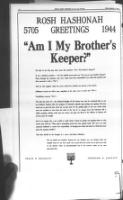
ROSH HASHONAH
5705 GREETINGS 1944
"Am I My Brother's
Keeper?"
Far back in the dim past, there arose that question: "Am I My Brother's Keeper?"
It was a defensive question — but the implied answer then was, "Yes you are your brother's keeper!"
Down through the centuries, men who would shun their responsibility have asked that question and
then answered it with a "No"—
And yet that negative reply has never solved the problem nor proven a true answer.
Selfishness toward our fellow man, regardless of his color, race or creed, says "No"—
Unselfishness answers "Yes"—
The time has come wh the advanced thought of the human rice must be convinced that we are
our brothers' keepers—that the progress of humanity depends upon giving—not getting. Not how
much can we get—but how much can we give must be the guiding light of the new world which
even now promises to arise from the ashes of the old. If we emerge from this holocaust still a
selfish, grasping, seeking world, then the misery, the grief, the blood of the millions of humans will
all have gone for naught.
But if we emerge into a new world—a world which is based on giving—not getting—then we who
survive may well say: "They paid a tremendous price—but they gained much. We owe it to that
martyred multitude to assume the responsibility of bringing into reality that ideal for which they have
given the supreme sacrifice".
This then should be the thought of a newer and better civilization:
We are indeed our brothers' keepers—as our brothers are our keepers—and our
thought must be not how much can we get—but how much can we give—not only
in the abstract realm of internationalism but in the concrete realm of our own
day-to-day lives.
PEACE • SECURITY
FREEDOM • JUSTICE