
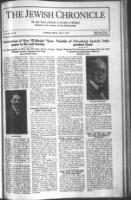

THE JEWISH CHRONICLE
The only Jewish publication in the State of Michigan
Devoted to the interests of the Jewish people
Vol. H. No .23
DETROIT, MICH., AUG. 3, 1917
$1.50 per Year
Single Copies10 Cents
Cornerstone of New "El Mosha" Syna- Founder of Cleveland Jewish Inde-
gogue to Be Laid Sunday
pendent Dead
First Co ngregation on West Side Will Serve District of Upper
Michigan Avenue—Organized Five Years
Ago by Morris Cohen
Evidence of the growth of the Jew-
. ish community of Detroit is once
more reflected i in the development of
group. Con-"'
another new religious
gregation "El Mosha," an organiza-
tion of Jewish residents on the west
side in the Michigan avenue district,
the cornerstone of a new
will lay
synagogue and Talmud Torah on
Sunday, August 5. The building, plans
for which represent an outlay of
,000, will be erected on Twenty-
ninth street at Michigan avenue. —
An interesting program has been
arranged. David A. Brown will de- ;
liver the address of the day., and other
speakers include several spiritual and
communal leaders of the community.
A unique featureof the ceremonies
will be the participation of the chil-
dren of the congregation. The little
formed. In honor of Morris Cohen,
whose enthusiasm had made the or-
ganization possible, the congregation
was named "El Nloslia." The little
"Minyon" had outgrown its quarters.
Fifty Jewish families Were represent-
ed in the congregation; and it was de-
cided to build a synagogue adequate
to the present needs of the groWing
district. Sentiment having already at-
tached to the quarters at 90 Twenty-
11111t11 street, the lot was purchased
and plans prepared for an edifice that
will be a credit to the entire Jewish
community of Detroit. The main au-
ditorium of the synagogue will ac-
commodate 400 men and 250 women.
Ample provision will be made for
school rooms and meeting rooms for
the Ladies' Auxiliary and the Young
Peo6le'se Society.
The officers of the congregation
are: President, I. Levinson; vice-pres-
ident, A. Friedman: secretary, R.
Zuieback: treasurer, 11. Rosenberg.
The building . condiittee consists of
H. Rosenberg, Wm. Bernstein, S. Sil-
berstein, R. Znieback, and M. Cohen.
Officers of the Ladies' Auxiliary are
Mrs. J. Cohen, president: Mrs. I. Lev-
inson, treasurer, and Mrs. R. Zinc-
had:, secretary.
BRANDEIS PRIZE WILL BE OF-
FERED THIRD TIME.
Maurice Weidenthal Was Prominent Newspaper Man and Active
in Jewish Communal Work—Noted as
Dramatic Critic
Cleveland, 0.—In the death of Mr.
Maurice Weidenthal, which occurred
suddenly early last Saturday morning
at his home, Cleveland loses one of
her most widely known and highly
esteemed pioneer residents.
r. Weidenthal, who was born in
Hungary in 1856, came to this city
with his parents when he was thirteen
years old. He was educated at Rock-
well school.
He was prominently identified with
newspaper activities here for more
than thirty years. He was a reporter
and later dramatic editor of the old
Cleveland Herald, now The Cleveland
News. lie • was dramatic critic and
editorial • writer for the Cleveland
Press.
About twenty-five years ago he was
city editor of The Plain Dealer, and a
reporter for the Cleveland World.
He was an exceptionally brilliant
writer, excelling as a dramatic critic.
He was fearless in expressing his
principles.
In 1906 he founded The Jewish In-
dependent, being its editor from the
time of its inception until, his. death.
MAURICE WEIDENTHAL
Mr. Weidenthal not only possessed
a vast fund of knowledge on secular and one grandson, Robert Newman.
subjects, but was also a great Jewish
Funeral services were held Sunday
scholar, being intensely loyal to Juda- afternoon at Mayfield Chapel. Dr. S.
ism, and it was through his efforts Wolfenstein officiated. The pallbear-
that "The Merchant of Venice" was ers were: Messrs. Sigmund Glick,
dropped from our public schools in Chicago; Joseph Sand, Aaron W.
the study of literature. He was - strong Newman, Adolph Heiner, Edward W.
in his opposition to caricatures of our Kline and Jacob Bruml.
co-religionists, as he believed they en-
Mr. Weidenthal was . distinguished
gendered prejudice.
for his sincerity of nature, his devo-
He was a member of The Temple, tion and •affection to his family, his
the B'nai B'rith, the Knights of Jo- unusually keen intellect. He was ex-
seph and the Sons of Benjamin.
ceptionally fluent in conversation, en-
He was married in 1883 in this city, deavoring at all times to use his jour-
and is survived by his widow, two chil- nalistic ability for the welfare of his
dren, Mrs. Joseph S. Newman and fellowmen. He was pleasant and af-
Mr. William H. Weidenthal; five sis- fable in his manners, and a true and
ters, Mrs. A. Kline. Mrs. E. M. Kline, loyal friend.
NErs. Sigmund Glick, Mrs. E. Sperling,
Miss Lillie Weidenthal; two brothers. RUSSIAN COUNCIL OF WORK-
Messrs. Henry and Leo Weidenthal,
MEN AND SOLDIERS DE-
The judges of the second Brandeis
prize essay contest, which is conducted
tinder the auspices of the Intercollegi-
ate Zionist Association of America,
have announced their decision as fol-
lows: Winner of the prize, Mr. Moshe
Nlinuchin, 2101 Harrison avenue, New
York, "Educational Institutions in
Palestine"; honorable mention, Mr.
Aaron Baroway, 2554 McCulloh
street, Baltimore, Md., "Rabbi Samuel
Mohilewer," and Mr. Israel Maizlish,
Lynn, Mass., "Forerunners and Foun-
MORRIS COHEN
ders of Zionism."
Mr. Justice Brandeis offers the prize
ones will sing two appropriate He-
brew hymns, "Ivrin Anachnu" and again for the year 1917-18, the contest
"Ma Tova." The honor of laying the remaining under the supervision of
cornerstone will be auctioned off to the Intercollegiate Zionist Associa-
the highest bidder, the proceeds to tion. The prize is $100 for the best
go to the building fund. An oppor- original essay on some phase of Jew-
tunity will also be given to members ish life and culture in Palestine by a
student in any college or university in
and friends of the congregation to
contribute to the building fund by the United States or Canada. The
the auctioning of 15 stones which will judges arc Judge Julian W. Mack, Pro-
constitute an arch above the main en-. fessor Felix Frankfiirter itnd Profes-
trance of the synagogue. The La- sor Richard Gottheil. The contest
dies' Auxiliary will add to the com- closes March 1, 1918.
fort of those who attend by serving
Among the subjects that may be
refreshments on the grounds. S. selected are the following: (1)
Sarahson will act as master of cere- "Democratic Tendencies in Jewish
monies.
Life „Since the French Revolution";
The history of "El Mosha" Congre-
(2) "Nationalism, Internationalism
gation is a brief one, but is indicative and Sosmopolitanism and Their Bear-
ef the marvelous growth of the Jew- ing on Jewish Questions"; (3) "Fore-
igh populatio n in this city. It is only
runners and Founders of Zionism";
a matter of five years ago that Mor-
(b) Perez
ris Cohen, the first Jew to settle on (a) 11. I,. Lillienblum;
Leo
Pinsker;
(4)
(c)
Smolenskin:
Michigan avenue 30 years ago, realiz- "The
Arab Population in Palestine and
ing the necessity for an organization
of the Jewish residents of the Mich- Syria"; (5) "Climatic Conditions in
igan avenu e district, and anticipating Palestine"; (6) "The Agricultural
the growth in numbers and influence Laws of the Bible"; (7) "Dry Farming,
o f the Jews on the west side, called and Irrigation in the Jewish Colon-
together a few neighbors and pro- ies"; (8) "Agricultural Products in
Palestine"; (9) "Animal Husbandry in
"sed that they form a "Minyon." Palestine"; (10) "Jewish Financial In-
The building at 90 Twenty-ninth stitutions in Palestine." Additional
street was rented, and here the little
subjects may he submitted for ap-
group met to conduct services. Grad- proval by the Intercollegiate Zionist
ually
new members were added and
a more
permanent organization Association.
•
JEWISH EXILE ELECTED
MAYOR OF PETROGRAD.'
Hirsch Schreider, a revolutionary
leader in Russia, who had been exiled
from that country for a number of
years because of his participation in
the revolution in 1905. was elected
Mayor of Petrograd. Hirsch Schrei-
. der is a Jew.
The election of a Jew to the mayor-
alty of the capital of the Russian Re-
public is considered of tremendous
significance to the future political life
of the Jews in the new Russia.
(A cablegram which has been re-
ceived by the Jewish "Forwarts" in
New York and confirmed by the
"Tageblatt" Petrograd correspondent,
does not say anything of his activities
and affiliations in Jewish life.)
LEGISLATURE CHANGES ELEC-
TION DATE ON ACCOUNT
OF ROSH HASHONAH.
Pittsburgh, Pa.—The Stern Bill,
changing the date of the fall primary
election from September 18th to a
later date, out of consideration of the
fewish voters of Pennsylvania, has
passed the Senate and now goes to the
frovernor. This is the bill that Coun-
cilman Enoch Rauh of Pittsburgh
went to Harrisburg and advocated be-
cause the eighteenth is the most sol-
emn holiday in the Jewi§h calendar,
NOUNCES ANTI-SEMITIC
AGITATION
Mr. Herman Berstein, who is now
in Petrograd, is acting as the special
correspondent of the New York Her-
ald, reported among other things, a
set of resolutions passed by the Coun-
cil of Workmen and Soldiers, in
which the renewed efforts towards
anti-semitic agitation in Russia are
strongly condemned. In a series of
paragraphs, the resolution recounts
the real reasons for this agitation,
which are attributed to the reaction-
ary influences, and it calls upon the
entire revolutionary democracy to
conduct an energetic struggle against
every attempt at anti-Jewish agitation.
It also calls upon all local councils to
watch the activities of anti-semitic
groups and agitators and to conduct
an unceasing educational campaign
among the masses, counteracting anti-
semitic agitation, and the central coml.
mittee is instructed to publish the
necessary literature ort the Jewish
question. In greetings directed to the
Jewish workingmen fighting in the
revolutionary ranks, the Council of
Workmen and Soldiers calls on them
to inculcate in the 'Jewish masses the
firm conviction. that the whole organ-
ized revolutionary democracy of Rus-
sia will defend them with their-lives
against any attempts at anti-Jewish
violence.