
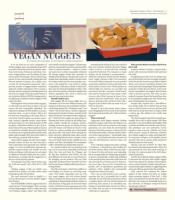

BY ANNIE RAUWERDA, STATEMENT COLUMNIST
Illustration by Melia Kenny, Page Design by Sarah Chung
If we are what we eat, we’re a generation of
chicken nuggets. I grew up eating fun finger food
as an after-school snack and an easy dinner, some-
times in the shape of dinosaurs and Disney char-
acters. Nuggets please even the pickiest of eaters
(case in point: this teenager who ate chicken nug-
gets for 15 years and practically nothing else) and
take just minutes to prepare. As an adult, I pass
on meat for environmental reasons but I join a
growing number of nugget-inclined consumers
opting for meatless alternatives. We’ve created a
demand, and top companies are battling tooth and
nail to be our supply. With release after release of
new imitation chicken, fall 2021 is shaping up to be
the golden age of imitation chicken nuggets. What
a time to be alive.
What happens when you take chicken nuggets,
an obscenely processed food to begin with, and
remove the only recognizable ingredient? The
vegan form emerges out of the shadows, a mystery
meat sans meat … so, just a mystery. They’re not
just fried tofu. Depending on the brand, they’re a
concoction of protein isolate, soy protein concen-
trate, textured vegetable protein, wheat gluten
and preservatives no one’s great-grandma would
recognize. Chickenless chicken is a slew of para-
doxes: both earthy and artificial, highly processed
yet classified as a healthy alternative, plant-based
but without any recognizable plants (clearly made
inside a plant, though). They taste eerily similar to
the real thing, a pinnacle of food science.
Vegan chicken nuggets also play into a nugget-
obsessed culture, for they are more than just a
food. A generation of young people uses “chicken
nugget” as a term of endearment and paste slo-
gans like “nugs not drugs” and “nug life” on water
bottles and laptops. Such phrases not only signal
an affinity for breaded chicken but also a know-
ing lameness, a message that the nugget-lover is
down-to-earth and easy to please.
“Even though I look like a burnt chicken nug-
get, I still love myself,” said a little kid in a 2016
Vine.
“Chicken nuggets is like my family,” says
another kid in another viral video, before eating
the breaded poultry for breakfast.
The most retweeted tweet in English is a
17-year-old’s attempt to win free chicken nuggets
from Wendy’s.
One of RedBubble’s chicken nugget products is
a shirt that says “Chicky Nuggies” above an image
of Yoda eating nuggets. There’s a sticker that says
“26.2 (chicken nuggets eaten)” and others that
read “Netflix and chicken nuggets.” Chicken nug-
gets have transcended sustenance and entered the
realm of cultural obsession — similar to Trader
Joe’s and wine, two other consumables with great
PR. Buying nuggets brings back memories of
childhood family dinners and play date snacks, of
simpler times and simpler cuisines. You don’t need
the chicken itself to get the same nostalgic expe-
rience. Like alcohol-free wine (which is surging
in popularity), chickenless chicken is about more
than taste: It’s about participating in culture. The
deep-fried, faux-poultry confections, despite their
obscure ingredients, fill a need—a cultural soft
spot and a growing market share.
The fake chicken wars
Fake nuggets fill my freezer. Right now, my
roommates and I have four different brands, each
packed in earthy green tones and labeled with law-
suit-skirting phrases like “chickenless strips” and
“chik’n.” One brand is Boca, a stalwart vegetarian
brand started in the late 70s (now owned by Kraft
Heinz) that boasts “the original chick’n veggie nug-
get.” I find that their nuggets are quite similar to
Morning Star Farm’s (owned by the Kellog Com-
pany), another decades-old company: powdery
breading and not too greasy. In contrast, the nug-
gets from Raised and Rooted (owned by Tyson
Foods) are a greasy nostalgia trip to McDonald’s
play places; they waft umami flavors through the
house and pack a deliciously huge caloric punch.
We’ve also bought Earth Grown, Gardein, Trader
Joe’s and Whole Foods brands. Lightlife has new
tenders and filets, MorningStar has Incogmeato
Chik’n, and Nestle is investing in fake meat too.
It’s a packed market, but two booming rivals
hog a lot of recent press: Impossible and Beyond
Meat. Like Coke and Pepsi, the Whopper and
the Big Mac, Starbucks and Dunkin’, the big-
gest difference between the two powerhouses is
the branding, not the products. This year, both
Impossible and Beyond have branched out from
fake beef and taken a highly publicized stab at rec-
reating chicken.
The fake meat giants, which boast millions in
seed funding, are focused on converting meat-
eaters. This month, Impossible came out with
new vegan nuggets, and rival startup Beyond
Meat is coming to the freezer aisle, too. After dis-
continuing its disappointing imitation chicken in
2019, Beyond is trying again. Its fava-bean-based
tenders, which have been at restaurants since July,
are coming to grocery stores like Walmart as soon
as October.
Standing beside the big rivals is the cool kid of
fake meat startups, Simulate (formerly Nuggs),
which is led by a 22-year-old from Australia
named Ben Pasternak. The company is a media
darling, and its branding is unconventional —
unlike the earthy hues of other brands, Simulate
is less “veggie” and more “edgy.” In a recent post,
the brand’s official Instagram account parodied
social justice slideshows with an absurdist story
about Iceland. It starts with “What’s going on in
Iceland right now and how you can help” and
proceeds to describe a narrator’s “friend Jared”
who said the narrator had “’mice hands,’ which
is just so rude of him, because he knows I’m so
sensitive about my small hands.” Later, the post
shows a drawing of the narrator’s hand with a
Nugg for scale. It didn’t make any sense at all, yet
that was the point.
Steeped in up-to-the-minute meme culture,
and a whopping $44.99 for a pack of one hundred,
the brand positions itself as the “Tesla of chicken
nuggets.”
Where’s the beef?
Vegetarians aren’t hippies anymore. Peeking
behind the opaque walls of the meat industry can
radicalize even the devout carnivore, and younger
generations care more about the environmental
impacts of what they consume. As observed in the
rise of alternative milks, a climate-minded culture
now invites vegan products — intentionally vegan
products — out of health food aisles and onto end
caps and advertisements: grocery’s prime real
estate.
At 15, I abruptly stopped meat after watching
“Cowspiracy,” a documentary that unveiled the
pernicious climate effects of the livestock indus-
try. Some of its facts and tactics were misleading,
but its message holds up: Eating large quantities
of meat is unsustainable. A 2018 study published
in the journal Science found that while meat and
dairy provide 18% of calories and 37% of the pro-
tein in our diets, they use 83% of farmland and
produce 60% of agriculture’s greenhouse gas
emissions. Those statistics have permanently
changed the contents of my plate.
Now, I am not only proud to have a climate-
conscious diet, but I am grateful that it’s easily
attainable. It’s rare that I find a restaurant without
a meatless option, and even fast-food giants are
eschewing meaty menus at an astonishing rate.
Passing on meat feels rather normal, not alterna-
tive. More than any time in recent history, the
world caters to vegetarians.
Why can’t the chicken cross the road? It’s too
fat to walk
Imitation chicken is having a moment half a
century after processed chicken itself captivated
the world.
If capitalism grows like a tree, the chicken nug-
get is its fruit: born out of an oversupply of poultry
in the 50s and 60s, it took your grandma’s chicken
dinner and returned something deboned, bat-
tered, deep-fried and packaged. Marketing efforts
promoted a notion that true leisure wasn’t cook-
ing but consumption and nuggets allowed home
cooks to sit back and relax. The work you once
endured to prepare dinner had instead been done
by an amorphous supply chain. The chicken nug-
get is, if nothing else, easy to prepare.
Decades later, humans have a $66-billion-a-
year chicken habit. We’ve slashed their growing
time to a third of what it once was and have bred
birds that are nearly three times as large as birds
a century ago. The chicken is the world’s most
popular bird.
The chicken nugget’s ingredients, though ques-
tionable, don’t seem to phase people. Pink slime
panic blew over, the headlines about lighter fluid
in chicken dwindled away and the unpronounce-
able petroleum and corn derivatives weren’t
enough to deter everyone. Celebrity chef Jamie
Oliver showed a group of elementary schoolers
how chicken nuggets are made, and though they
let out groans of disgust at the liquified carcass
and skin, they had no qualms about putting the
finished product in their mouth.
“Anyone want one of these?” he asked after
his stomach-churning demonstration. When the
kids proceeded to raise their hands and lunge at
the plate, the camera panned to the chef’s disap-
pointed expression.
Just like the traditional chicken nugget’s ability
to transcend the bad press, fake chicken nuggets
haven’t been phased by criticism of their ingredi-
ents or carbon footprint. Despite being ultra-pro-
cessed and packaged in plastic, a nugget forged out
of soy may still seem greener than the real thing.
Little research has evaluated the climate
impacts of fake chicken, but there are studies
about promising impacts of fake beef. A 2018
report commissioned by Beyond Meat and con-
ducted by the Center for Sustainable Systems at
the University of Michigan compared Beyond
Meat burger with beef.
Wednesday, October 6, 2021 // The Statement — 4
Read more at MichiganDaily.com
VEGAN NUGGETS
H
o
o
k
e
d
o
n
BY ANNIE RAUWERDA, STATEMENT CORRESPONDENT