

Jaaron Simmons waited for a
phone call — one that would dic-
tate the future of both his bur-
geoning family and coaching
career.
It was mid-April 2020 and
video analyst David Metzen-
dorf had left the Michigan men’s
basketball team for an assistant
coaching position at the Air Force
Academy. Simmons, at the end of
his year-long stint working along-
side Metzendorf as a graduate
assistant on the Wolverines’ staff,
wanted the job and knew he could
step in right away. He just had to
convince Michigan coach Juwan
Howard of the same.
“‘Hey Coach, I know how to do
everything,’ in a nutshell that’s
what I was saying,” Simmons told
The Daily. “‘I can continue where
Dave left off. We won’t miss a
beat. I promise you,’ that’s what I
was telling him, ‘I promise you we
won’t miss a beat.’ ”
Just days earlier, Simmons had
been offered the video analyst
role at the University of Illinois at
Chicago, where former Michigan
assistant, Luke Yaklich, had been
named the head coach. While
grateful for the opportunity, Sim-
mons wanted to stay in Ann Arbor.
His girlfriend was pregnant with
their first child and moving across
state lines wasn’t an ideal scenar-
io.
Sure enough, 24 hours after
their initial conversation, Howard
called him back.
“He’s like, ‘You good. You can
stay stationary. You don’t have to
move the family. I want to offer
you the position to be our video
coordinator,’ ” Simmons said.
“You know, I accepted it and I’m
still here.”
Added Michigan assistant Saddi
Washington: “To Jaaron’s credit,
he did a great job of learning the
video and adding tools to his tool-
belt so when these opportunities
came, he could advocate for him-
self to slide into those roles.”
Jean Dolores Schmidt was hav-
ing a blast.
The 98-year-old nun, better
known as Loyola Chicago super-
fan Sister Jean, looked on as her
11-seed Ramblers were on the
brink of yet another upset — this
time in the 2018 Final Four.
With just 11:46 remaining in the
game, Loyola Chicago took a nine-
point lead over 3-seed Michigan.
The Wolverines needed a spark
and Jaaron Simmons obliged.
The backup point guard hit just
his sixth 3-pointer of the season to
ignite a 17-4 run over the next six
minutes and vault Michigan into
the 2018 National Championship
game, where it would eventually
lose to Villanova. For Simmons,
though, who had joined the Wol-
verines as a graduate transfer
from Ohio University prior to the
season, the run was a dream come
true.
“I had never played in the
NCAA Tournament to that point,”
Simmons said. “So from game
one, with (Zavier Simpson) get-
ting in foul trouble against Mon-
tana, I think, and me getting into
the game, that was memorable.
Just stepping on the floor for the
first time. Then you fast forward
to being out in Los Angeles and
playing Texas A&M. We’re far
from Michigan and there’s a lot of
Michigan fans you know, we filled
that arena. That was eye-opening
for me and that was the reason
that I came to Michigan, because
of that Block ‘M,’ because of the
alumni and the fans that travel.
“… I can’t pick one moment but
it was all just a great experience.”
Team success aside, that season
was hardly all sunshine and rain-
bows for Simmons.
During his two years with the
Bobcats — he sat out the 2014-2015
season after transferring from the
University of Houston after his
freshman season — the Dayton,
Ohio native averaged 15.7 points,
7.2 assists and earned first-team
All-MAC honors as a senior. Upon
joining the Wolverines though, he
played a measly eight minutes per
game off the bench as a graduate
transfer.
“It was extremely difficult,”
Simmons said. “Throughout my
career, pretty much my whole life,
I’d been a starter, one of the main
guys on the team. A leader on the
team. So to become a role player in
my last year, it was difficult.”
Grounded by his desire to win
and earn a master’s degree from
Michigan, though, Simmons never
checked out on the team — some-
thing that both his teammates and
coaches took note of.
“I always tell people this, from
the first day, that kid’s humbleness
and competitive nature was a big
reason why we were able to make
it to Monday night,” Washington
said. “Because there are programs
where guys are in that situation
and they become problematic in
the locker room, become a distrac-
tion or become a cancer. Jaaron
was just the opposite. He’s always
been a giver.”
Added Simmons’s mother, Sar-
ita Simmons: “I think it built a lot
of character in him as far as ‘You
can’t have everything your way. …
You can play basketball but you’re
there to get your education.’ He
was like ‘Okay, I’ll keep going.’ He
was not a quitter, so he was not
going to quit.”
Faced with the disappoint-
ment of a reduced role, Simmons
learned how much he loved the
game of basketball that season.
Devoid of the notoriety and acco-
lades he had achieved previously,
he still had to show up every day,
work as hard as any of the starters,
cheer them on from the sidelines
and, most importantly, perform
when his name was called.
On a team with 10 underclass-
men, the 22-year-old Simmons
counseled his teammates as only
an experienced college player
could.
“Jaaron helped me,” Isaiah Liv-
ers, a freshman at the time, said.
“You hear about freshmen strug-
gling during their first year on
campus, being away from home,
not understanding college bas-
ketball or the new system. Jaaron
was like that big brother for me.
He was a guy who took me under
his wing. If me, (Eli Brooks) and
(Jordan Poole) were struggling
during practice or a game, he’d
pull us aside and say, ‘Hey, man.
Everything’s all right. There’s
more stuff to worry about than
worrying about your performance
or a practice. You gotta move on.’
… I’ll never, ever forget what he did
for me.”
Whether Simmons meant to or
not, he became a coach that sea-
son.
Scouting is equal parts science
and art. While it requires the
highly-mechanical task of sifting
through hours of game tape to
identify everything from an oppo-
nent’s ball-screen coverages to its
baseline plays, it also requires a
discerning eye to pick out nuanc-
es and how to best exploit those
tendencies. This is what keeps
Simmons in the office late into the
night.
After Michigan’s student man-
agers have downloaded, coded
and saved film of the Wolverines’
next opponent, Simmons parses
through about four to five games,
records his observations and then
exchanges notes with the assistant
coach assigned to that specific
scout. It’s an interaction predicat-
ed on equal standing between the
two parties, and one that Simmons
has become increasingly comfort-
able with.
“He’ll present an idea to you,”
Michigan associate head coach
Phil Martelli said. “He’ll even
come down after seeing what
I have written up and the film
has been produced and he’ll say,
‘Hey, what do you think about
this or what do you think about
that idea?’ because he has seen so
much of this film. … He’s much
more assertive in that way this
year and maybe last year at times
he felt like he was still a player, like
he was still connected with those
guys. He has clearly moved to the
point where he sees himself very,
very tied to the staff.”
For Simmons, that newfound
confidence is a byproduct of
preparation.
“If I had to say one thing I’d
say that I learned to be a grinder
in the office,” Simmons said. “I
was always a hard worker on the
court, getting my work in, trying
to improve my game but coach
Howard uses that term a lot, ‘Be a
grinder,’ and I learned that it takes
a lot to be a coach. It’s not just
you come in and you try and tell
guys what to do. There’s a lot that
comes with it and I learned how to
grind in the office.”
From there, Simmons creates
digestible film packages for How-
ard and the players. In addition to
a clip consisting of the opponents’
general actions and tendencies, he
creates clips of individual players
on the opposing team, giving each
Michigan player a chance to hone
in on their specific matchups.
Everything is uploaded to their
personal iPads for convenient
viewing.
Video is not just reserved for
game days, though.
“We watch a lot of practice
film,” Simmons said. “We’ll have
our scout team run the opposing
team’s main sets and we’ll put that
together to make sure we see the
opposing team running their set,
then we’ll show the scout team
running their set and how well or
bad we did defending it in prac-
tice.”
Prior to the season, the NCAA
increased the number of staff
members allowed on the court
during practice by two. How-
ard chose Simmons and Director
of Basketball Operations Chris
Hunter.
With the student managers tak-
ing over recording duties from the
stands, Simmons has experienced
the nitty-gritty of coaching like
never before. Both he and the Wol-
verines have benefited.
“His feel for the game and
knowledge of the game is help-
ful for our staff because it’s just
another set of eyes that gets to see
things from a player perspective,”
Washington said. “And now, he’s
grown so much by watching so
much video. He’s watching it from
a coaching perspective now and
his advice and his recommenda-
tions are a lot of times on point.”
Added Livers: “Him actually
playing the game, he understands
a lot more. He can put himself in
that situation and be like, ‘Hey,
this is what you can do on the
floor. Let’s work on this today.’
That’s the type of stuff that he can
recognize, because he has a feel
for the game, especially being a
point guard.”
In his current role, Simmons
also
coordinates
the
team’s
recruiting events — which this
year revolve around Zoom calls
rather than in-person visits. From
reaching out to a recruit and his
family, to operating informative
powerpoints during the Zoom
calls and developing, you guessed
it, film of Michigan’s style of
play, Simmons is the logistical
point-person.
“If there’s a player that (the
recruit) might be similar to on our
team now, we’ll put together clips
and kinda show them our style of
play and basically where they fit
in,” Simmons said. “That’s my job,
to paint that picture for them and
make sure that they see this is a
place where they can thrive and
be successful.”
So far, so good. The Wolver-
ines’ incoming class features
two five stars, three McDonald’s
All-Americans and four top-
100 players, making it the No. 1
recruiting class in the country
per 247Sports. Howard and the
rest of the coaching staff might
be the faces of the operation, but
Simmons plays an essential part
in the pitch.
“If there’s an unsung hero in
recruiting, it’s him,” Martelli
said.
At this stage of Simmons’s
young career, every moment is a
learning opportunity. Just like
analyzing film and participating
in practice, his involvement in
recruiting is a mutually beneficial
exercise — he puts forth the effort
and receives insight in return.
“That’s my favorite part of the
(recruiting) call,” Simmons said.
“When I get to turn my camera
off, turn my mic off and I can just
listen. I feel like I learn so much
during those times because we
have some great recruiters on
this staff. … They do such a good
job connecting with these fami-
lies and being genuine. What I’m
always saying behind the cam-
era is, ‘Man, we would get every
kid if they knew that everything
they’re saying on this Zoom call,
this is real. We really live this
every day. This is our culture.’ ”
Union
Neuchâtel
was
in
the midst of another coaching
change. The Swiss basketball
club, located just 30 kilometers
from the French border, had just
hired its third coach of the sea-
son. It was only December.
Simmons — who had signed
with the team just months after
Michigan’s 2018 Final Four run
— quickly realized that his pri-
orities laid elsewhere, an ocean
away.
“We did speak to him daily
while he was there,” Sarita Sim-
mons said. “It was just a little
rough being that far away from
home. I think that was the issue,
so it didn’t work out the way he
planned there.”
Added Jaaron: “As a child, I
never dreamed of going overseas
to play professionally. I dreamed
of playing in the NBA, obvious-
ly, but a lot of people are con-
tent with going overseas if they
don’t make it to the NBA. Me, on
the other hand, I was definitely
appreciative and thankful, and
going into it I wanted to make the
most out of it and make it work
but being overseas, that kinda
wasn’t for me. So it was kinda eas-
ier for me to hang it up and move
in a different direction.”
His dreams of playing profes-
sional basketball behind him,
Simmons switched gears entirely
— or so he thought. He returned to
Ann Arbor to finish his two-year
master’s program at Michigan
with no intention of becoming
a graduate assistant. But when
Juwan Howard, newly-appoint-
ed as the coach of the Wolver-
ines, reached out and offered him
the position, Simmons’s outlook
changed entirely.
“From day one, I knew this is
where I needed to be,” Simmons
said. “It was kinda like a call-
ing from God that I transitioned
immediately from playing over-
seas to the coaching world. Since
that day that I stepped foot in
this office on the other side of the
game, I’ve been in love with it.”
As for his future plans, Sim-
mons intends to do what he’s
always done — put his head down,
work hard, take every opportu-
nity in stride and let the rest fall
into place.
“Short term, I just want to con-
tinue to learn,” Simmons said.
“Long term, the way my life has
gone, I’m just going to wait for the
opportunities. Whatever opportu-
nity presents itself that’s the best
for me and my family, that’s the
opportunity I’m going to take. …
I just want to take it one day, one
year at a time. That’s pretty much
how I operate. I don’t want to get
too far ahead of myself.”
In the meantime, Simmons
will just keep flourishing behind-
the-scenes of one of college bas-
ketball’s premier programs. Just
don’t expect him to be there much
longer.
“He’s been a star in his role as
a video analyst,” Washington said.
“He’s going to be a star one day if
he decides to take the coaching
path.”
The Michigan Daily — michigandaily.com
Sports
Wednesday, March 17, 2021 — 15
CONNOR BRENNAN
Daily Sports Editor
On the Michigan sideline, Jaaron
Simmons finds a home
ALEC COHEN/Daily
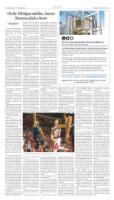
Jaaron Simmons has been grinding in his new role as Michigan’s video analyst.
Tel Aviv University Sackler School of Medicine
New York State/American Program
The Sackler School of Medicine-New York State/ American Program
offers an outstanding four year medical school curriculum, taught in
English, leading to the M.D. degree. The Program is chartered by the
Regents of the University of the State of New York and is accredited by
the State of Israel.
Students do their clerkships and electives in the hospitals in Israel, the
U.S. and Canada. One of these hospitals, Sheba Medical Center, was
selected by Newsweek magazine as one of the top 10 hospitals around
the world.
Graduates participate in the National Resident Matching Program and
return to the United States for their residency training. Since its
commencement in 1976, over 2,000 alumni have completed their
residency training at the most distinguished hospitals in the United
States and Canada.
www.sacklerschool.org provides extensive information about Sackler
SOM. For further information, e-mail sacklermed@sacklermed.org
Applications for the Class of 2025 will be available on our website
on Tuesday, January 5, 2021