

Entering his fourth season as the
head coach of the Michigan men’s
lacrosse team, Kevin Conry is gradu-
ally building off the foundation laid by
his predecessor, John Paul. After reeling
in the No. 4 and No. 3 recruiting classes
in 2020 and 2021, respectively, Conry
is hungry to shake up the Big Ten with
a Wolverine squad that is quietly yet
quickly ascending.
Finding a replacement for Paul,
the human embodiment of Michigan
lacrosse, was no simple task for ath-
letic director Warde Manuel.
Nevertheless, on June 21, 2017,
just six weeks after he declared
Paul wouldn’t be returning, Manuel
announced that Maryland assistant
head coach and defensive coordinator
Kevin Conry would serve as the Wol-
verines’ next head coach.
Coming from a perennially stout
Terrapins’ organization that defeat-
ed Ohio State in the NCAA cham-
pionship game that season and had
won the Big Ten the past three sea-
sons, Conry brought a track record
of winning at the Division I level that
appealed to an up-and-coming pro-
gram like Michigan. And as a Long
Island native who played college
lacrosse at Johns Hopkins, Conry had
deep East Coast roots that would help
the Wolverines recruit, bolster their
coaching staff and enhance their
understanding of the game.
In tandem with the completion of
U-M Lacrosse Stadium — a brand-
new, lavish complex featuring a 2,000-
seat stadium, an indoor turf room and
direct passage into a 20,000-square-
foot strength and conditioning center
— Conry’s arrival set Michigan up for a
new era. He was someone who Manu-
el thought could turn the corner.
“(He was) different enough from
me in so many ways that I think (was)
a good thing,” Paul said. “It (could)
kinda jumpstart the program in a
different direction, which I think
any time you have a coaching change,
that’s what you need. Really a kick in
the ass from a different direction.”
But Conry also respected the
immense utility of Paul’s legacy and
culture that he had spent so many
years developing. During the transi-
tion period, the pair had an amica-
ble relationship. While Paul taught
Conry how to navigate the com-
plexities of the University and form
relationships with a proper support-
ing cast of Wolverine faculty, Conry
worked to build on many of the core
elements Paul had already woven into
the team’s fabric.
“It was certainly encouraging,
because you know when someone
invests their heart and soul and so
much time into something, you know
it’s gonna be trending positively,”
Conry said. “It was a really solid foun-
dation that we could springboard
(from) and really continue to develop
the championship culture that we
were putting together. … As we tran-
sitioned in, we continued that growth
process, but we were confident that
we had a really strong baseline to
build off of.”
Under Conry, the synergy of utiliz-
ing new and old team values seeming-
ly paid dividends.
In 2018, having retained many of
their key roster pieces from the year
prior, the Wolverines picked up where
they left off, once again finishing 8-6.
Despite stumbles against ranked
opponents early on the season, drop-
ping matchups to the No. 18 Penn and
No. 11 Yale, Michigan later picked up
signature wins over the No. 4 Notre
Dame on the road and the No. 14 Penn
State in an overtime thriller. In both
contests, the Wolverines set major
milestones, earning their first wins
over a top-five program and a ranked
Big Ten program, respectively.
As Conry made his transition in his
first year with Michigan, he benefited
tremendously from the support, pro-
duction and leadership of its veteran
players. According to Conry, seniors
like midfielders PJ Bogle and Parker
McKee fully embraced the uncer-
tainty that a coaching change brought
and served as blank pages for Conry
to work with.
“The best teams coach themselves,”
Conry said. “If you wanna have a suc-
cessful championship team, you have
seniors that buy in, know what they’re
doing and can keep the rest of the team
not just in line, but also encourage
them to do the right things and to have
that positive leadership.”
On the playing field, Brent Nose-
worthy had a record-setting junior
season. Notching 48 points on a
whopping 41 goals, he surpassed
King’s short-lived record for points in
a season and led the Big Ten with 2.93
goals per game. By Noseworthy’s side,
Curran recorded 31 points and helped
mentor then-freshman attackmen
Kevin Mack and Alex Buckanavage.
“Not only (were) they invested
enough to understand what they
(needed) to do, but they (could) teach
somebody else and help them grow
as well,” Conry said. “(Noseworthy
was) gonna go out and shoot an extra
bucket of balls. He (was) gonna take
somebody with him. And that’s real-
ly where good teams become great
teams and cusp teams become cham-
pionship teams.”
***
Although 2018 set the stage for a
positive future, the Wolverines took a
step back in 2019.
Plagued by injuries in several piv-
otal areas, including on the defensive
front and at the faceoff X, Michigan
struggled to slow down its opponents
and win important possessions all
season long, giving up 13.46 goals per
game and losing 67.6 of its faceoffs.
On the offensive end, the Wolverines
missed the goal-scoring capabili-
ties of Noseworthy, who missed five
games due to injury.
Michigan limped into its season
finale against No. 10 Ohio State with
a meager 3-9 record.
Heading into the contest, the Wol-
verines were evidently underdogs.
But rallying behind a now-healthy
Noseworthy and other seniors like
Curran and Second Team All-Big Ten
defenseman Nick DeCaprio, Michigan
was motivated to end the otherwise
disappointing season on a high note by
defeating its rival for the first time.
“I was really proud of the fight in
those guys,” Conry said. “When we
had the injuries, we had to adapt and
change. … Walk out there and say,
‘Hey, we still have a game to play. We
gotta be successful.’ ”
Bolstered by four assists in the first
half by Buckanavage, a single-game
team record, the Wolverines sur-
prisingly skirted out to an 8-4 lead at
halftime. Just over halfway through
the third quarter, Noseworthy netted
the 100th goal of his career — the first
Michigan player to do so — to extend
the Wolverines’ lead. Although the
Buckeyes closed the deficit to two
with 10 minutes remaining, a subse-
quent pair of goals from Noseworthy
secured the monumental win for
Michigan, 13-10.
In a difficult season that drastical-
ly differed from the one preceding it,
2019 taught Conry and his players a
lot about adversity.
“Handling success is something
that’s really important,” Conry said.
“You walk through the door, your
last game’s a win, and you say, ‘Okay,
yeah, have we made it?’ I think that
knowledge of, ‘Why did we become
successful? What got us there?’ — that
was the biggest lesson of 2019. No
matter what happens, we gotta get up
in the morning and gotta look at our-
selves in the mirror and say, ‘Are we
prepared to be successful today? Are
we ready to put the work in to do so?’
We learned and grew throughout the
year in order to do that.”
Heading into 2020 with healthy
legs and new faces, the Wolverines
looked to take this newfound wis-
dom, redeem themselves and move
forward as a program. They wouldn’t
have the opportunity to fully do that
though. On Mar. 11, Michigan nar-
rowly defeated Marquette, 13-12, to
move to 4-3 in a befuddling season
that had featured an impressive dis-
play of grit against the No. 5 Bulldogs,
but also a stunning loss to freshly-pro-
moted Merrimack.
Little did the Wolverines know at
the time, though, that they had played
the last Michigan sporting event to
occur for the next seven months.
Just a day later, the NCAA canceled
the remainder of all winter and spring
sports seasons due to the COVID-
19 pandemic, which was worsening
by the day. Just like that, the world
of sports turned upside down as the
country went into lockdown.
On May 18, Furman University
announced its intention to cut its varsity
men’s lacrosse and baseball programs
due to the financial impact of COVID-
19. Before long, schools across the coun-
try revealed similar plans to cut some of
their non-revenue sports as well, most
frequently smaller programs like gym-
nastics, tennis and swimming.
For a moment in time, as a young
and developing program, everything
the Wolverines had ever been work-
ing toward seemed to hang in limbo.
The Michigan Daily — michigandaily.com
Sports
Wednesday, February 17, 2021 — 15
DREW COX
Daily Sports Editor
Michigan lacrosse: A New Era
JULIA SCHACHINGER/Daily
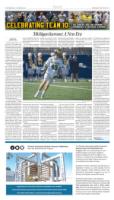
Before the season was canceled in March, Midfielder Josh Zawada led the Wolverines 32 points last season during his freshman campaign.
Read more at
MichiganDaily.com