

While
many
University
of
Michigan students use the sum-
mer months to gain experience
from internships and jobs, others
engage in various research proj-
ects across campus to gain criti-
cal skills for career development.
But in a matter of weeks, those
plans to participate in cutting-
edge research at the No. 1 public
research university in the U.S.
were halted as the COVID-19 pan-
demic shut down all non-essential
in-person research activity.
Since then, the University has
started ramping up non-essential
research. Furthermore, members
of the research community have
begun to resume in-person lab
work in phases, while following
procedures to protect the health
and safety of researchers. How-
ever, undergraduate students, who
are heavily involved in many labs
across campus, are still restrict-
ed from returning to labs under
Gov. Gretchen Whitmer’s current
guidelines, which classifies under-
graduate students as “non-essen-
tial in-person visitors.”
LSA
sophomore
Kylie
Sch-
ache, a UROP student during the
school year, said she was planning
on working in a lab that studies
Alzheimer’s disease for the sum-
mer. The lab work was a full-time
paying position in which she would
work 40 to 50 hours per week.
These plans, however, came to
a halt when COVID-19 prevented
undergraduates from returning to
labs –– and it doesn’t seem like this
will change anytime soon, Sch-
ache said. As a result, Schache said
she is considering taking a semes-
ter off to gain additional research
experience at the University in
hopes of preparing her for a career
in research.
“I’m actually considering that
I might need to take a gap semes-
ter,” Schache said. “The fact that
the University of Michigan is the
number one public research uni-
versity is the primary reason why
I chose to attend there and really
the definitive reason why I’m will-
ing to attend the most expensive
public university in the United
States. So the loss of research
opportunities kind of called into
question whether attending the
University merits the cost at this
point. I can take the classes and I
can get the degrees, but ultimate-
ly what’s going to prepare me for
what I want to do with my career
— which I want to do a career in
research — it’s the research oppor-
tunities that are most important.”
University spokeswoman Kim
Broekhuizen reaffirmed in an
email to The Daily that under-
graduates are unable to partici-
pate in laboratory research at
this time due to Whitmer’s latest
executive order. Broekhuizen also
noted the University’s efforts to
develop principles to protect the
health and safety of researchers
as they begin to resume work amid
COVID-19.
“The university must adhere to
state regulations, and so we will
closely monitor any updates to
the governor’s executive order as
it relates to laboratory research,”
Broekhuizen wrote.
As of June 26, the University
completed the laboratory research
re-engagement waves, and more
than 95 percent of the University’s
lab workforce is now re-engaged,
according to an update from
Rebeccca Cunningham, vice presi-
dent for research. While research-
ers continue to resume in-person
activity, labs are to remain operat-
ing at about 30 percent capacity at
any given shift.
Gary Luker, professor of radiolo-
gy, biomedical engineering, micro-
biology and immunology, conducts
research focusing on molecular
imaging of cell signaling in can-
cer. Over the course of his entire
time working in the lab, Luker has
had roughly 35 to 40 undergradu-
ate students participate in their
research.
3
Thursday, July 2, 2020
The Michigan Daily — michigandaily.com NEWS
A proposal to increase tuition
by 1.9 percent for the 2020-2021
school year and add an additional
$50 COVID-19 student fee failed to
pass at the University of Michigan
Board of Regents meeting Thurs-
day morning. The decision was
widely talked about by students
on social media, with many saying
they were shocked by the Univer-
sity’s attempt to raise tuition, espe-
cially since the majority of students
in a representative survey of the
student body said they expected a
tuition discount.
University
spokesman
Rick
Fitzgerald described the motiva-
tion behind the proposed 1.9 per-
cent increase in tuition in an email
to The Daily.
“The administration proposed
a 1.9 percent tuition increase on
the Ann Arbor campus to balance
the budget, provide higher levels
of financial aid, and adapt to the
COVID-19 pandemic,” Fitzgerald
wrote. “The budget also included
continuing the Go Blue Guaran-
tee and contained a 5.6 percent
increase in undergraduate finan-
cial aid. That additional $12.8 mil-
lion increase in aid would have
meant most in-state undergradu-
ates receiving need-based grant
aid would have seen no increase in
tuition costs in the coming year.”
University tuition and fees have
increased 42.05 percent for the last
10 years, including the same 1.9
percent last year for in-state under-
graduates and 3.7 percent for out-
of-state undergraduates. University
President Mark Schlissel has noted
this trend in rising tuition is to
maintain the University’s commit-
ment to academic excellence, espe-
cially as inadequate state funding
for higher education continues to
decrease. This year, as Michigan
struggles with coronavirus, state
appropriations are likely to be fur-
ther reduced as the state faces a
$3.2 billion budget deficit.
“The university has long been
committed
to
affordability,”
Fitzgerald wrote. “Significant uni-
versity
resources
are
directed
toward financial aid. Last fiscal
year, we provided $344 million in
grant and scholarship support for
students. Only 1 percent of that
support was directly funded by the
state, 10 percent by federal sources,
and 6 percent by private sources.
The remaining 83 percent was from
university
resources,
including
general fund, endowment support
and athletics.”
Though students have lamented
tuition increases in the past, this
year’s strong opposition centers
around students hesitant to pay
increased tuition without receiv-
ing the full benefits of in-person
instruction. Though the Univer-
sity’s recently released decision
describes their plan as an “in-res-
idence, public-health informed”
fall semester, all classes of over 50
people will be held online, and each
department and school will make
the final determination.
Last month, some students filed
a lawsuit seeking compensation for
the move to online classes in March.
The University said they do not
owe students money for switching
formats due to academic freedom
principles that give the University
alone the power to decide mode of
instruction.
Additionally, LSA sophomore
Becca Stachel told The Daily that
tuition is already a huge obstacle
for many students attending the
University. Stachel finds it difficult
to justify paying the same tuition
for online classes in the fall, espe-
cially for students impacted most
by COVID-19.
“A lot of people aren’t financially
stable (after the pandemic) and
tuition is a huge burden on a lot of
students,” Stachel said. “So, to have
a lesser quality of education, but
still have to pay the same amount
of money when you likely also took
pay cuts because of the pandemic,
seems unfair to me.”
In early June, Central Student
Government members Public Poli-
cy senior Damian Chessare, Rack-
ham student Hayden Jackson and
Architecture student Lauren Con-
roy put together a survey gauging
student sentiment on tuition and
enrollment in light of the COVID-
19 pandemic. Their report found
the majority of students surveyed
expected a tuition discount of just
under 20 percent to be acceptable if
classes were in a hybrid format.
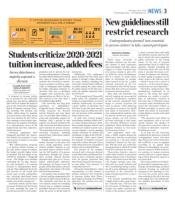
59.4 percent of the students
surveyed said a discount decision
would affect their enrollment deci-
sions at least a moderate amount.
Over 40 percent projected that
their future financial circumstanc-
es were either “very insecure” or
“somewhat insecure.”
LSA junior Annie Mintun, a LSA
representative to CSG, created a
petition calling for the University
to decrease tuition after Thurs-
day’s Regents meeting. As of Friday
afternoon, the petition has over
2700 signatures.
Students criticize 2020-2021
tuition increase, added fees
CLAIRE HAO AND
MEGAN SHOHFI
Daily News Editor and
Daily Staff Reporter
Design by Hibah Chughtai
New guidelines still
New guidelines still
restrict research
restrict research
KRISTINA ZHENG
Summer News Editor
Read more at michigandaily.com
Read more at michigandaily.com
Undergraduates deemed ‘non-essential
in-person visitors’ in labs, cannot participate
Survey data shows a
majority expected a
discount