

Friday, February 14, 2020 // The Statement
2B
Managing Statement Editor
Magdalena Mihaylova
Deputy Editors
Emily Stillman
Marisa Wright
Associate Editor
Reece Meyhoefer
Designers
Liz Bigham
Kate Glad
Copy Editors
Madison Gagne
Sadia Jiban
Photo Editor
Keemya Esmael
Editor in Chief
Elizabeth Lawrence
Managing Editor
Erin White
I
n Hebrew, the word for “to love”
has the same root as the word “to
give.” I’ve always admired the way
an ancient language is woven together with
purpose, the way the words hang on to each
other, collide, twist into webs of meaning
that say more together than any word could
alone.
To love and to give. This is what it looks
like:
After six decades, my grandparents argue
over what year they got married. One after-
noon at lunch, they interrupt each other as
they tell me and my sister about that cold
February, a month of love, a night in the
stained-glass chapel. My grandpa emphati-
cally swings his corned beef sandwich in the
air and insists it was the winter of ’58, a year
of recession. They tell us about their first
place together, a small townhouse on West-
brook in Detroit, near Six Mile. When my
grandfather was in the Navy, my grandma
wrote him letters every day. We talk about
school and how my mother works too much.
When we walk them to the car, my grandpa
opens the passenger door and ushers his
wife inside.
In home movies, you never see my dad —
he’s always behind the camera. On the day
my twin sister and I were born, he points
the lens at the two babies in my mother’s
arms and says “Hi, girls” just like he did this
morning on the phone. As we sort through
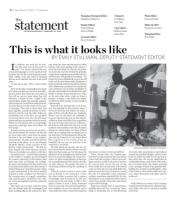
old photo albums, I find a picture of him
playing a baby grand piano — the gift my
mom bought him when they got married.
There are two babies in walkers on the floor
— me and my sister — and our dog is perched
at the window. I imagine my mom behind
the camera, capturing in that instant what
must have been everything: the sunlight,
the music, the husband, the kids and the dog
in the house they built to raise their family. I
think of them now in the living room, sitting
in quiet contentment at the end of another
long day at work, wordless over the hum of
the evening news of tragedy somewhere
and cautious peace somewhere else. They
are warm and together and lucky under the
same roof.
How lucky am I to know what love looks
like: the dreamy kind, the waterlogged and
dusty wedding album, the woman in a deli-
cate white lace dress and the man in a black
bowtie, wide-eyed, gazing at the camera. I
know the hard kind, too: The day my grand-
ma swears she can’t live without my grandpa,
tough doctor’s appointments and decisions to
sell the house. The giving of everything — for
better, for worse, till death do us part, he will
make sure she gets home safely. Hundreds of
letters sent back and forth, hundreds of phone
calls. Maybe they sacrificed a lot, maybe she
can’t stand the way he leaves toothpaste in
the sink, and he hates how she bites her nails.
Maybe it doesn’t always feel like love, when
we let each other down, when we break a
promise or forget to say thank you. Maybe
we don’t love hard enough, or easy enough or
right enough.
But look at us, learning how to do it any-
way. On midnight at the rundown diner, I
sit across from my best friend. We share a
plate of fries and talk about our weekends.
When I say we talk about our weekends, I
mean we talk about the way we felt when he
walked us home and didn’t kiss us goodbye;
the way it’s been years since he called us a
bitch but we still miss him; the way we felt
euphoric and horrified at the idea of anyone
seeing our naked bodies, our faces without
make-up or reading what we might have to
say about love. We lick the grease off our fin-
gers and say whatever we can: forget about
him, or go for it, or I’m so sorry, or you are
beautiful the way you are and that is not
what love is, it can’t be.
We talk about our parents and our sis-
ters and our family dinners where everyone
fights and then makes up. We talk about the
aging love of our grandparents and the fresh
love of a newlywed sibling. We remind our-
selves we orbit around planets of this love,
the unconditional kind, the kind we feel like
we don’t deserve, the people who give us
everything without asking for anything in
return.
What do we have to give? I want to give
love as fiercely as I’ve received it. I won-
der what it takes to sustain half a century
of marriage, what it means to see the man
across the room and smile, to fall in love
gently, if there is such a thing. Sometime
when I was young, I learned you should love
your neighbor as you love yourself, and at
some point since then, I must have forgotten
that means you have to love yourself first.
That’s always been the hardest part,
hasn’t it? Loving ourselves? My mom thinks
I have bad taste in guys; I think I just can’t
figure out how to look in the mirror and love
the way my body curves, the way my lips
form words, the way my hand curls around
a pen to write, the way my mind shifts into
bouts of worry, the way I’m silent in a crowd,
the way I’m sometimes cruel, sometimes
reckless, sometimes ungrateful for the love
that is given to me. I hope that I’ll love better
when I love myself. I hope that what I have
to give will be enough.
Right now, though, there is something so
palpable about the love around me, some-
thing so promising and so heartbreaking.
Across the table, my grandpa wraps his hand
around my grandma’s fingers, and my sister
kicks me under the table as if to say look at
that, that’s love. We eat our sandwiches in
comfortable silence, and I think of the shaky
lens of a home movie, the camera zooming
in on a younger version of my grandmother
holding her newborn granddaughter, what
a life it’s been, what words could never cap-
ture, what’s been given and taken and lost
and loved.
Emily Stillman is a senior in LSA studying
Organizational Studies and is a Deputy State-
ment Editor. She can be reached at erstill@
umich.edu.
statement
THE MICHIGAN DAILY | FEBRUARY 14, 2020
BY EMILY STILLMAN, DEPUTY STATEMENT EDITOR
This is what it looks like
PHOTO COURTESY OF EMILY STILLMAN